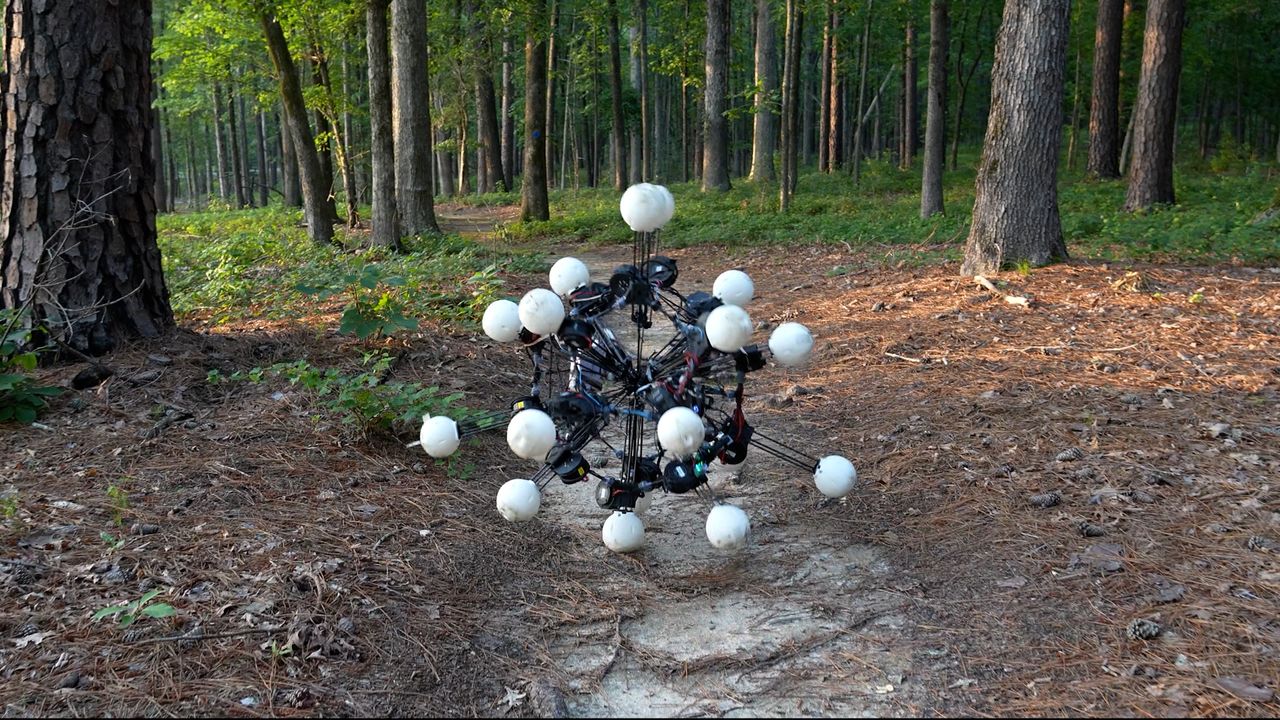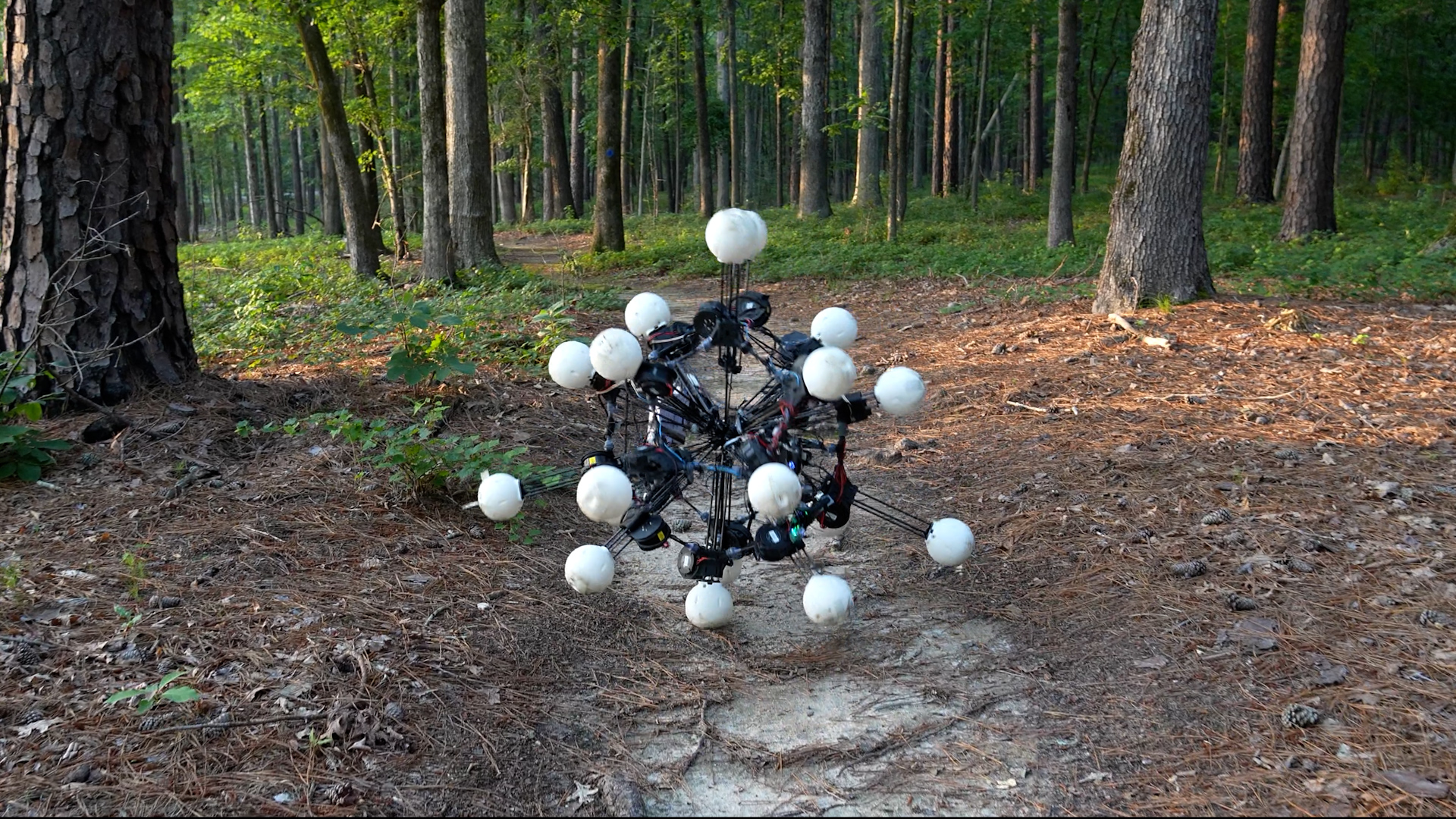
New research suggests that a sea-urchin-like robot could offer a new blueprint for making more versatile robots. (Image credit: Duke University)
Share this article Join the conversation
Follow us Add us as a preferred source on Google Newsletter Subscribe to our newsletter
A weird 20-legged machine could change how scientists think about the ideal robot form.
For decades, roboticists have been inspired by the natural world, building machines that resemble humans, dogs, insects and even horses. But new research suggests that the most useful robot body may look less like a human and more like a sea urchin.
The robot has no front or back. Its 20 telescoping legs, each costing $300, radiate from a central body, with a depth camera at each leg tip, leading the researchers to name it Argus, after the all-seeing monster of Greek mythology. This design results in a machine that can move in any direction, stabilize itself after being pushed, cross rough terrain, carry a 10-pound (4.5 kilograms) payload and even climb up walls.
The Duke University scientists who created the robot published their findings May 27 in the journal Science Robotics.
"Watching Argus move is unlike watching any other robot we've worked with," Jiaxun Liu, a doctoral student in Duke's General Robotics Lab and co-author of the study, said in a statement. "The first time we saw it navigate among trees and rough terrain, even under heavy collisions [when someone pushed it], we knew this was something different."
Simulating symmetry
The team arrived at Argus' design after running more than 1,500 simulations of different robot shapes. Instead of asking what animal the robot should resemble, the researchers focused on how symmetrical a machine could be in all directions — a mathematical concept called dynamic isotropy.
The dynamic isotropy score ranges from 0 to 1 and measures how evenly a robot can accelerate its body, or center of mass, in every direction. A score of 1 means a robot can react or move nearly identically in all directions.
Sign up for the Live Science daily newsletter now
Get the world’s most fascinating discoveries delivered straight to your inbox.
Contact me with news and offers from other Future brandsReceive email from us on behalf of our trusted partners or sponsors
"When a robot can accelerate equally well in every direction, it stops needing to face the world in any particular way," Boyuan Chen, director of Duke's General Robotics Lab and co-author of the study, said in the statement. "Forward and backward become the same. Left and right become the same. The whole problem of robot control changes character."
According to the researchers, most robots today — including advanced four-legged robots, humanoids and conventional drones — score below 0.6, meaning they're better at moving or reacting in some directions than others. With its 20 legs, Argus scored a 0.91, close to the theoretical maximum.
To achieve this high score, the team arranged Argus' body around a shape called a regular dodecahedron, a three-dimensional form with 12 pentagonal faces. The arrangement gives the robot a nearly uniform field of view and allows it to move without needing to orient itself the way a conventional robot would.
Chen said that based on these findings, robots don't need to imitate humans or dogs to boost their agility, and instead are designed from deeper mathematical principles.
Releasing the robot
To test whether Argus' design was truly optimal, the team took the robot out on the Duke campus, where it rolled across concrete, grass, dense foliage, soft sand, wet surfaces and bark. It handled obstacles up to 5 inches (12.7 centimeters) tall, kept moving even after three of its legs were broken, and pushed a 3-foot (1 meter) cube while rolling.
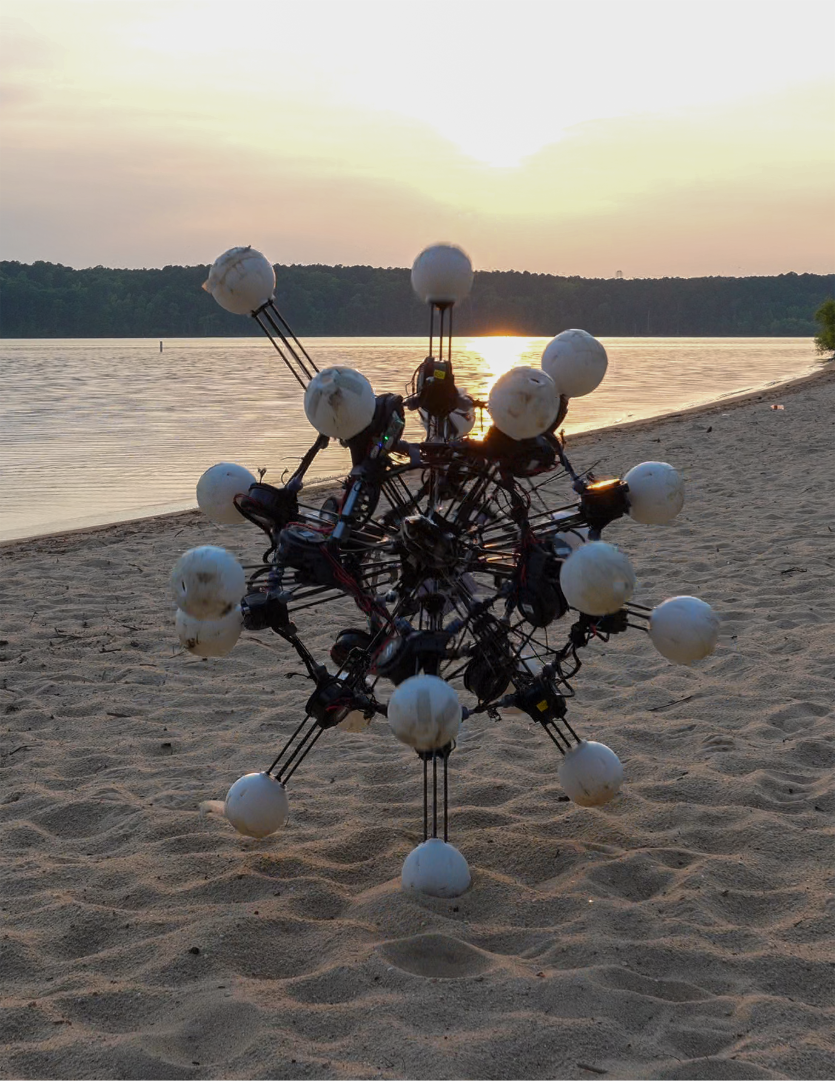
Argus, the 20-legged robot, rolls across a sandy beach.
(Image credit: Duke University)Related stories
Argus is a proof of concept and not the final answer on the optimal robot design, the researchers wrote in the study. Its broader importance may be in how it was designed rather than where or how it can be used in real-world scenarios — it could be a mathematical way to compare different robot bodies and design new form factors from scratch.
"It shows that designing for dynamic symmetry isn't just a theoretical curiosity," Boxi Xia, a postdoctoral researcher at Duke's General Robotics Lab and co-author of the study, said in the statement. "It produces a robot you can deploy in the wild, on uneven ground and in clutter, even in low-gravity settings. It changes what's possible."
Article Sources
Liu, J., Xia, B., & Chen, B. (2026). Extreme dynamic symmetry enables omnidirectional and multifunctional robots. Science Robotics, 11(114). https://doi.org/10.1126/scirobotics.aec1725
 Kenna Hughes-Castleberry
Content Manager, Live Science
Kenna Hughes-Castleberry is the Content Manager at Live Science. Formerly, she was the Content Manager at Space.com and before that the Science Communicator at JILA, a physics research institute. Kenna is also a book author, with her upcoming book 'Octopus X' scheduled for release in spring of 2027. Her beats include physics, health, environmental science, technology, AI, animal intelligence, corvids, and cephalopods.
View More
You must confirm your public display name before commenting
Please logout and then login again, you will then be prompted to enter your display name.
Logout