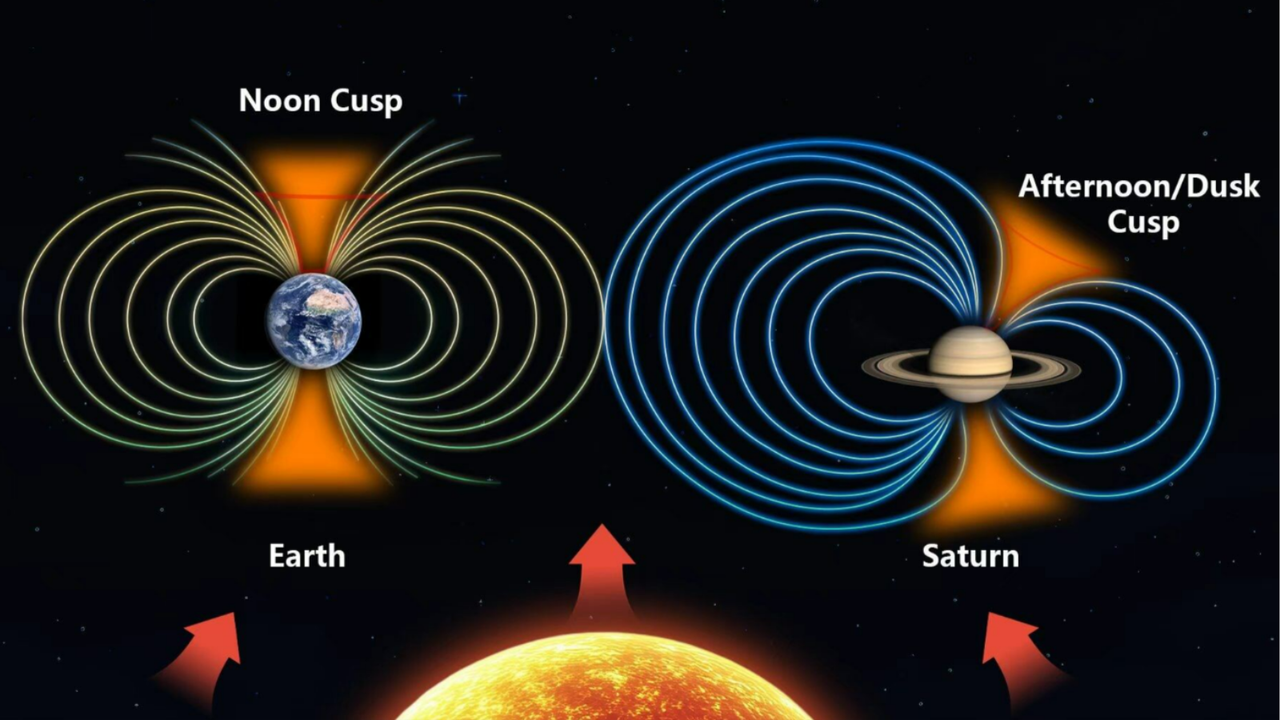
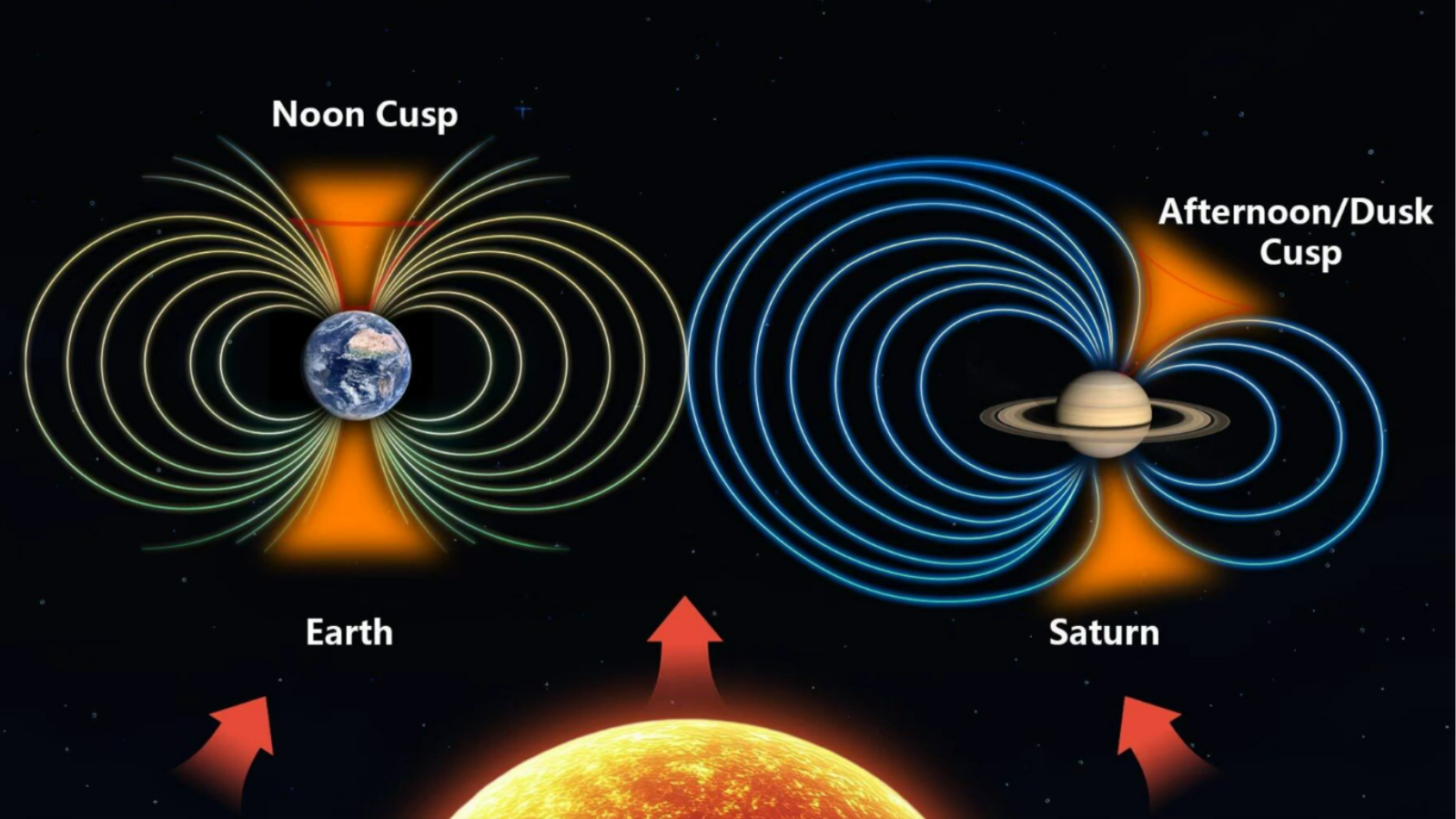
 An illustration showing Earth's uniform magnetic field and the uneven magnetic field of Saturn (Image credit: Coates/Xu/et al (2026)) Share this article 0 Join the conversation Follow us Add us as a preferred source on Google Newsletter Get the Space.com Newsletter
 Breaking space news, the latest updates on rocket launches, skywatching events and more!
Contact me with news and offers from other Future brands Receive email from us on behalf of our trusted partners or sponsors By submitting your information you agree to the Terms & Conditions and Privacy Policy and are aged 16 or over.You are now subscribed
Your newsletter sign-up was successful
Want to add more newsletters?
An account already exists for this email address, please log in. Subscribe to our newsletterSaturn has a lopsided magnetic field, far different from the mostly even magnetosphere of Earth, new research suggests. The ringed gas giant's wonky magnetic shield may be the result of its rapid rotation (a day on Saturn lasts just 10.7 hours), and the effects of its moons, especially the icy ocean moon Enceladus.
The team behind this research reached these findings when they examined six years of data regarding Saturn collected by the Cassini spacecraft, which orbited the gas giant between 2004 and 2017. The aim of this research was to discover where the magnetic field lines of Saturn start to curve back into the planet’s poles, where they funnel charged particles down into the atmosphere, a point known as the "magnetic cusp."
"A better understanding of Saturn’s environment is especially urgent now as plans for our return to Saturn and its moon Enceladus start to be developed," team member Andrew Coates of University College of London's Mullard Space Science Laboratory said in a statement. "These results feed into the excitement that we are going back there. This time we will look for evidence of habitability and for potential signs of life."
Enceladus is such a drag
Saturn is the second-largest planet in the solar system after Jupiter, and the Saturnian magnetic field is ten times as wide as the gas giant itself. This new research determined that its uneven nature is the result of the planet's rapid rotation and the fact that, as it spins, Saturn drags a heavy soup of plasma around with it.
This matter is the result of gases emitted by the Saturnian moons, particularly Enceladus, which is known to spray out icy plumes that originate from its subsurface ocean.
"This study also provides critical evidence for a long-held theory – that the rapid spin of massive planets like Saturn with active moons replaces the solar wind as the dominant force shaping magnetospheres. It shows that Saturn’s magnetosphere, as well as the magnetospheres of other rapidly spinning gas giants, likely differ fundamentally from Earth's," Coates said. "Enceladus itself is a key driver of this environment, releasing huge amounts of water vapour that gets ionised, loading the magnetosphere with heavy plasma that is then pulled around as the planet spins.”
Get the Space.com NewsletterContact me with news and offers from other Future brandsReceive email from us on behalf of our trusted partners or sponsors 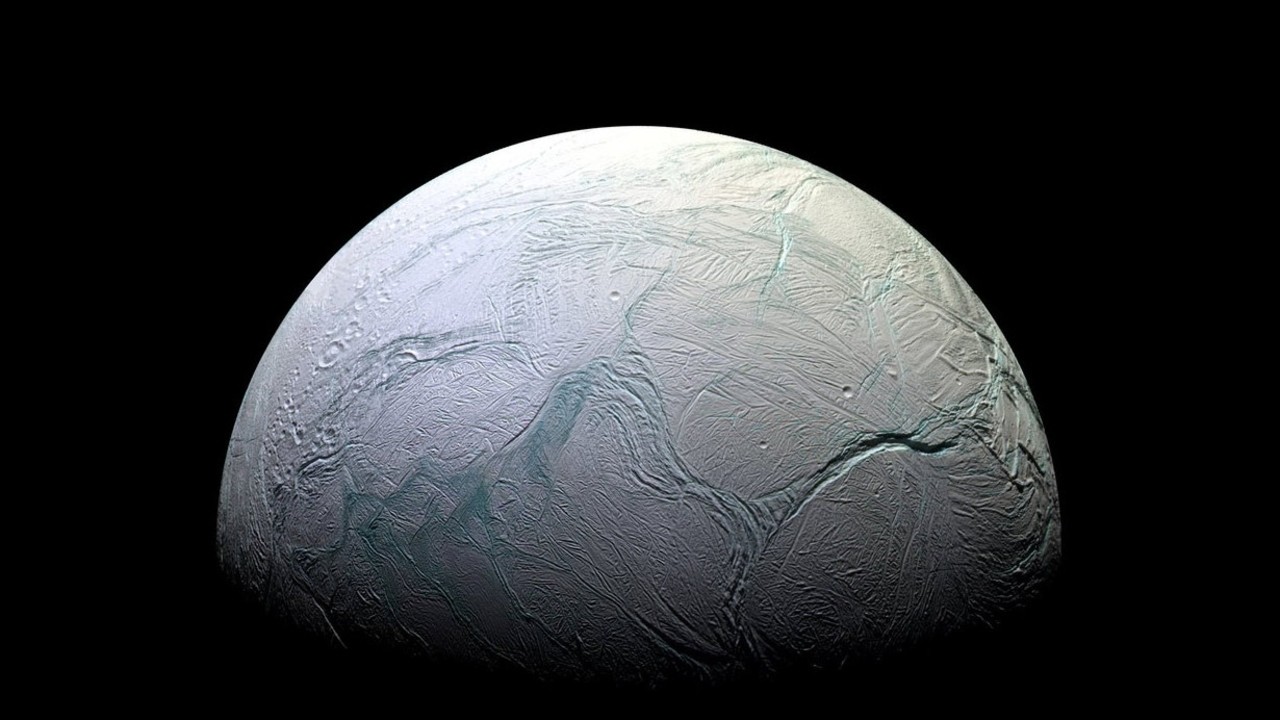
Team leader Zhonghua Yao of the University of Hong Kong explained that the differences between the structure of the Saturnian magnetic field and that of Earth's magnetosphere point to a unified fundamental process that governs how outflows of charged particles from the sun, known as the solar wind, interact with different planets. This discovery could be vital in understanding how winds from other stars interact with planets beyond the solar system. "Comprehensive terrestrial observations reveal the working mechanisms of Earth, while comparative studies between planets inform us of the fundamental laws that can be applied to understand other systems, such as exoplanets," Yao said.
Particularly useful for Yao and colleagues was data from two of Cassini's instruments, the Cassini Magnetometer (MAG) and the Cassini Plasma Spectrometer (CAPS), both of which detected incidents during which the spacecraft passed through Saturn's magnetic cusp. This revealed 67 such occasions between 2004 and 2010. Using this to simulate the shape of Saturn's magnetic field, the team found that the way the solar wind interacts with the ringed planet's magnetosphere is similar to interactions with the magnetic field of its fellow gas giant, Jupiter.
The team's research was published on Wednesday (April 1) in the journal Nature Communications.
 Robert LeaSenior Writer
Robert Lea is a science journalist in the U.K. whose articles have been published in Physics World, New Scientist, Astronomy Magazine, All About Space, Newsweek and ZME Science. He also writes about science communication for Elsevier and the European Journal of Physics. Rob holds a bachelor of science degree in physics and astronomy from the U.K.’s Open University. Follow him on Twitter @sciencef1rst.
View MoreYou must confirm your public display name before commenting
Please logout and then login again, you will then be prompted to enter your display name.
Logout MORE FROM SPACE... 1NASA set to launch Artemis 2 moon mission today, the 1st crewed lunar flight since 1972
- 2This star-forming galaxy is blowing out powerful winds topping 2 million mph
- 3Yes, NASA's launching Artemis 2 astronauts to the moon on April Fools' Day. It's not a joke.
- 4Comet MAPS faces a make-or-break moment as it dives toward the sun on April 4 — could it shine in the daytime sky?
- 5How to use your Unistellar smart telescope to track the Artemis 2 rocket light curve in the name of science