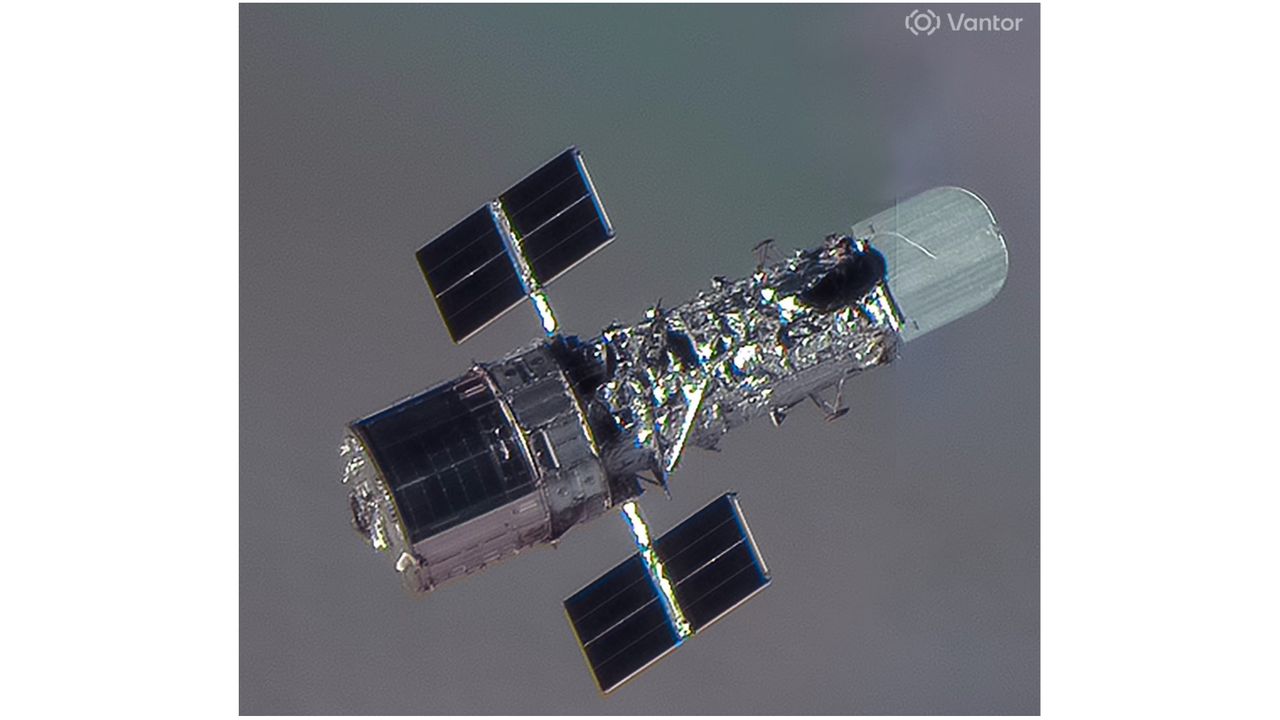
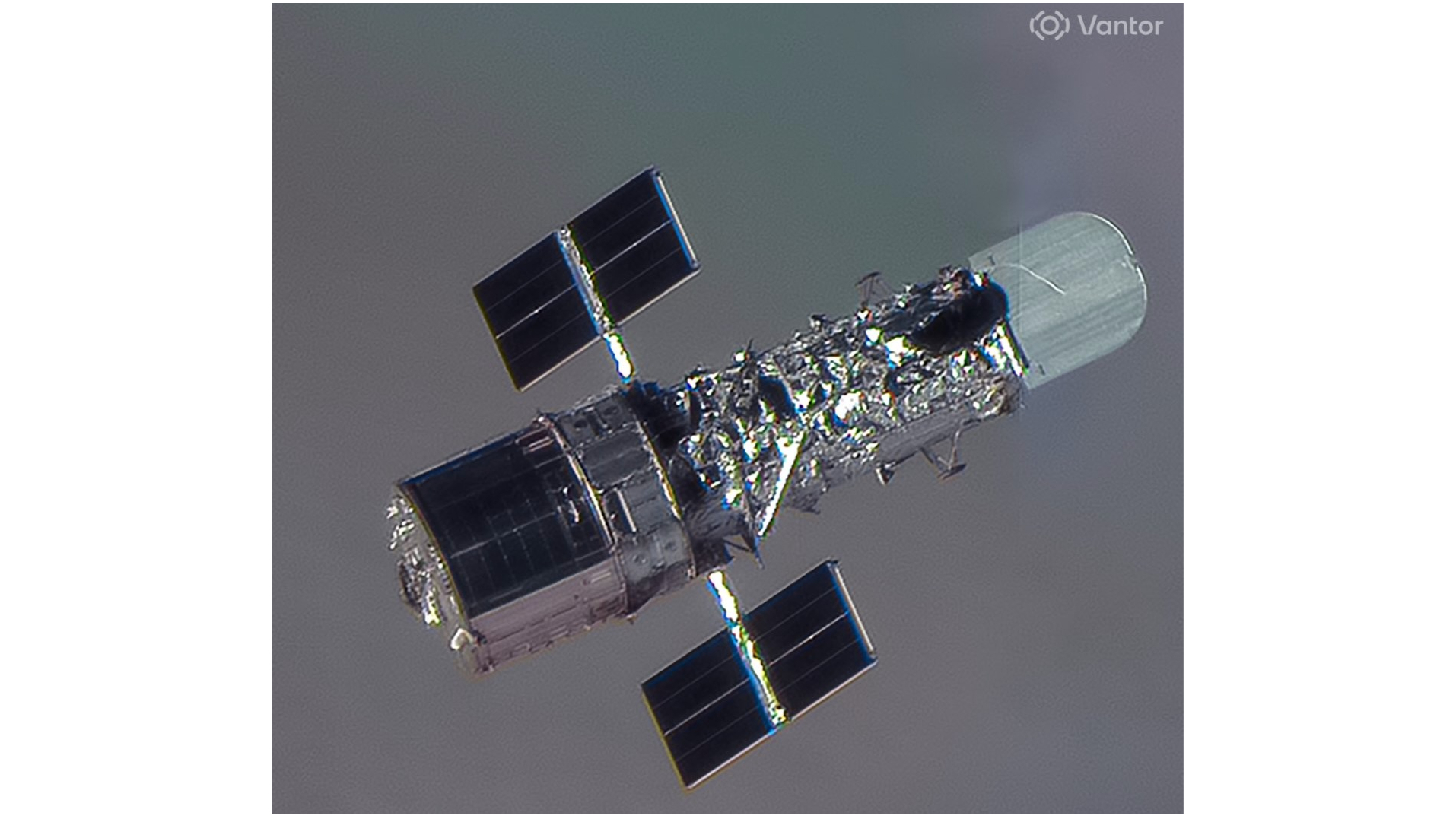
 Vantor's WorldView Legion 4 satellite captured this photo of the Hubble Space Telescope on April 23, 2026, from a distance of 38.4 miles (61.8 kilometers). (Image credit: Vantor) Share this article 0 Join the conversation Follow us Add us as a preferred source on Google Newsletter Get the Space.com Newsletter
 Breaking space news, the latest updates on rocket launches, skywatching events and more!
Contact me with news and offers from other Future brands Receive email from us on behalf of our trusted partners or sponsors By submitting your information you agree to the Terms & Conditions and Privacy Policy and are aged 16 or over.You are now subscribed
Your newsletter sign-up was successful
Want to add more newsletters?
An account already exists for this email address, please log in. Subscribe to our newsletterNASA's Hubble Space Telescope was on the receiving end of an amazing space photo for a change.
On Friday (April 24), Hubble's 36th birthday, the Colorado-based spatial intelligence company Vantor published a stunning, close-up shot of the telescope that was taken the day before by one of its WorldView Legion Earth-observing satellites.
"Celebrating 36 years of discovery with the Hubble Space Telescope," Vantor wrote in an X post that shared the photo. "For over three decades, Hubble has expanded our understanding of the universe —delivering breathtaking imagery and groundbreaking science that continue to inspire. Proud to support the technologies and teams that make moments like this possible."
Celebrating 36 years of discovery with the Hubble Space Telescope 🔭 Collected on April 23, 2026, by one of Vantor's WorldView Legion satellites, this remarkable non-Earth image showcases Hubble from just 61.8 km away—an incredible perspective of one of humanity’s most iconic… pic.twitter.com/pCfyWgCzASApril 24, 2026
The post also gives some details about the image and Hubble itself, which launched to low Earth orbit (LEO) aboard the space shuttle Discovery on April 24, 1990.
For example, the in-space photo was taken from just 34.8 miles (61.8 kilometers) away, providing "an incredible perspective of one of humanity’s most iconic scientific instruments," the X post reads. "With a space sample distance of 4.0 cm [1.6 inches], Hubble’s signature cylindrical body, gleaming thermal shielding, and extended solar arrays are clearly visible, along with the open aperture door at the front of the telescope."
Vantor (previously known as Maxar Intelligence) operates six WorldView Legion satellites, all of which orbit at the same general altitude — around 322 miles (518 km) above Earth. The sharp-eyed spacecraft can resolve features as small as 11.8 inches (30 cm) on their home planet.
The new Hubble shot was captured by WorldView Legion 4, a Vantor spokesperson told Space.com via email. That satellite reached orbit atop a SpaceX Falcon 9 rocket in August 2024, along with WorldView Legion 3. (The other four rode to space on Falcon 9s in May 2024 and February 2025, with two satellites going up on each launch.)
Get the Space.com NewsletterContact me with news and offers from other Future brandsReceive email from us on behalf of our trusted partners or sponsorsHubble famously launched to LEO with a flawed mirror, which was fixed by astronauts during a servicing mission in 1993. The telescope has been going strong ever since, capturing amazing imagery of the cosmos that has captivated astronomers and laypeople alike.
Hubble has recently shown signs of its advanced age, but the iconic observatory continues to make important scientific observations and discoveries. NASA has expressed optimism that the telescope can continue operating through 2035.
 Mike WallSpaceflight and Tech Editor
Michael Wall is the Spaceflight and Tech Editor for Space.com and joined the team in 2010. He primarily covers human and robotic spaceflight, military space, and exoplanets, but has been known to dabble in the space art beat. His book about the search for alien life, "Out There," was published on Nov. 13, 2018. Before becoming a science writer, Michael worked as a herpetologist and wildlife biologist. He has a Ph.D. in evolutionary biology from the University of Sydney, Australia, a bachelor's degree from the University of Arizona, and a graduate certificate in science writing from the University of California, Santa Cruz. To find out what his latest project is, you can follow Michael on Twitter.
View MoreYou must confirm your public display name before commenting
Please logout and then login again, you will then be prompted to enter your display name.
Logout MORE FROM SPACE... 1From Apollo to alien worlds: 4 'firsts' you can spot in the night sky tonight
- 2Why do some starburst galaxies mysteriously shut down? New study provides clues
- 3Watch Russia launch 3 tons of cargo to the International Space Station today
- 4How did humanity end up underground in 'Silo'? Apple TV digs deep in new Season 3 teaser (video)
- 5This X-ray image shows our solar system 'breathing'