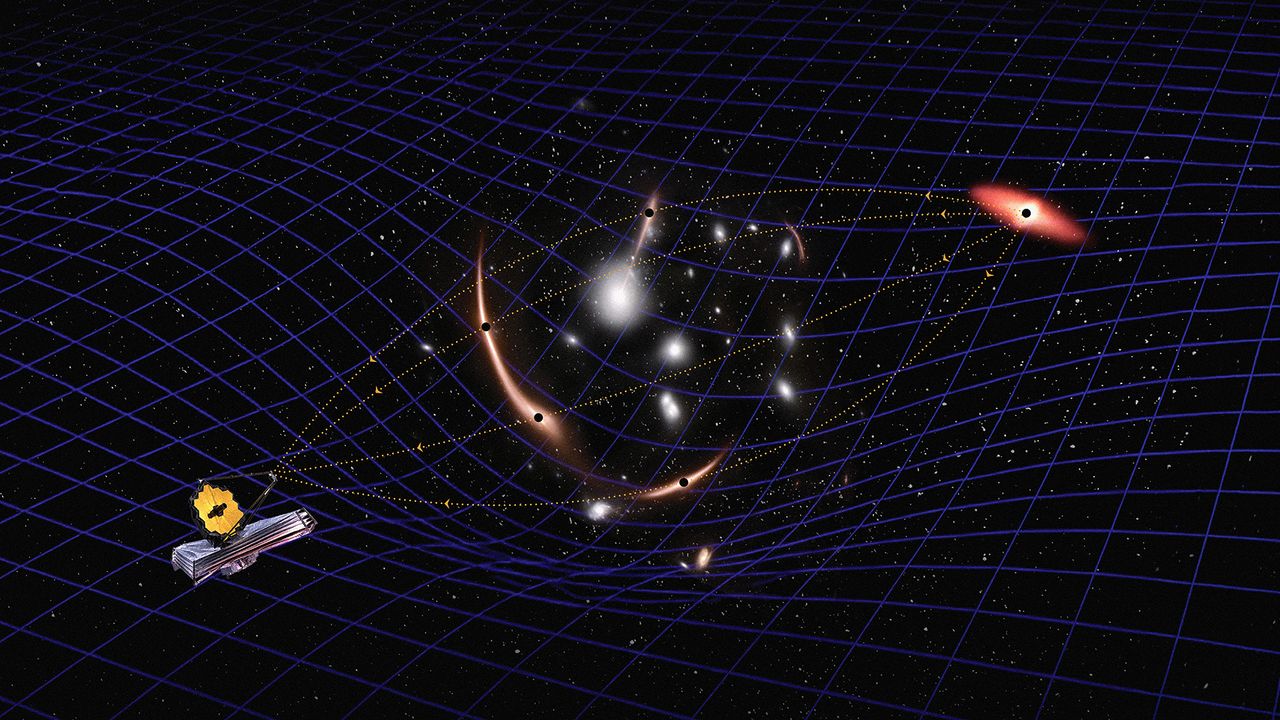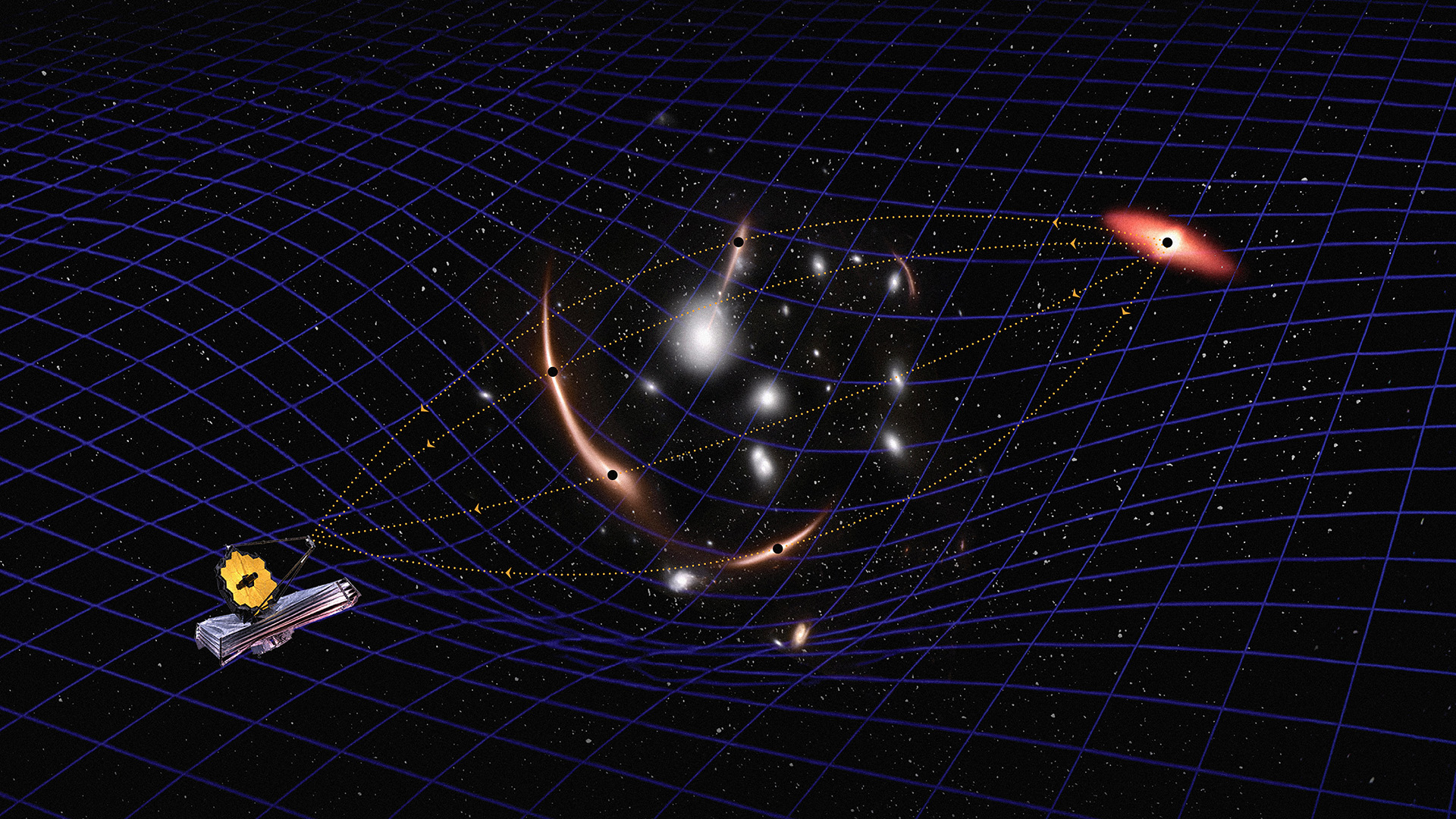
An illustration of JWST spying the black hole’s host galaxy through a gravitational lens. The black hole (right) is thought to be the most distant, ancient dormant black hole ever detected. (Image credit: Navid Marvi/Carnegie Science)
Share this article Join the conversation
Follow us Add us as a preferred source on Google Newsletter Subscribe to our newsletter
The James Webb Space Telescope has spotted the most distant, dormant black hole in the known universe , hiding in a galaxy more than 10 billion light-years from Earth.
The newly analyzed black hole, located in a galaxy called MRG-M0138, smashes the previous distance record for such an object by 15 times, according to a study published Thursday (June 4) in the journal Science.
Studying black holes like this, which formed early in the universe's 13.8-billion-year-old history, will give researchers an unprecedented look at how black holes evolved when the universe was young. Within MRG-M0138, for example, scientists suspect there used to be a quasar (an extremely bright and supermassive black hole) that grew very quickly, eventually throwing out a significant amount of gas in the galaxy needed to form new stars. This process rapidly shut down star formation in the galaxy, robbing the black hole of its fuel source and likely explaining why the area looks so quiet today.
When stars go stagnant
Scientists are curious about how quickly star formation ceases in ancient galaxies such as this one. Luckily, MRG-M0138 is just part of a larger dataset of early-universe galaxies gathered from James Webb Space Telescope (JWST) observations; the research team also examined four other distant, gravitationally lensed galaxies with the telescope this last year, and analysis is ongoing.
"While the stars in MRG-M0138 are ancient, star formation shut down much later in the other galaxies that we've just observed with JWST," lead author Andrew Newman, a staff scientist at Carnegie Science in California, told Live Science in an email.
"They're like cinders that we can study to learn what put out the fire," Newman continued, then alluded to a direction of future research. "In particular, we're looking for signs of gas that's been blown out of the galaxy, by a black hole more active than the one in MRG-M0138."
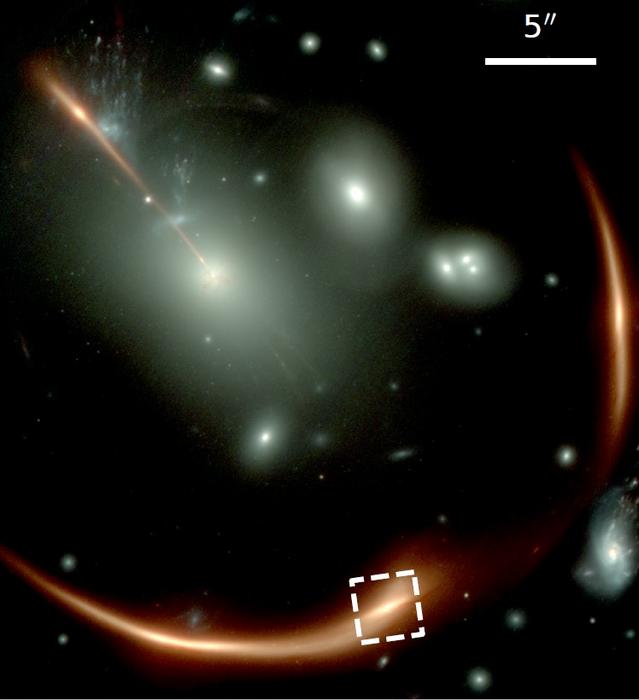
Galaxy MRG-M0138 is imaged in this James Webb Space Telescope image, due to gravitational lenses through a cluster of galaxies in the foreground (white sources).
(Image credit: NASA/JWST)
Aside from the star-formation sequence at MRG-M0138, the researchers also determined the mass of its black hole — which is roughly six billion times that of the sun.
Sign up for the Live Science daily newsletter now
Get the world’s most fascinating discoveries delivered straight to your inbox.
Contact me with news and offers from other Future brandsReceive email from us on behalf of our trusted partners or sponsors
Making this measurement wasn't easy; because MRG-M0138's black hole is dormant and not interacting with any gas around it, it's invisible in all wavelengths of light. Weighing the cosmic monster required repurposing a technique using star motions, usually used in galaxies much closer to Earth. To track the motion of stars orbiting the black hole, the team relied on a natural magnifying glass, called gravitational lensing.
Researchers took advantage of another galaxy, between MRG-M0138 and Earth, whose gravity is so powerful that it bent the light of objects behind it, magnifying groups of stars. This lens made the image of MRG-M0138 about 30 times larger than what would usually be visible, allowing the researchers to track the stars whirling about the black hole. The team then analyzed the stars' motions to determine how quickly they moved, as well as any differences in motion between stars that were closer or further from the black hole, to figure out the black hole's mass.
Related stories
"By demonstrating the feasibility of such a technique for galaxies in the early universe, we can now undertake a more complete census of how black holes develop over time, and infer their role in shaping galaxy evolution," senior author Richard Ellis, an astrophysics professor at University College London, said in a statement.
That said, other techniques will be needed to gather that census of black holes because JWST is designed to take a very detailed look at a small patch of sky. To push the research forward, the team is hoping for lensed-galaxy observations from the wide-angle Euclid space telescope — as well as the forthcoming Nancy Grace Roman Space Telescope, which is also optimized to look at large swaths of the sky.
"We want to find more galaxies like these: places where star formation shut down in the early universe, and that are magnified by a gravitational lens," Newman told Live Science. "We need sensitive infrared images of large areas of sky to find these rare objects, and fortunately that is exactly what the Euclid telescope is providing and the Roman Space Telescope, scheduled for launch later this year, will soon deliver."
See how much you know about black holes with our black hole quiz!
TOPICS
 Elizabeth Howell
Live Science Contributor
Elizabeth Howell was staff reporter at Space.com between 2022 and 2024 and a regular contributor to Live Science and Space.com between 2012 and 2022. Elizabeth's reporting includes multiple exclusives with the White House, speaking several times with the International Space Station, witnessing five human spaceflight launches on two continents, flying parabolic, working inside a spacesuit, and participating in a simulated Mars mission. Her latest book, "Why Am I Taller?" (ECW Press, 2022) is co-written with astronaut Dave Williams.
View More
You must confirm your public display name before commenting
Please logout and then login again, you will then be prompted to enter your display name.
Logout