 Fast solar wind could spark geomagnetic storms tonight, pushing auroras into mid-latitudes. (Image credit: Created in Canva Pro.) Jump to:
 - Where can I see the northern lights tonight?
- What time should I look for the northern lights tonight?
- How can I see the northern lights from where I live?
- While you're at it… look for Lyrid meteors!
Breaking space news, the latest updates on rocket launches, skywatching events and more!
Contact me with news and offers from other Future brands Receive email from us on behalf of our trusted partners or sponsors By submitting your information you agree to the Terms & Conditions and Privacy Policy and are aged 16 or over.You are now subscribed
Your newsletter sign-up was successful
Want to add more newsletters?
An account already exists for this email address, please log in. Subscribe to our newsletterHead's up, aurora chasers! A surge of speedy solar wind is currently hurtling toward Earth at speeds up to 430 miles per second (700 km/s) and the conditions could spark geomagnetic storms tonight (April 17) and tomorrow (April 18)
NOAA's Space Weather Prediction Center has issued a moderate (G2) geomagnetic storm watch while forecasters at the U.K. Met Office say there is a chance of strong (G3) bursts if activity intensifies.
Geomagnetic storms are ranked on a G-scale, from G1 (minor) to G5 (extreme). Stronger storms can push auroras much farther from the poles, making them visible across mid-latitudes.
Auroras form when solar wind interacts with Earth's magnetic field, sending charged particles into the upper atmosphere. There, they collide with gases such as oxygen and nitrogen, transferring energy that is released as light, producing the colorful displays seen in the night sky. The stronger the solar wind, the more dynamic and widespread the auroras can become.
NOAA's geomagnetic storm watch for April 17-18. (Image credit: NOAA SWPC)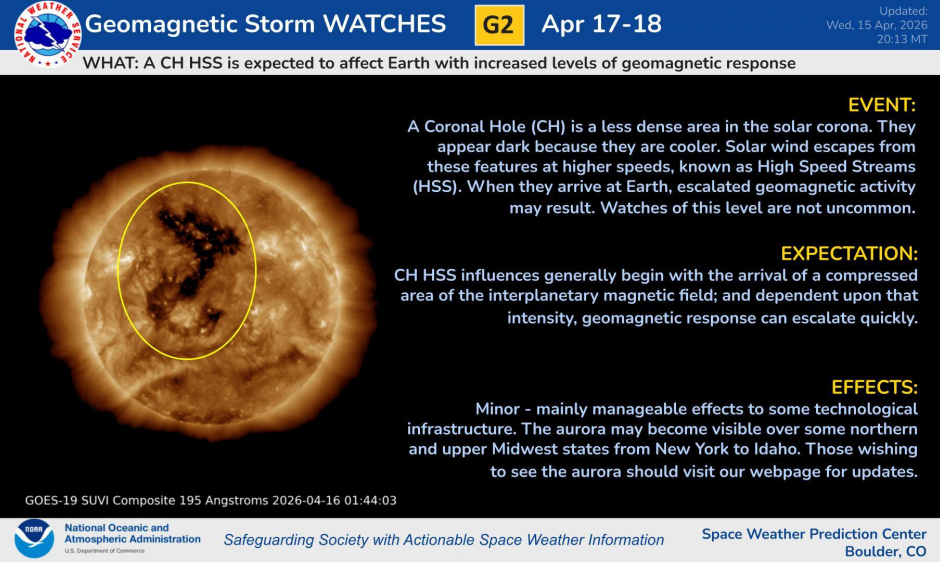
Where can I see the northern lights tonight?
Depending on whether conditions align and geomagnetic storms are triggered, the northern lights could become visible across the northern U.S. tonight. But remember, auroras are never guaranteed and depend on how successfully the solar wind interacts with Earth's magnetic field.
Swipe to scroll horizontallyGeomagnetic storm
Most southern possible visibility
G3 - Strong
Illinois and Oregon
G2 - Moderate
New York and Idaho
G1 - Minor
Northern Michigan and Maine
Northern Hemisphere aurora forecast courtesy of the U.K. Met Office
What time should I look for the northern lights tonight?
The northern lights may be visible across northern U.S. states tonight and tomorrow (April 17-18).
According to NOAA's 3-day forecast, activity is expected to peak during the following windows:
Swipe to scroll horizontallyTime (EDT)
Time (GMT)
Activity
5:00 p.m. (April 17) to 2 a.m.
2100 (April 17) to 0600 (April 18)
Moderate G2 conditions possible
2:00 a.m. to 5 a.m.
0600-0900 (April 18)
Minor G1 conditions possible
How can I see the northern lights from where I live?
Find a north-facing vantage point with a clear view of the northern horizon, as far from light pollution as possible.
- Use your phone camera to scan the sky, as a phone camera is great at picking up faint auroras before your eyes spot them. This will give you a good idea of which direction to focus your attention.
- Try and let your eyes adapt to the dark for at least 30 minutes; this will help your night vision develop.
- Wear warm clothing! Part of the fun of aurora hunting is the chase. Be prepared to sit or stand for hours if conditions are looking promising, as you won't want to miss the show when it starts!
We recommend downloading a space weather app that provides aurora forecasts based on your location. One option I use is "My Aurora Forecast & Alerts," available for both iOS and Android. However, any similar app should work well.
While you're at it… look for Lyrid meteors!
The radiant of the Lyrid meteor shower is located near the Hercules-Lyra border. (Image credit: Future)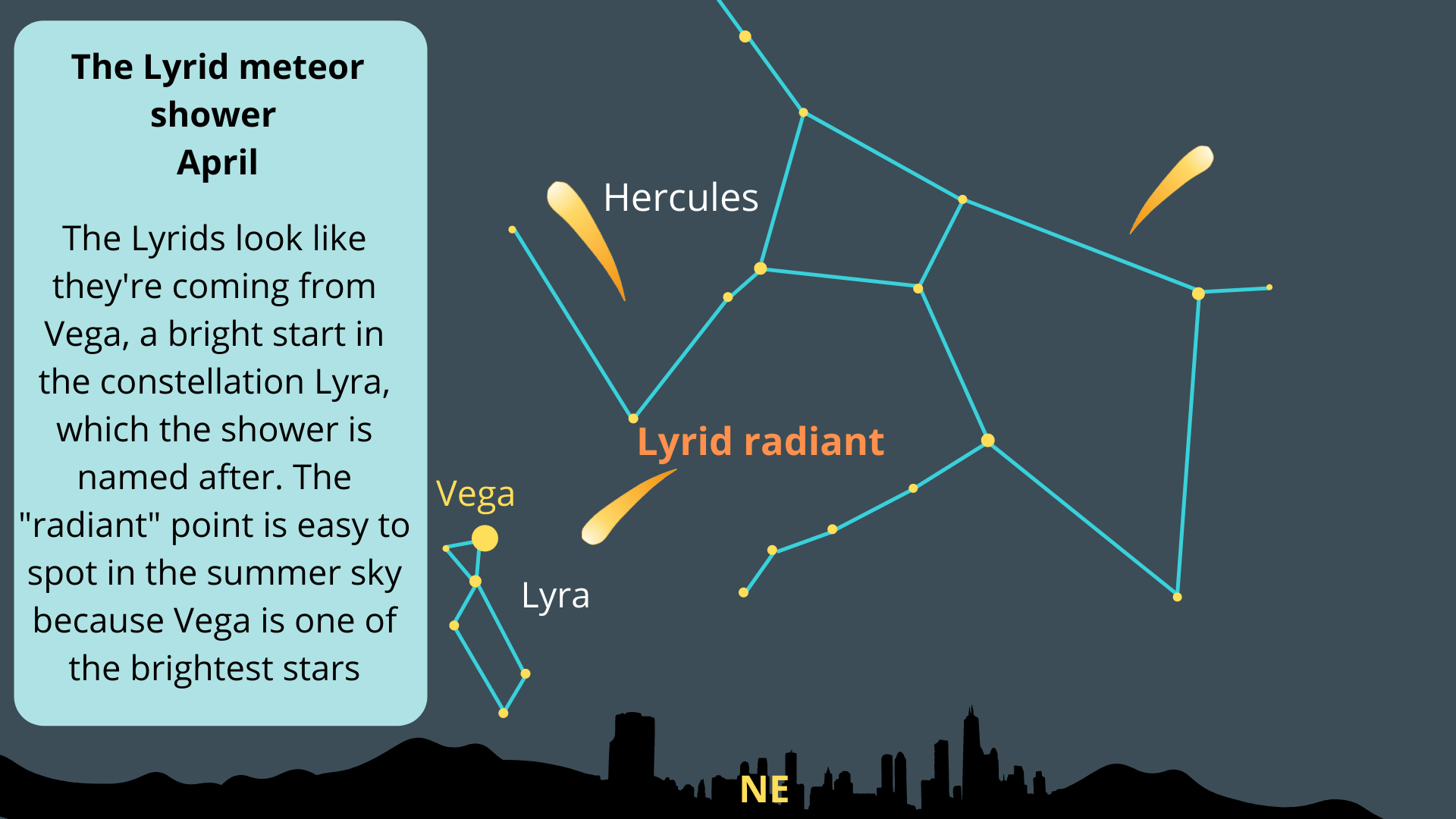
If you're heading outside tonight or over the weekend to hunt for auroras, keep an eye out for the Lyrid meteor shower too.
The Lyrid meteor shower is active between April 16 and April 25 and will peak in the predawn hours on April 22.
Lyrids will appear to emanate from the radiant in the Lyra constellation, which rises in the northwest and climbs higher in the sky toward the early morning hours. But make sure you don't look directly at the radiant, as while meteors appear to originate from Lyra, the longer, more dramatic shooting stars often appear farther away, so scan as much of the sky surrounding the radiant as possible.
 Daisy DobrijevicSkywatching Editor
Daisy Dobrijevic joined Space.com in February 2022, having previously worked as a staff writer for All About Space magazine. She completed an editorial internship with BBC Sky at Night Magazine and worked at the National Space Centre, communicating space science to the public.
Daisy holds a PhD in plant physiology and a Master's in Environmental Science. Based in Nottingham, U.K., she covers all things space, with a special focus on solar activity and space weather. She also has a keen interest in astrotourism and is always on the lookout for the next northern lights adventure.
She will be a guest speaker aboard HX's Solar Eclipse Expedition in August 2026 and will join Hurtigruten as an onboard astronomer for a northern lights sailing in January 2027.
View MoreYou must confirm your public display name before commenting
Please logout and then login again, you will then be prompted to enter your display name.
Logout MORE FROM SPACE... 1Interstellar invader comet 3I/ATLAS made a startling transformation as it passed the sun
- 2This giant telescope could discover habitable exoplanets and secrets of our universe — if it gets its funding
- 3Landing astronauts on the moon 'is absolutely doable, and it's doable soon,' NASA's Artemis 2 commander says
- 4'That was a wonderful toilet': Artemis 2 commander defends mission's lunar loo
- 5Fantasy RPG 'Crimson Desert' lets you stab your way up to space, showcasing a remarkably detailed cosmos