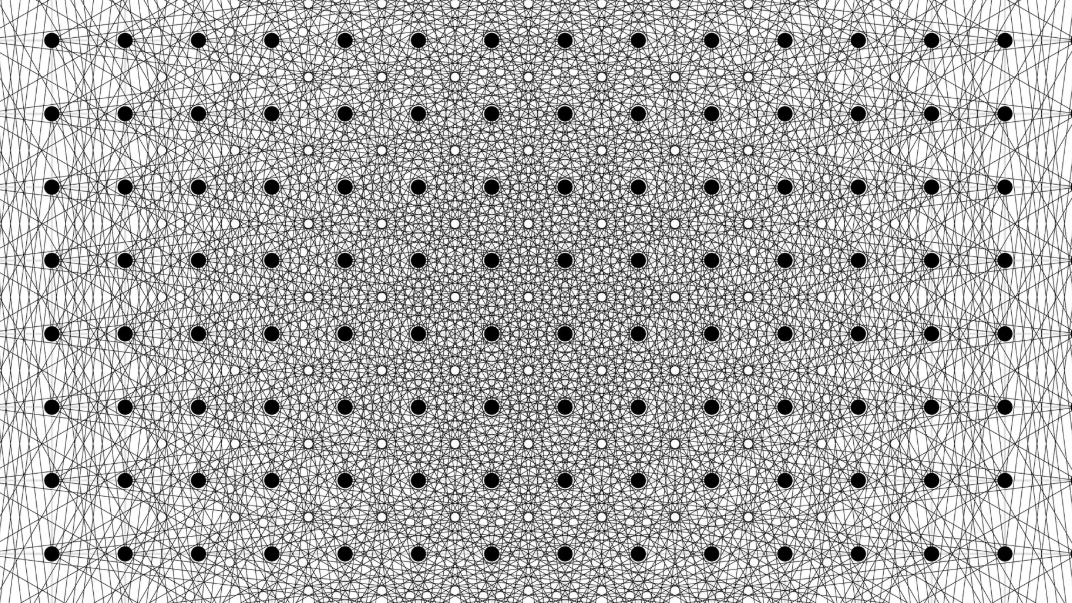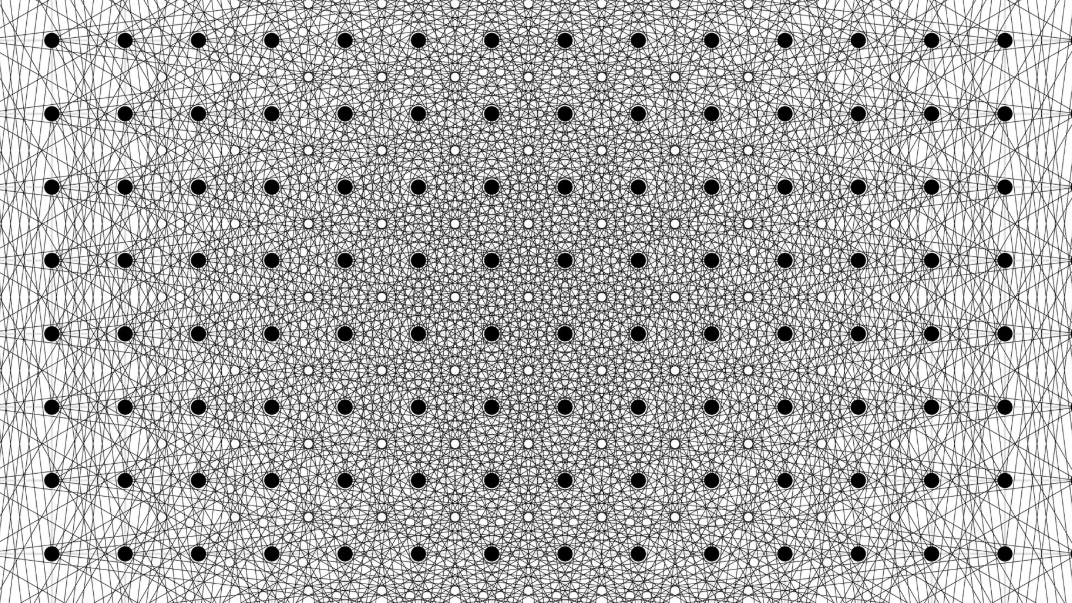
How many unit distances can you fit on a single piece of paper? OpenAI says one of its models knows. (Image credit: OpenAI)
Share this article Join the conversation
Follow us Add us as a preferred source on Google Newsletter Subscribe to our newsletter
An artificial intelligence (AI) model has solved an 80-year-old math problem in a feat hailed as a major milestone for AI's mathematical ability.
The planar unit distance problem, first posed by Hungarian mathematician Paul Erdős in 1946, asks a seemingly simple question: What is the maximum number of pairs of points that can exist one unit apart on a two-dimensional plane? Erdős claimed this number would rise slightly faster than the number of dots.
The most accurate human upper bound to the problem was first set in 1984. But last week, OpenAI announced in a blog post that an internal AI model had solved the problem — finding a group of arrangements that broke past the limit set by Erdős.
Perhaps more importantly, the AI lab claimed that the general-purpose reasoning model it used wasn't specifically trained for the problem or even in mathematics at all.
"This proof is an important milestone for the math and AI communities. It marks the first time that a prominent open problem, central to a subfield of mathematics, has been solved autonomously by AI," company representatives wrote in the post.
The successful prompt given to the company's internal model can be viewed in the accompanying research paper. In it, OpenAI scientists said its model used a completely novel approach to replace a working theory usually associated with the planar unit distance problem.
"These ideas were well-known to algebraic number theorists, but it came as a great surprise that these concepts have implications for geometric questions," OpenAI representatives added in the post.
Sign up for the Live Science daily newsletter now
Get the world’s most fascinating discoveries delivered straight to your inbox.
Contact me with news and offers from other Future brandsReceive email from us on behalf of our trusted partners or sponsors
OpenAI said the result marks the first time that AI has autonomously solved an open problem in a field. However, perhaps in light of a wave of popular backlash to past claims that the tech would replace humans, the company also pointed out that the technology is intended to improve the work mathematicians do, not replace it. External, human mathematicians were asked to review and confirm the results, and they wrote a companion paper to explain the context around how the AI came to its conclusion.
"While the original proof produced by AI was completely valid, it was significantly improved by the human researchers at OpenAI and the many other mathematicians involved in the present paper," Thomas Bloom, a mathematician at the University of Manchester who maintains the Erdős problems website, wrote in the companion paper. "The human still plays a vital role in discussing, digesting and improving this proof, and exploring its consequences."
RELATED STORIES
Nonetheless, mathematicians' responses to the result have been mainly glowing. "There is no doubt that the solution to the unit-distance problem is a milestone in AI mathematics: if a human had written the paper and submitted it to the Annals of Mathematics and I had been asked for a quick opinion, I would have recommended acceptance without any hesitation," Tim Gowers, a professor of mathematics at the University of Cambridge, wrote in the companion paper. "No previous AI-generated proof has come close to that."
OpenAI's blog post suggested that the result also goes beyond just the planar unit distance problem, serving as a proof of concept demonstrating that AI can be applied more to "frontier research."
Whether that is borne out remains to be seen. In October last year, OpenAI representatives, including manager Kevin Weil and executive Sebastien Bubkeck, claimed that GPT-5 had solved 10 previously unsolved problems Erdős identified in mathematics, and made progress on 11 others. Bubkeck rowed back on this statement and deleted his initial post after experts, including Bloom, pointed out that the problems had already been solved by human mathematicians.
Article Sources
OpenAI, Planar Point Sets with Many Unit Distances, https://cdn.openai.com/pdf/74c24085-19b0-4534-9c90-465b8e29ad73/unit-distance-proof.pdf
 Drew Turney
Drew is a freelance science and technology journalist with 20 years of experience. After growing up knowing he wanted to change the world, he realized it was easier to write about other people changing it instead. As an expert in science and technology for decades, he’s written everything from reviews of the latest smartphones to deep dives into data centers, cloud computing, security, AI, mixed reality and everything in between.
View More
You must confirm your public display name before commenting
Please logout and then login again, you will then be prompted to enter your display name.
Logout