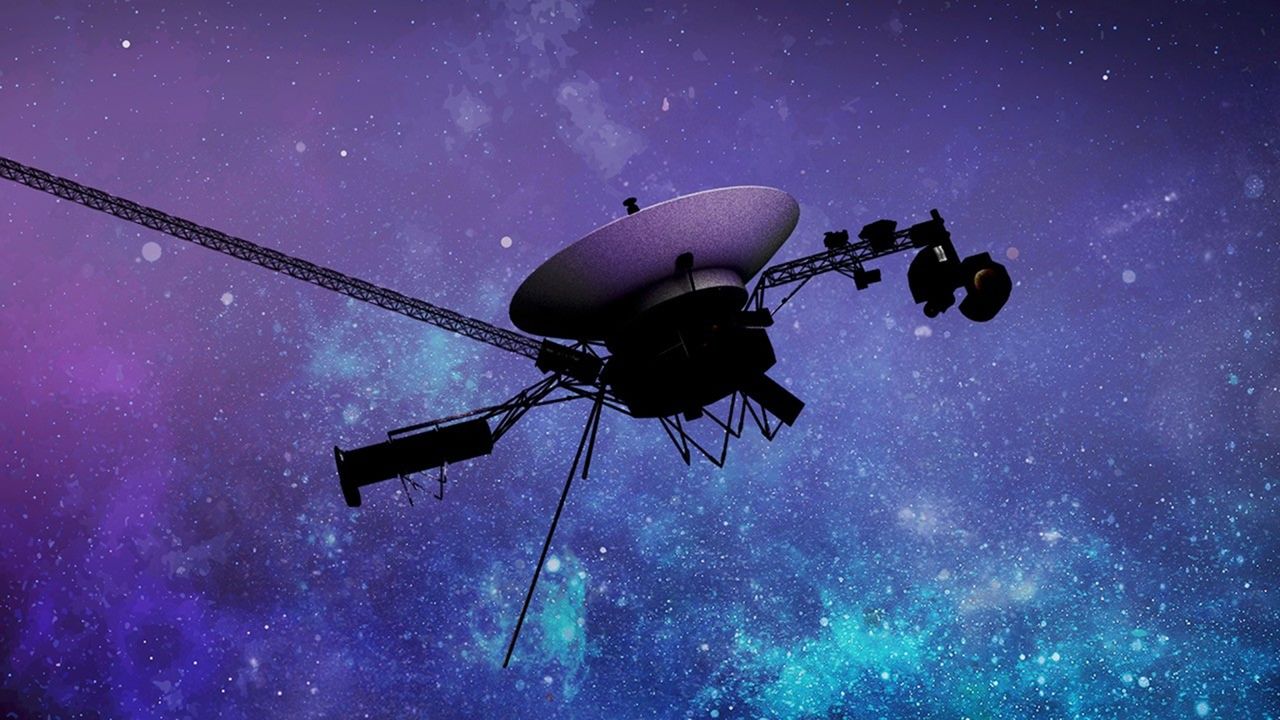
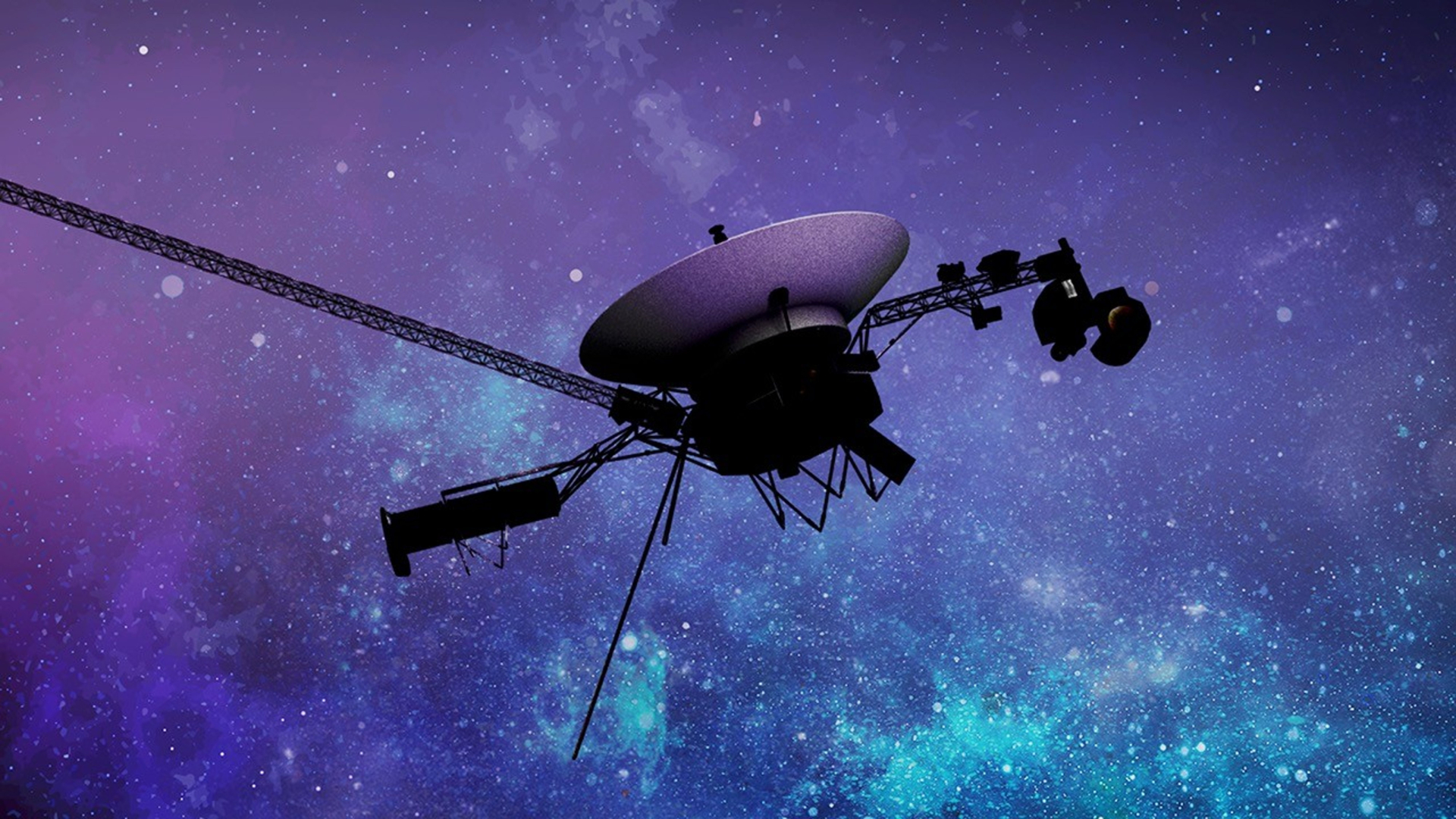
 An artist's impression of the Voyager 1 spacecraft. (Image credit: NASA/JPL-Caltech) Share this article 0 Join the conversation Follow us Add us as a preferred source on Google Newsletter Sign up for the Live Science daily newsletter now
 Get the world’s most fascinating discoveries delivered straight to your inbox.
Become a Member in Seconds
Unlock instant access to exclusive member features.
Contact me with news and offers from other Future brands Receive email from us on behalf of our trusted partners or sponsors By submitting your information you agree to the Terms & Conditions and Privacy Policy and are aged 16 or over.You are now subscribed
Your newsletter sign-up was successful
Want to add more newsletters?
Join the club
Get full access to premium articles, exclusive features and a growing list of member rewards.
Explore An account already exists for this email address, please log in. Subscribe to our newsletterAfter nearly half a century in space, the Voyager 1 spacecraft just shut down one of its last remaining science instruments in a desperate attempt to preserve power. NASA's decision to turn off the instrument comes just ahead of a last-ditch "Big Bang" moment that mission managers hope will give the two Voyager probes an extra boost of life later this summer.
On Friday (April 17), Voyager 1 was commanded to shut down the Low-Energy Charged Particle (LECP) experiment, an instrument that has looked at ions, electrons and cosmic rays surrounding the spacecraft for the past 49 years.
The spacecraft launched in 1977, initially to survey Jupiter and Saturn, before its mission was extended again and again. In 2012, Voyager 1 officially crossed into interstellar space, becoming the first spacecraft to send data from outside the solar system. It remains the most distant spacecraft in history.
The twin probe Voyager 2, which surveyed all of the outer planets from Jupiter to Neptune, entered interstellar space about six years later, and the two spacecraft are still transmitting from the black.
But their time is running short. Both spacecraft rely on a radioisotope thermoelectric generator, which converts decaying plutonium into power. The spacecraft lose roughly 4 watts of power a year.
"Power margins have grown razor thin, requiring the team to conserve energy by shutting off heaters and instruments while making sure the spacecraft don't get so cold that their fuel lines freeze," representatives from NASA's Jet Propulsion Laboratory (JPL), which manages the Voyager program, wrote in an April 17 blog post.
Sign up for the Live Science daily newsletter nowContact me with news and offers from other Future brandsReceive email from us on behalf of our trusted partners or sponsorsAfter the latest shutoff, only two of Voyager 1's 10 science instruments remain powered, while three instruments are currently running on Voyager 2. These instruments have helped scientists characterize the conditions of space beyond the solar system, as well as the physical properties of the heliopause, the boundary where the solar wind clashes with the interstellar medium.
A "Big Bang"
This latest Voyager 1 instrument shutoff will grant the spacecraft only about one year of life, as things stand, but there's a plan to get more out of the spacecraft: JPL will use a "Big Bang" procedure to try extending the dwindling power reserves of not only Voyager 1 but also Voyager 2.
"The idea is to swap out a group of powered devices all at once — hence the nickname — turning some things off, and replacing them with lower-power alternatives, to keep the spacecraft warm enough to continue gathering science data," JPL representatives wrote in the blog post.
RELATED STORIES- NASA switches off Voyager instruments to extend life of the two interstellar spacecraft: 'Every day could be our last.'
- NASA engineers discover why Voyager 1 is sending a stream of gibberish from outside our solar system
- After months of sending gibberish to NASA, Voyager 1 is finally making sense again
For now, two instruments on Voyager 1 are examining magnetic fields and waves of plasma (superheated gas). But if all goes according to plan, the team hopes to gain back enough power from the Big Bang to turn the LECP back on. In fact, engineers decided to keep a small, half-watt motor for LECP running for now, just in case the instrument can be used again.
In May and June, JPL will run some Big Bang tests on Voyager 2, which has more power supplies available and is slightly closer to Earth. Assuming all goes well, the riskier Voyager 1 Big Bang moment would happen no earlier than July.
Sending any commands to Voyager 1 takes 23 hours because it is so far from Earth — 15 billion miles (25 billion kilometers) away. After JPL relayed its commands, the LECP shutdown process took a little more than three hours. Starting it up again, especially given the cold and distance, could be a bit trickier.
TOPICS Elizabeth HowellLive Science Contributor
Elizabeth Howell was staff reporter at Space.com between 2022 and 2024 and a regular contributor to Live Science and Space.com between 2012 and 2022. Elizabeth's reporting includes multiple exclusives with the White House, speaking several times with the International Space Station, witnessing five human spaceflight launches on two continents, flying parabolic, working inside a spacesuit, and participating in a simulated Mars mission. Her latest book, "Why Am I Taller?" (ECW Press, 2022) is co-written with astronaut Dave Williams.
View MoreYou must confirm your public display name before commenting
Please logout and then login again, you will then be prompted to enter your display name.
Logout LATEST ARTICLES 1Florida is facing its most intense drought in 15 years. Here's how it got so bad and how long it will last.
- 2Neanderthal toddlers grew faster than modern humans, probably because of the harsh environment they evolved in
- 3'Nations need to prepare now': Key Atlantic ocean current is much closer to collapse than scientists thought
- 4New blood test aims to spot liver scarring before it paves the way to cancer
- 5'We're the best servants anyone could dream of!': AI superintelligence has no need to enslave humans because we're already bowing to it