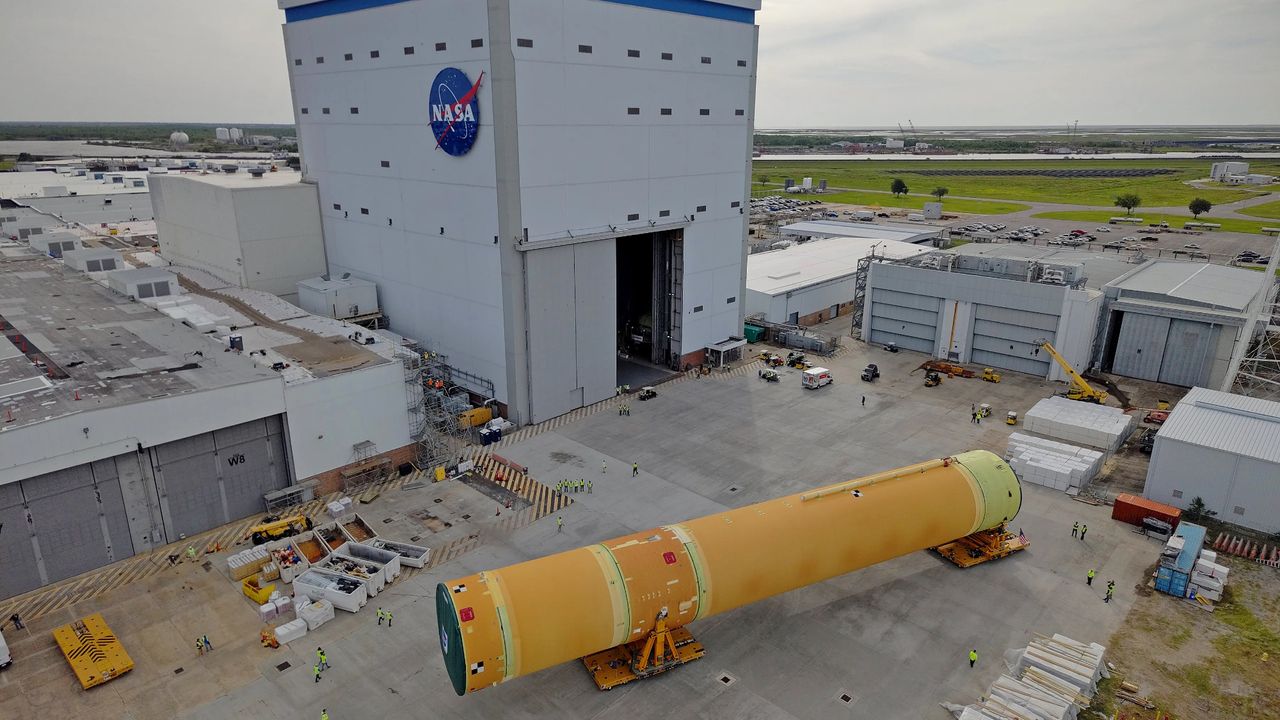
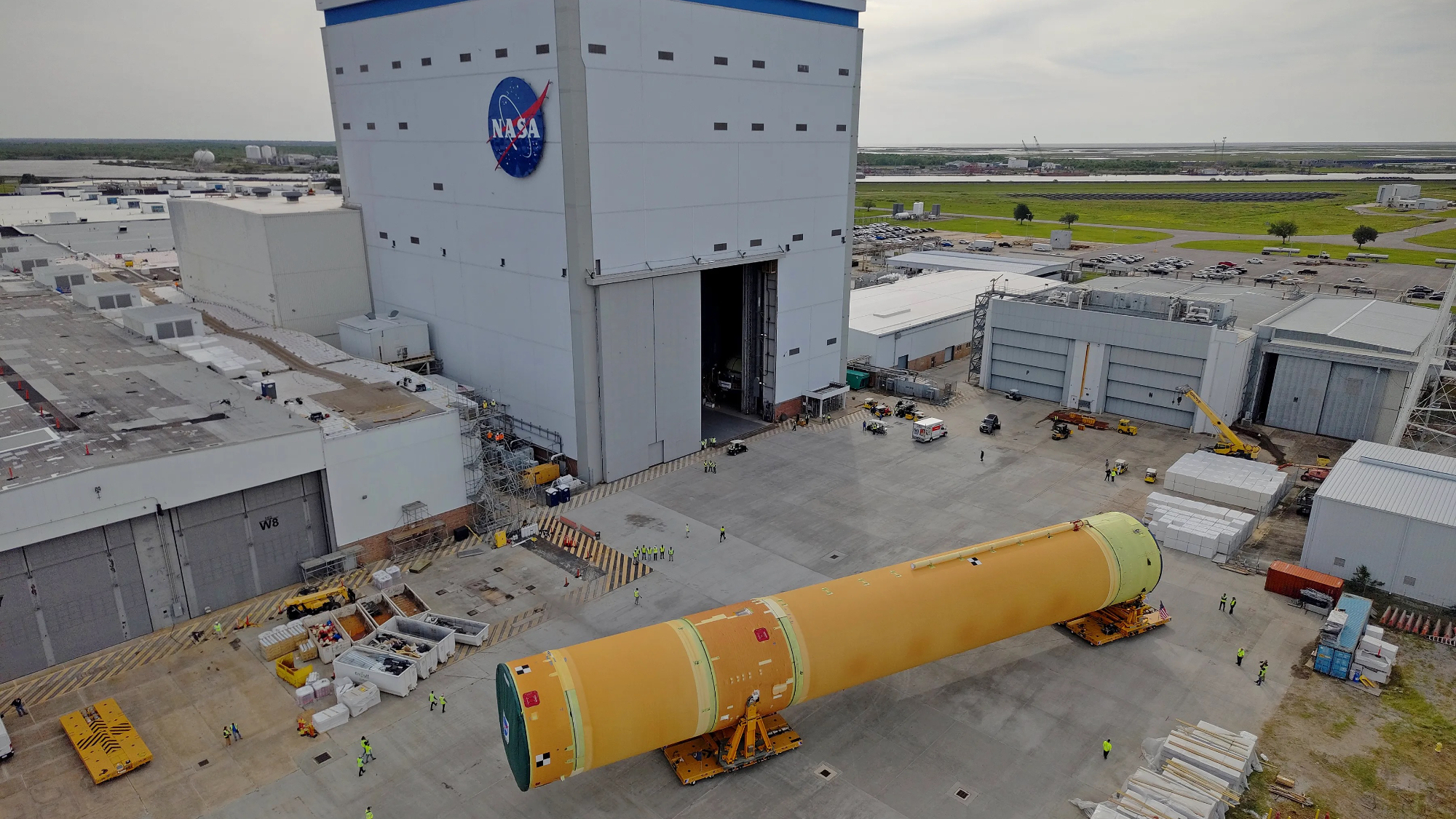
 NASA moved the core stage of the Space Launch System rocket that will launch the Artemis 3 mission in 2027 from Michoud Assembly Facility to the Pegasus barge in New Orleans on April 20, 2026. (Image credit: NASA/Michael DeMocker) Share this article 0 Join the conversation Follow us Add us as a preferred source on Google Newsletter Get the Space.com Newsletter
 Breaking space news, the latest updates on rocket launches, skywatching events and more!
Contact me with news and offers from other Future brands Receive email from us on behalf of our trusted partners or sponsors By submitting your information you agree to the Terms & Conditions and Privacy Policy and are aged 16 or over.You are now subscribed
Your newsletter sign-up was successful
Want to add more newsletters?
An account already exists for this email address, please log in. Subscribe to our newsletterA week and a half after the epic Artemis 2 mission splashed down, the biggest piece of NASA's next moon rocket is on the move.
On Monday (April 20), NASA rolled out the core stage of the Space Launch System (SLS) rocket that will launch Artemis 3, the next mission in the agency's Artemis program of moon exploration.
The huge rocket body emerged from NASA's Michoud Assembly Facility in New Orleans, then was loaded onto the agency's Pegasus barge for shipment to the launch site — Kennedy Space Center on Florida's Space Coast.
The milestone was a big step toward the launch of Artemis 3, which is targeted for mid-2027. The crewed mission will test rendezvous and docking operations in Earth orbit between NASA's Orion capsule and one or both of the private lunar landers the agency has contracted for the Artemis program — SpaceX's Starship and Blue Origin's Blue Moon.
If all goes well with that mission, humans will touch down near the moon's south pole on Artemis 4, which is currently slated to lift off in late 2028. (It's unclear at the moment which lander will fly on that mission.)
"Seeing this SLS rocket hardware roll out is a powerful reminder of our progress toward returning humans to the lunar surface," Lori Glaze, acting associate administrator for the Exploration Systems Development Mission Directorate at NASA Headquarters in Washington, said in a statement on Monday.
"This is the backbone of Artemis 3," she added. "As it heads to Florida for final integration, we are one step closer to testing the critical capabilities needed to land Americans on the moon, and ultimately, paving the way for our first crewed missions to Mars."
Get the Space.com NewsletterContact me with news and offers from other Future brandsReceive email from us on behalf of our trusted partners or sponsorsThe final, integrated Artemis 3 SLS core stage will stand 212 feet (64.6 meters) tall. The part that rolled out from Michoud on Monday was just 80% of that height, because it was lacking a sizable piece — the engine section.
The rollout came just 10 days after the successful conclusion of Artemis 2, which sent four astronauts on a historic flight around the moon.
Artemis 2 was the first crewed moon mission since 1972, and the first human spaceflight for both SLS and Orion. It also broke humanity's all-time distance record, sending people farther from Earth than they'd ever gone before — 252,760 miles (406,778 kilometers).
 Mike WallSpaceflight and Tech Editor
Michael Wall is the Spaceflight and Tech Editor for Space.com and joined the team in 2010. He primarily covers human and robotic spaceflight, military space, and exoplanets, but has been known to dabble in the space art beat. His book about the search for alien life, "Out There," was published on Nov. 13, 2018. Before becoming a science writer, Michael worked as a herpetologist and wildlife biologist. He has a Ph.D. in evolutionary biology from the University of Sydney, Australia, a bachelor's degree from the University of Arizona, and a graduate certificate in science writing from the University of California, Santa Cruz. To find out what his latest project is, you can follow Michael on Twitter.
View MoreYou must confirm your public display name before commenting
Please logout and then login again, you will then be prompted to enter your display name.
Logout MORE FROM SPACE... 1Astronauts photograph Lyrid meteor shower from ISS | Space photo of the day for April 21, 2026
- 2NASA reveals its Roman Space Telescope today: How to watch live, and what's next for the next-generation observatory
- 3Don't miss the Lyrid meteor shower 2026 peak tonight! Viewing times, location and tips
- 4NASA's Curiosity rover finds building blocks of life on Mars. Scientists aren't sure how they got there
- 5NASA shuts down Voyager 1 instrument to keep probe exploring interstellar space