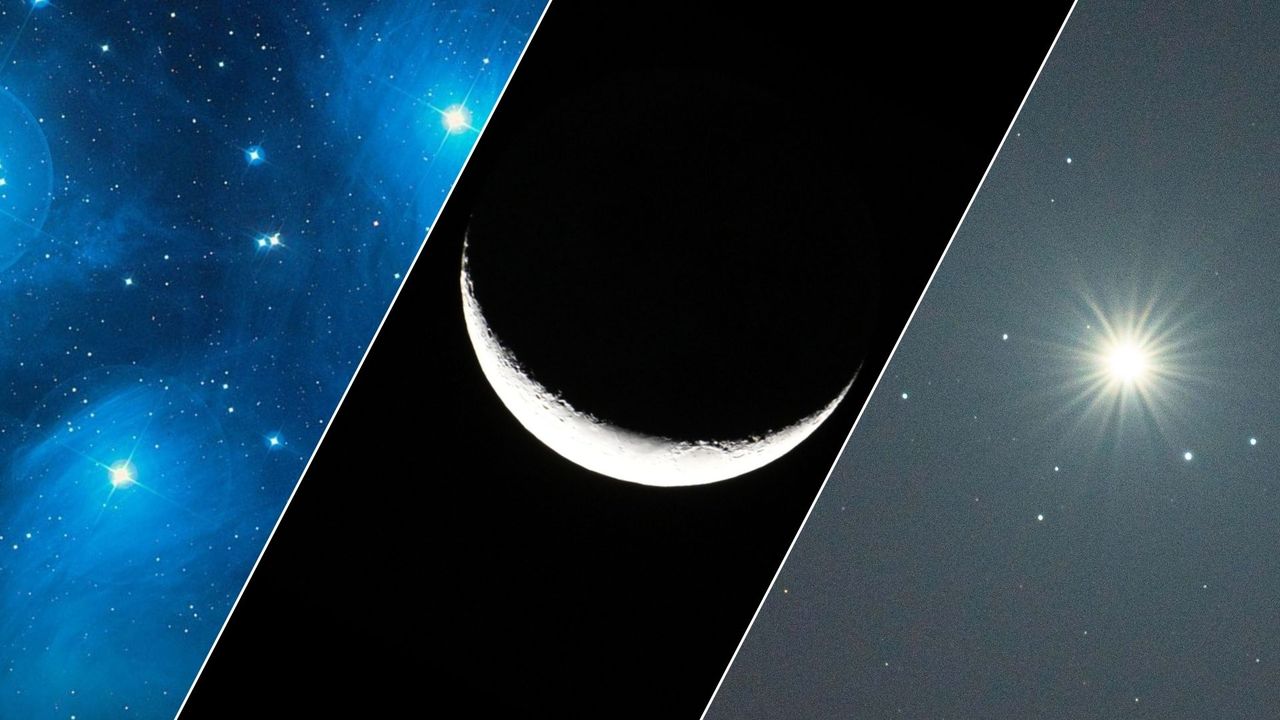
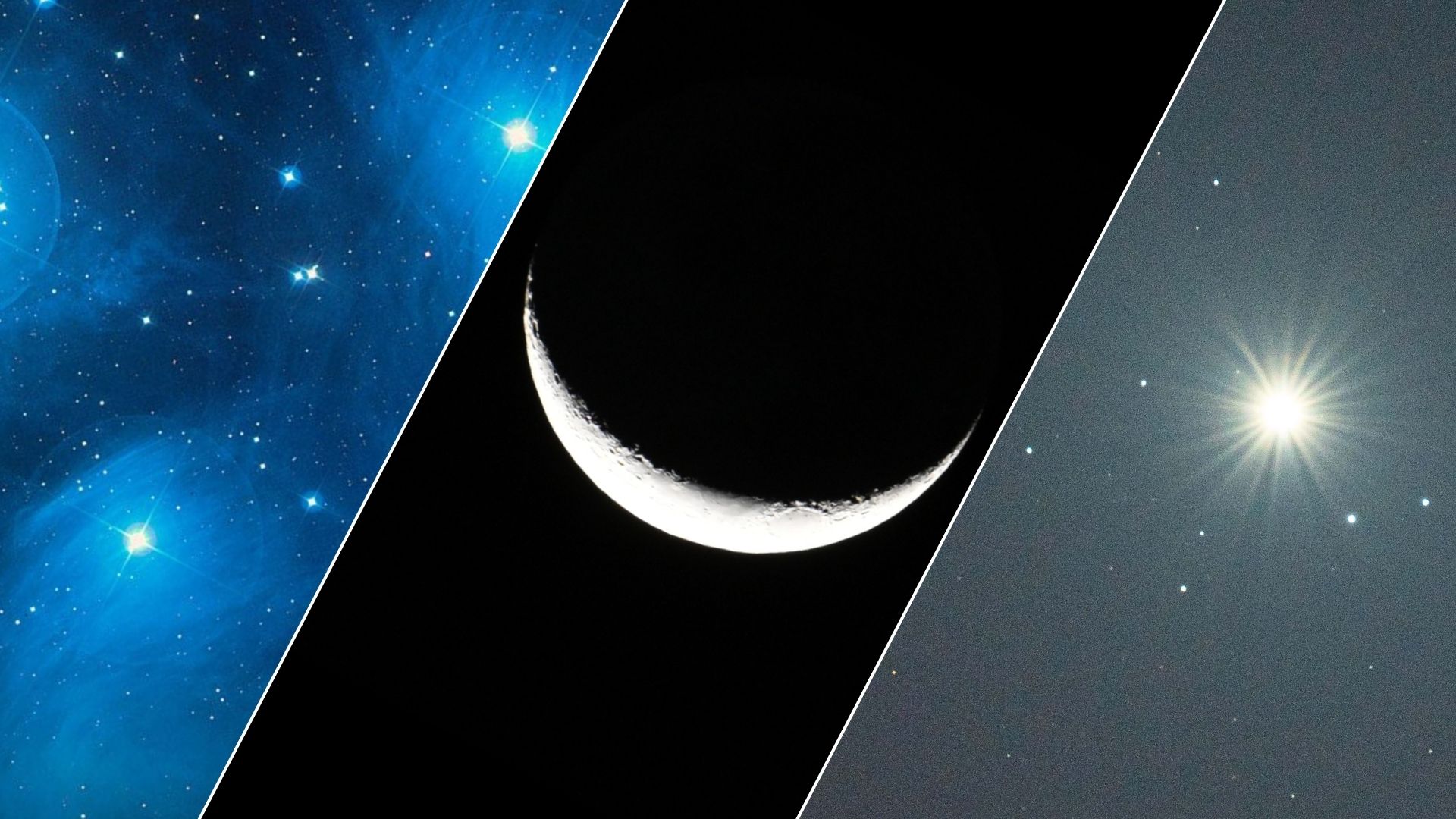
 The crescent moon meets Venus and the Pleiades tonight. (Image credit: Left: NASA, ESA and AURA/Caltech. Middle: Tayfun Coskun/Anadolu via Getty Images. Right: Costfoto/Future Publishing via Getty Images) Share this article 0 Join the conversation Follow us Add us as a preferred source on Google Newsletter Get the Space.com Newsletter
 Breaking space news, the latest updates on rocket launches, skywatching events and more!
Contact me with news and offers from other Future brands Receive email from us on behalf of our trusted partners or sponsors By submitting your information you agree to the Terms & Conditions and Privacy Policy and are aged 16 or over.You are now subscribed
Your newsletter sign-up was successful
Want to add more newsletters?
An account already exists for this email address, please log in. Subscribe to our newsletterLook to the western sky about 30-90 minutes after sunset on April 19 for a fleeting but incredible sight, as the razor-thin crescent moon shines above the Pleiades open star cluster and Venus in the early spring sky.
The upturned 11%-lit waxing crescent moon will shine approximately 20 degrees above the western horizon — the width of two clenched fists held at arm's length — just two days after the new moon on April 17.
Venus will be visible below the moon, appearing as a bright evening star setting just two hours after the sun, so be sure to find a clear view of the western horizon if you hope to see the three striking objects come close to lining up in the evening sky!
How to measure distances in the night sky using nothing but your hand. (Image credit: Created in Canva Pro)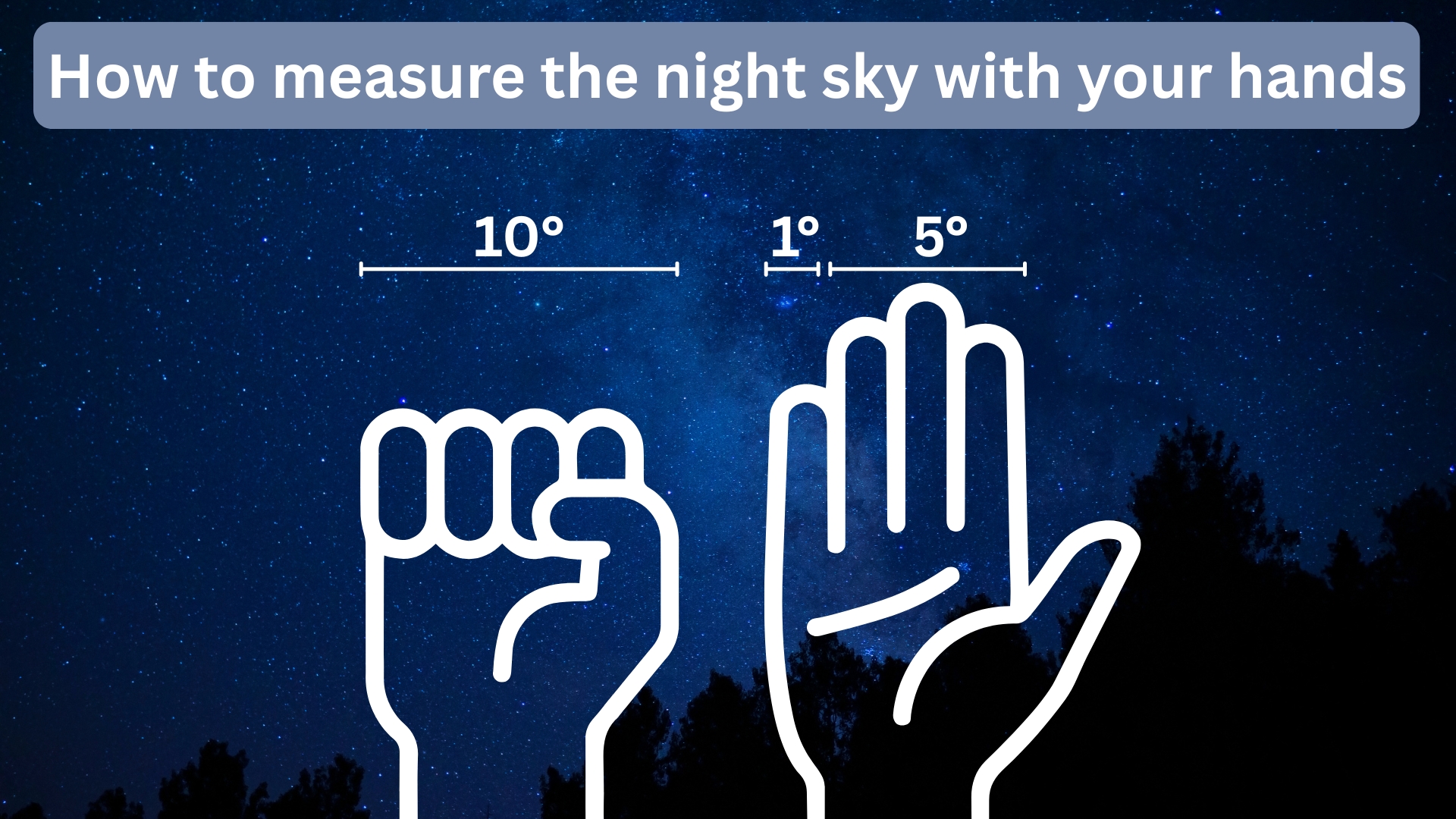
The ice giant Uranus will lurk 5 degrees to the upper right of Venus at a magnitude, or brightness, of just +5.8, making it almost impossible to spot with the naked eye. Its proximity to the horizon will make it even more challenging to spot on the evening of April 19. However, a pair of binoculars or a telescope may allow you to resolve its tiny greenish disk hanging in the blackness of space.
You may notice a soft glow illuminating the shadowed side of the lunar disk as it glides silently towards the horizon, as sunlight bounces off Earth's cloudy surface to strike its natural satellite. The phenomenon — known as "earthshine", the "Da Vinci Glow", or "the old moon in the new moon's arms"- is most easily seen on the nights surrounding the new moon phase, when the angle between the moon and Earth leaves them well positioned to share our sun's light.
Want to see the wonders of the cosmos for yourself but aren't sure where to start? Then why not check out our beginner's guide to stargazing, along with our picks of the best telescopes and binoculars for exploring the post-sunset realm.
Get the Space.com NewsletterContact me with news and offers from other Future brandsReceive email from us on behalf of our trusted partners or sponsorsEditor's Note: If you capture a photo of the moon and Pleiades and want to share it with Space.com's readers, then please send your photo(s), comments, and your name and location to [email protected].
 Anthony WoodSkywatching Writer
Anthony Wood joined Space.com in April 2025 after contributing articles to outlets including IGN, New Atlas and Gizmodo. He has a passion for the night sky, science, Hideo Kojima, and human space exploration, and can’t wait for the day when astronauts once again set foot on the moon.
View MoreYou must confirm your public display name before commenting
Please logout and then login again, you will then be prompted to enter your display name.
Logout MORE FROM SPACE... 1This life-hunting rover may be SpaceX's 1st-ever Mars launch
 - 2Watch live: Blue Origin reusing New Glenn rocket stage for 1st time on April 19 launch
- 3How the 'Project Hail Mary' book walks the line between hard and speculative science fiction… and why the film did not
- 4New moon of April 2026 brings incredible views of the constellation Hydra, Jupiter, Venus and more this week
- 5'Tall waves moving in slow motion': Here's how oily oceans on Saturn's giant moon Titan may behave