 Image source, Getty ImagesByChris Vallance, Senior technology reporter and Liv McMahon, Technology reporter
- Published37 minutes ago
Apple has confirmed it has launched a new legal complaint against the UK government at a court that deals with objections to the use of covert surveillance powers.
The tech giant has not told BBC News what the complaint relates to but the Financial Times, external has reported it is another challenge to a Home Office demand for so-called "backdoor" access to highly encrypted Apple user data.
The row, which centres on the government's desire to be able to see material protected by an advanced data protection system - which currently even Apple itself cannot access - has been rumbling on since early 2025.
The government said it would not comment on legal proceedings or what it called "operational matters".
But it added in a statement: "The UK supports strong encryption and robust privacy protections, but it is also vital that law enforcement can access communications when necessary and proportionate to protect the public from terrorism, serious crime, and child sexual abuse."
Apple has meanwhile referred reporters to a statement given last year, after its initial challenge to the UK government's request.
This said it was "gravely disappointed" it could still not offer its Advanced Data Protection feature to new UK users, following its decision to withdraw it in February 2025.
"As we have said many times before, we have never built a backdoor or master key to any of our products or services and we never will," the company added.
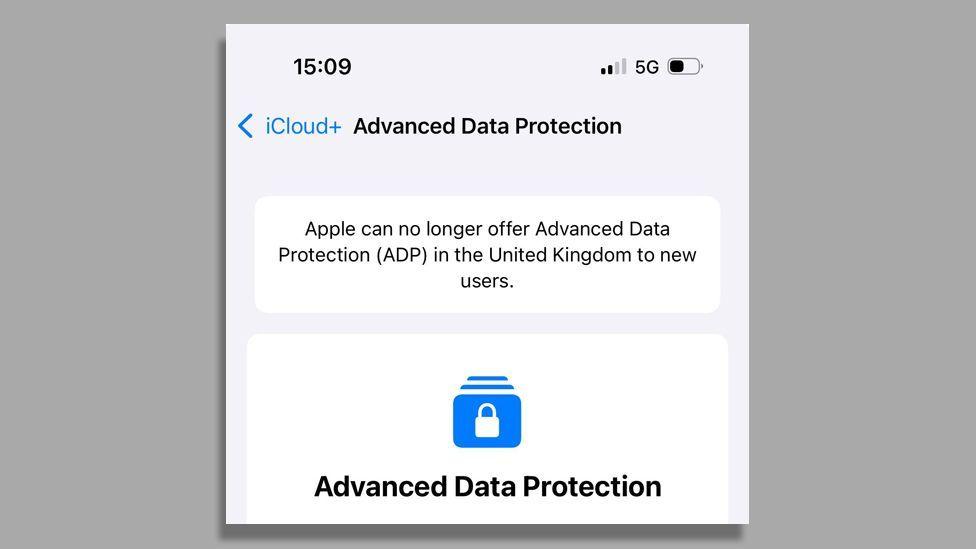 Image source, AppleImage caption,
 Since last February, UK iPhone users have been met with a notice on the Advanced Data Protection settings page which says the tool cannot be enabled.
Advanced Data Protection is an opt-in feature that allows users to turn on a higher level of protection for data stored in iCloud, such as back-ups, Drive storage, photos and voice memos.
It is secured using end-to-end encryption - meaning not even Apple would be able to see its contents.
The government's requests for Apple to permit it access to data held under this system were issued under the Investigatory Powers Act (IPA).
It includes powers allowing the government to issue secret notices - called technical capability notices - which can secretly force companies to provide UK security services with ways to access customer data.
The government had fought unsuccessfully to keep legal challenges to its first notice to Apple secret.
Its notice was later withdrawn after angering US politicians, who were concerned it would affect their own citizen's data.
But the government issued a new request in October which did not apply to US users.
Privacy groups which previously campaigned against its secret orders welcomed Apple's new legal complaint.
"We are happy to learn that Apple is once again challenging the UK's regime of secret orders," said Privacy International.
"While we don't know the substance of Apple's claim, if it relates to the previously reported orders aimed at undermining the security of Apple's iCloud storage, then Apple's claim, alongside side ours and Liberty's, is crucially important to preserving all of our privacy and security."
Ruth Ehrlich, director of external relations at Liberty, said the case was "hugely important" and has "far-reaching implications for the public's privacy rights well into the future".
"End-to-end encryption is an essential security tool that protects our personal data, including our bank details, health information, private conversations and images," she said.
"Opening a backdoor to all of that information carries a wide range of risks to our personal data. It is critical that the Government listens to the many concerns and commits to protecting our privacy rights."
But Sir Brian Leveson, the Investigatory Powers Commissioner, who provides independent oversight of the use of surveillance powers, has previously criticised media use of the term "backdoor", external.
He said notices such as those concerned in this case would only be issued "if the Secretary of State deems it necessary and proportionate, and this decision is independently reviewed and approved by a Judicial Commissioner".
He added requests for data would also require separate authorisation under the IPA and these would be subject to independent oversight.

Sign up for our Tech Decoded newsletter to follow the world's top tech stories and trends. Outside the UK? Sign up here.
Related topics
What Apple pulling Advanced Data Protection means for you
- Published26 February 2025
US politicians furious at UK demand for encrypted Apple data
- Published14 February 2025
Court documents shed new light on UK-Apple row over user data
- Published29 August 2025