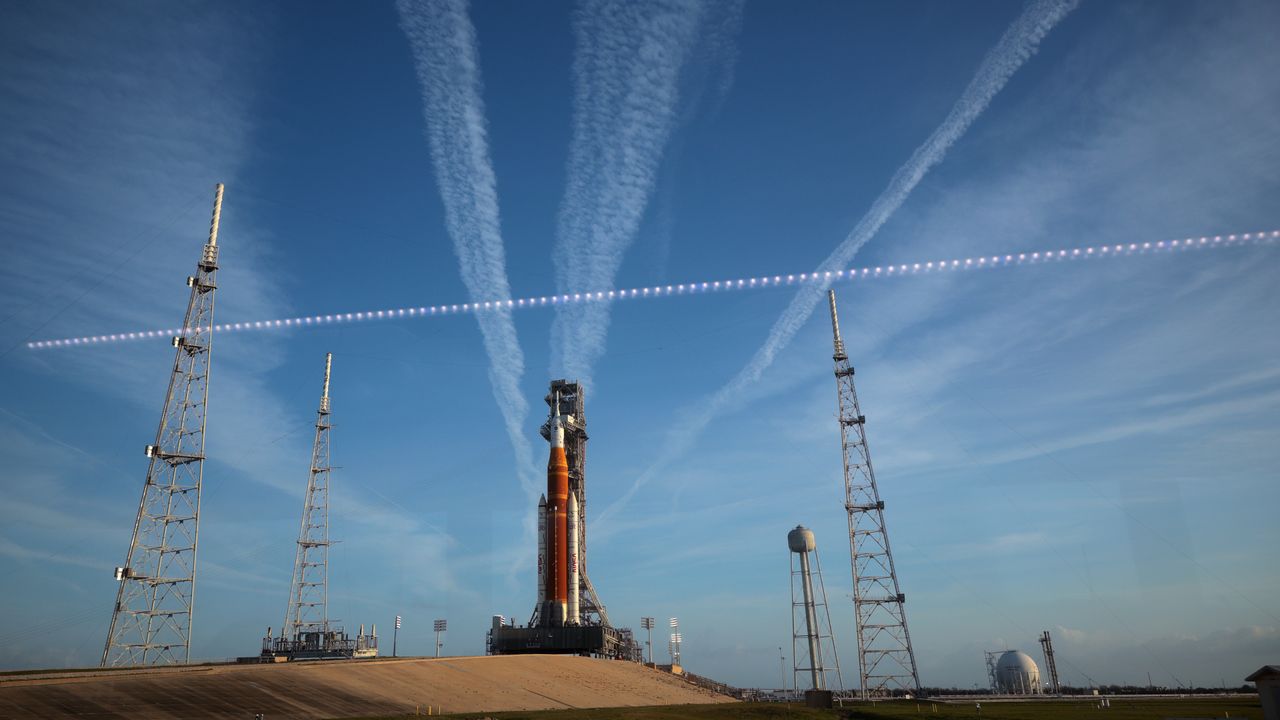
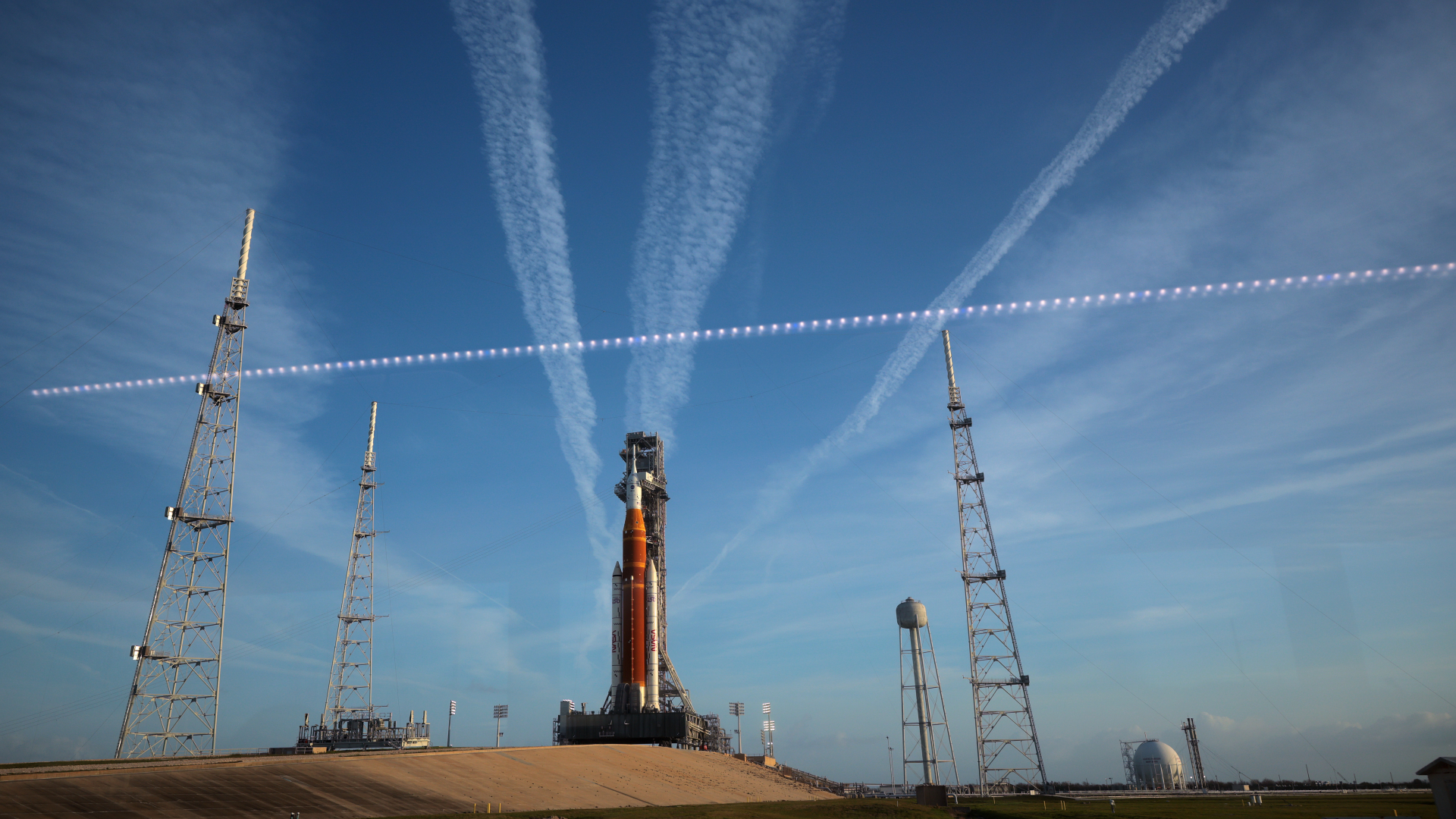
 The Artemis II rocket sits on launchpad 39B at Kennedy Space Center in Florida (Image credit: Chip Somodevilla via Getty Images) Share this article 0 Join the conversation Follow us Add us as a preferred source on Google Newsletter Sign up for the Live Science daily newsletter now
 Get the world’s most fascinating discoveries delivered straight to your inbox.
Become a Member in Seconds
Unlock instant access to exclusive member features.
Contact me with news and offers from other Future brands Receive email from us on behalf of our trusted partners or sponsors By submitting your information you agree to the Terms & Conditions and Privacy Policy and are aged 16 or over.You are now subscribed
Your newsletter sign-up was successful
Want to add more newsletters?
Join the club
Get full access to premium articles, exclusive features and a growing list of member rewards.
Explore An account already exists for this email address, please log in. Subscribe to our newsletterNASA's Artemis II mission remains on track for its planned April 1 launch, the space agency announced in a prelaunch news conference Tuesday (March 31).
At the news event, held at the Kennedy Space Center in Florida, NASA managers emphasized that both the vehicle and team are ready to fly, with current conditions not pointing to any major last-minute technical concerns. The briefing also broke down the two biggest possible spoilers of tomorrow's launch :the weather on the ground and in space.
However, Mark Berger, NASA's Launch Weather Officer for the Artemis II mission, highlighted that the flare is not currently expected to affect the launch. Artemis launch criteria is designed to avoid liftoff during severe solar conditions, but based on the latest outlook, this flare appears to be something NASA is monitoring rather than something that is stalling the launch.
"There is nothing here screaming 'no go' for any of these attempts," Berger said at the prelaunch conference.
That leaves Earth's weather as the more pressing concern. NASA's latest forecast heading into launch day called for an 80% chance of favorable weather, with high ground winds as the main issue. Berger mentioned that some precipitation could occur on launch day, but shouldn't be an issue.
"It looks pretty good," Berger added.
Sign up for the Live Science daily newsletter nowContact me with news and offers from other Future brandsReceive email from us on behalf of our trusted partners or sponsorsRELATED STORIES—Artemis II: NASA is preparing for a return to the moon, but why is it going back?
The prelaunch news conference also invited some lighthearted curiosity about whether anyone might try to sneak an April Fool's joke into the countdown. NASA did not indicate at the conference that it was aware of any jokes or stunts in the works, but the agency hardly lacks a history of mischief. As one example, NASA astronaut Owen Garriott performed a legendary prank on Mission Control while at Skylab, where he played a prerecorded conversation that sounded like his wife Helen had stowed away onboard. In another prank, NASA astronaut John Young smuggled a corn beef sandwich aboard Gemini III.
For Artemis II though, the tone coming out of the conference was more focused on the launch ahead as NASA attempts to return to the moon.
"Everybody understands the significance of this mission," Jeff Spaulding, senior test director for the Artemis II program at NASA's Kennedy Space Center, said in the briefing. "There's a lot of excitement and fervor with all of the [NASA] groups out there, but especially here at Kennedy."
Test your knowledge of previous astronauts that have gone to the moon with our moon landing quiz!
TOPICS Kenna Hughes-CastleberryContent Manager, Live Science
Kenna Hughes-Castleberry is the Content Manager at Live Science. Formerly, she was the Content Manager at Space.com and before that the Science Communicator at JILA, a physics research institute. Kenna is also a book author, with her upcoming book 'Octopus X' scheduled for release in spring of 2027. Her beats include physics, health, environmental science, technology, AI, animal intelligence, corvids, and cephalopods.
View MoreYou must confirm your public display name before commenting
Please logout and then login again, you will then be prompted to enter your display name.
Logout LATEST ARTICLES 1'It blew my mind': Long-lost ice-age ecosystem, including fossils of lion-size armadillo and giant ground sloth, discovered in Texas 'water cave'
- 2China's huge push to reduce air pollution had an unexpected consequence in the Arctic
- 3Scientists have discovered an 'Achilles' heel' in deadly superbugs
- 4Snag this Paramount+ deal and get a bird's-eye view of the world with these amazing documentaries — but be quick, it ends today!
- 5Quantum computers need just 10,000 qubits — not the millions we assumed — to break the world's most secure encryption algorithms