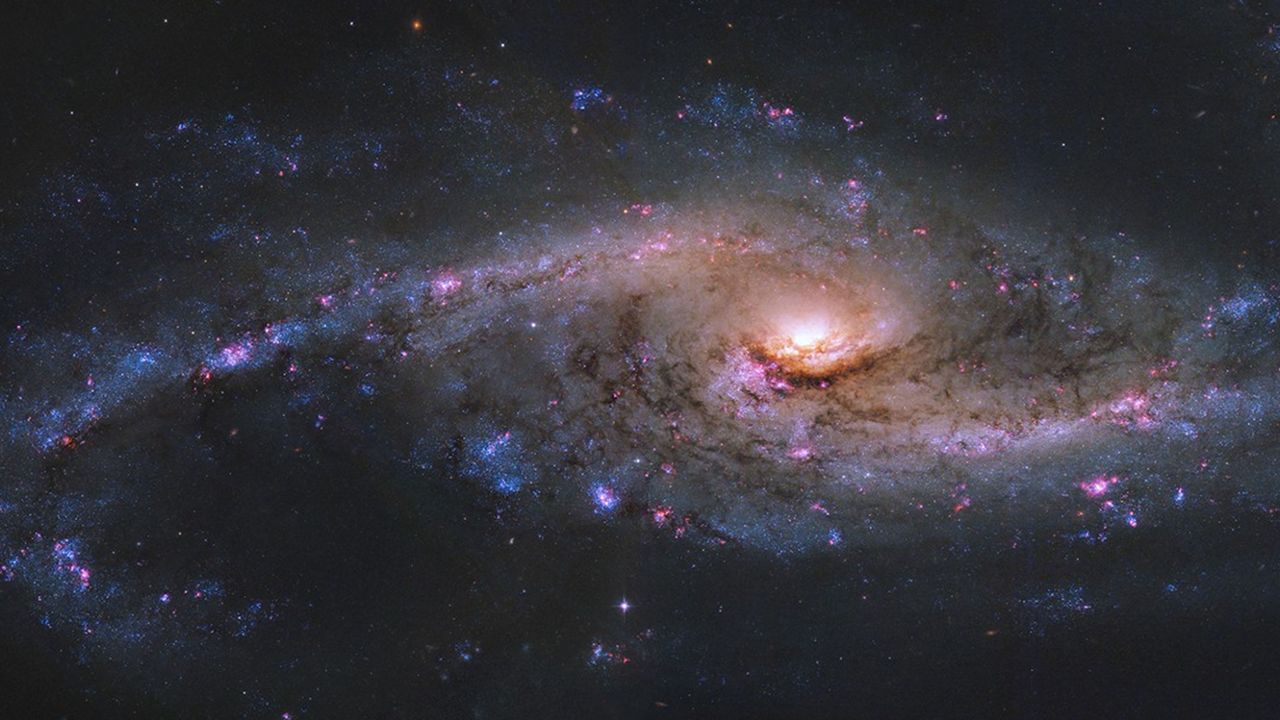
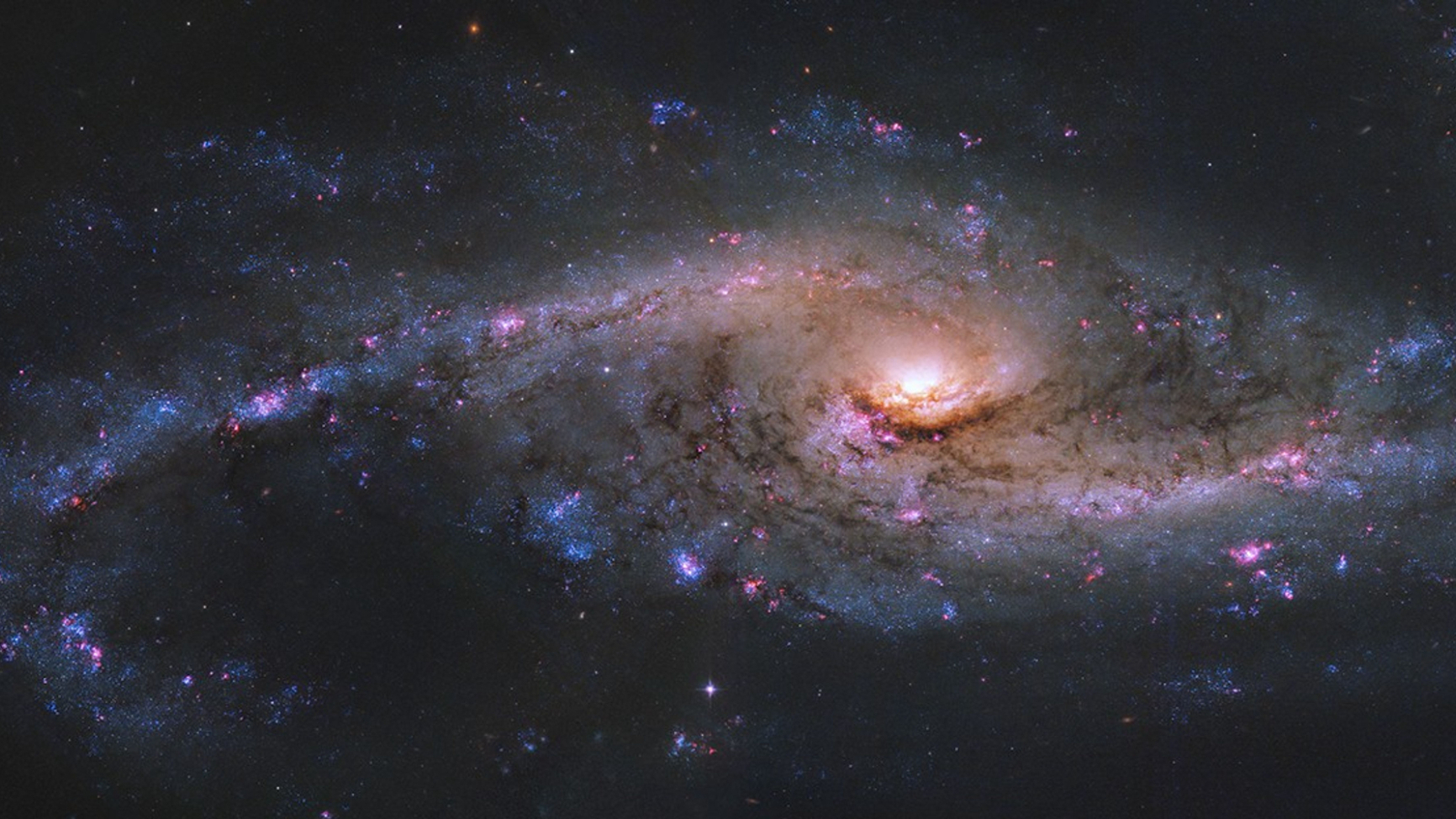
 The starburst galaxy NGC 4536, seen here in a photo by the Hubble Space Telescope, has bright blue clusters of baby stars and pink clumps of ionized hydrogen gas speckled throughout its sweeping spiral arms. (Image credit: NASA, ESA, and J. Lee (Space Telescope Science Institute); Processing: Gladys Kober (NASA/Catholic University of America)) Share this article 0 Join the conversation Follow us Add us as a preferred source on Google Newsletter Get the Space.com Newsletter
 Breaking space news, the latest updates on rocket launches, skywatching events and more!
Contact me with news and offers from other Future brands Receive email from us on behalf of our trusted partners or sponsors By submitting your information you agree to the Terms & Conditions and Privacy Policy and are aged 16 or over.You are now subscribed
Your newsletter sign-up was successful
Want to add more newsletters?
An account already exists for this email address, please log in. Subscribe to our newsletterA galaxy dying is not a gentle thing. Its star-making factories, once churning out millions of suns, grind to a halt. Rather than a slow fade, it's a sudden, striking shutdown, a phenomenon astronomers call rapid quenching.
Such phenomena are the mysteries of what we call post-starburst galaxies, which present some of the most compelling, yet often overlooked, stories unfolding across the universe. For astronomers, such systems are like cosmic crime scenes. They recently had a massive burst of star formation — a party of epic proportions — but now show almost no new stars being born. It's like finding a ballroom where the music just stopped, the lights went out, and everyone left in a hurry. The scene leaves us wondering about the sudden emptiness. And about the astonishing speed of their exit.
To truly understand what happens when a galaxy suddenly stops forming stars, we need to know what fuels star formation in the first place: gas. Cold gas, to be precise. You see, stars don't just appear out of nowhere; they're born from dense, chilly clouds of molecular hydrogen. If a galaxy runs out of this molecular gas, or if the gas gets disrupted and can't coalesce, star formation shuts down. Simple, right?
Not so fast. Previous studies on these fascinating, transitioning galaxies were a bit of a hodgepodge. They used inconsistent selection criteria, had varying sensitivities in their observations, and often worked with samples that were just too small to give us a clear, unified picture. It meant we had conflicting clues, and no coherent narrative for our cosmic whodunit. Some even suggested galaxies could still be chock-full of gas but somehow not forming stars, which would be a real head-scratcher for anyone trying to understand stellar nurseries.
Other researchers, though, showed that many of those seemingly gas-rich, quiet galaxies actually had star formation going on, just hidden behind thick clouds of dust, appearing "obscured" in optical observations. So, the picture was fuzzy, to say the least, and left a big hole in our understanding.
Enter the EMBERS I study, a truly clever piece of astronomical detective work. Led by Ben F. Rasmussen from the University of Victoria and his colleagues from institutions like the Space Telescope Science Institute and the University of St. Andrews, this team decided it was time for a comprehensive, multi-pronged attack on the problem. They set out to perform the first uniform assessment of both atomic and molecular gas in a large, well-selected sample of post-starburst galaxies. It's like bringing in the full CSI team after years of relying on a single, blurry photograph.
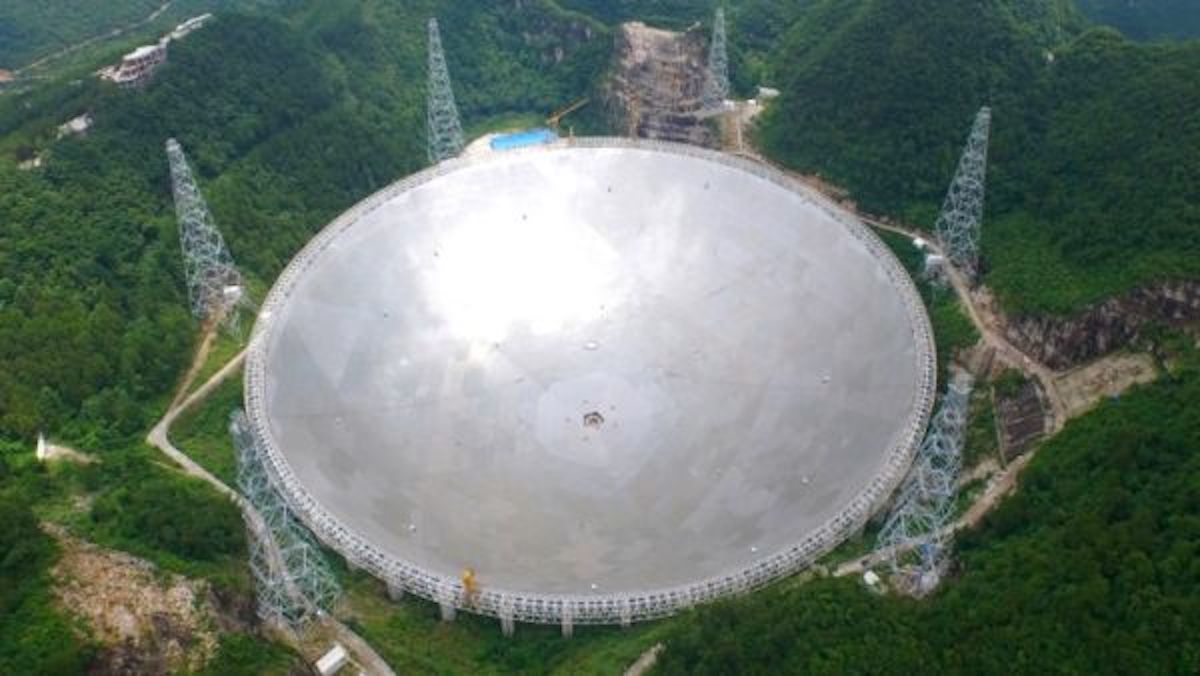
Get the Space.com NewsletterContact me with news and offers from other Future brandsReceive email from us on behalf of our trusted partners or sponsorsThey started with a list of 114 candidate galaxies pulled from the Sloan Digital Sky Survey, carefully picked out based on their stellar mass and distance. Then came the heavy lifting: staring at these galaxies for a really, really long time. To sniff out the atomic hydrogen — the more diffuse, cooler gas that acts as the initial, sprawling reservoir for future star formation — the team harnessed the immense power of China's Five Hundred-metre Aperture Spherical Telescope (FAST). That's a whopping 500-meter--wide (1,640-foot) dish, ideal for picking up faint signals from far away.
But the real star-making fuel is molecular hydrogen, and that's much harder to spot directly. So, astronomers use a trusty tracer: carbon monoxide, or CO. Think of it like a smoke detector for molecular clouds; where there's CO, there's likely H2 ready to collapse and form stars. To measure this CO emission, Rasmussen and his colleagues spent an astounding 188.9 hours, split across four different observation proposals, using the IRAM 30-meter telescope. That's a lot of late nights and early mornings staring at the sky. They obtained 52 new observations, combining them with nine archival ones for their total sample of 61 galaxies.
The big reveal is that, on average, post-starburst galaxies are indeed depleted in molecular hydrogen compared to their actively star-forming progenitors. We're talking about a significant drop — somewhere between 0.3 to 0.6 times less molecular gas than what you'd find in galaxies of similar stellar mass that are still cranking out stars. This strongly suggests that a key mechanism for rapid quenching is a galaxy simply running out of its star-forming fuel.
In other words, the party ends because the cosmic snack bar is empty.
But here's where the story gets really interesting, and less straightforward. This isn't to say every single post-starburst galaxy is totally barren. The study found a striking diversity in their cold gas reservoirs. Some of these galaxies, even after their dramatic starburst shutdown, still had molecular gas fractions ranging from a modest 2% of their stellar mass all the way up to a whopping 250% in the detected cases.
So, while the average post-starburst galaxy is indeed gas-starved, the individual stories are far more complex. This diversity has huge implications for understanding galactic evolution. It means there isn't just one universal rapid shutdown mechanism. For some galaxies, the shutdown might be irreversible, a truly permanent end to star formation, likely due to severe gas loss. For others, particularly those that retain a good chunk of gas, there's a tantalizing possibility of rejuvenation — a second act, where star formation could kick off again, albeit temporarily, leading to a temporary cessation rather than a terminal one.
 Paul SutterSpace.com Contributor
Paul M. Sutter is a cosmologist at Johns Hopkins University, host of Ask a Spaceman, and author of How to Die in Space.
View MoreYou must confirm your public display name before commenting
Please logout and then login again, you will then be prompted to enter your display name.
Logout MORE FROM SPACE... 1Watch Russia launch 3 tons of cargo to the International Space Station today
- 2How did humanity end up underground in 'Silo'? Apple TV digs deep in new Season 3 teaser (video)
- 3This X-ray image shows our solar system 'breathing'
- 4Viltrox AF 50mm f/1.4 Pro FE lens review
- 5How did the USSR win the space race to beat the US to the moon in Apple TV's new 'Star City'?