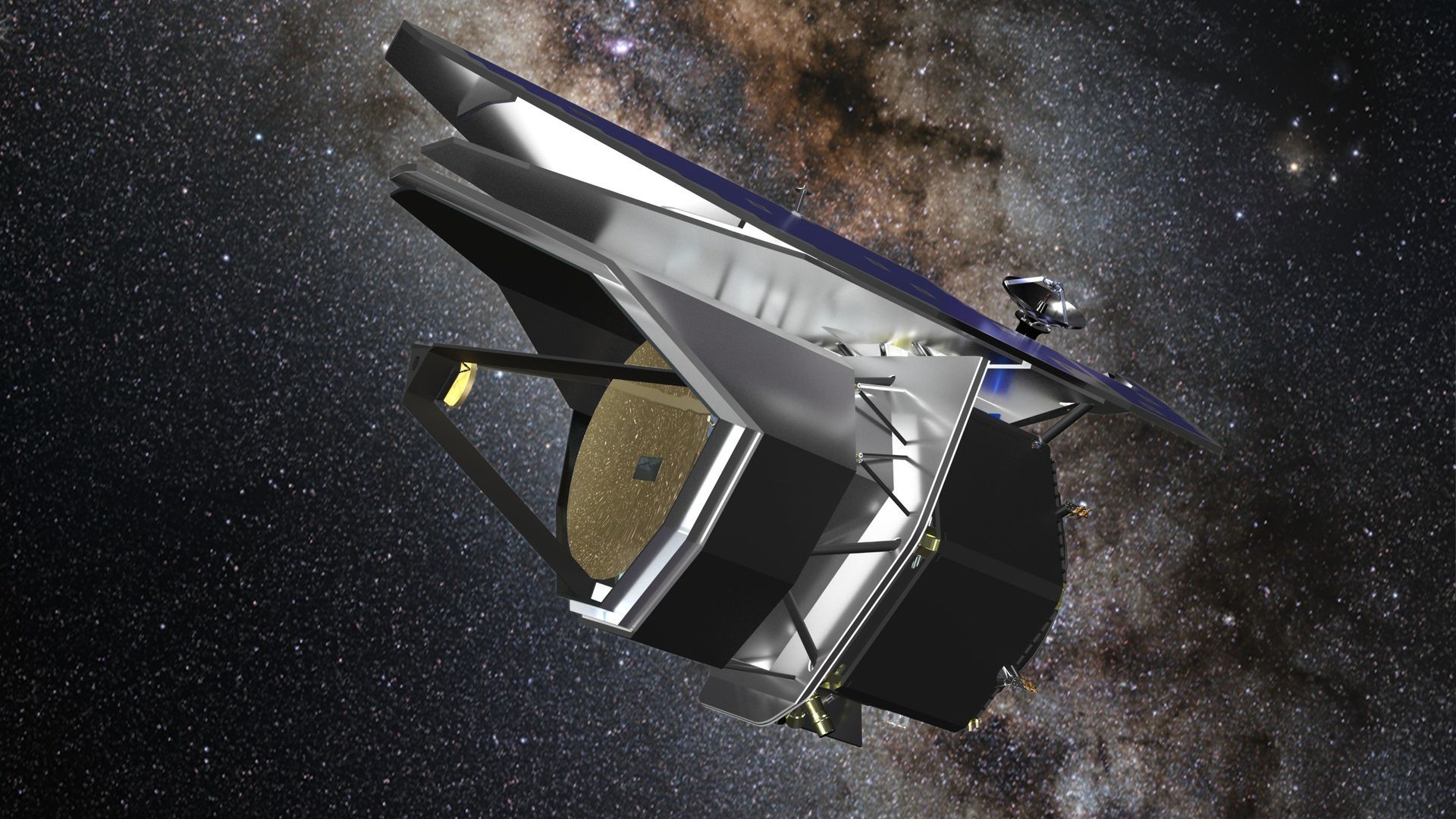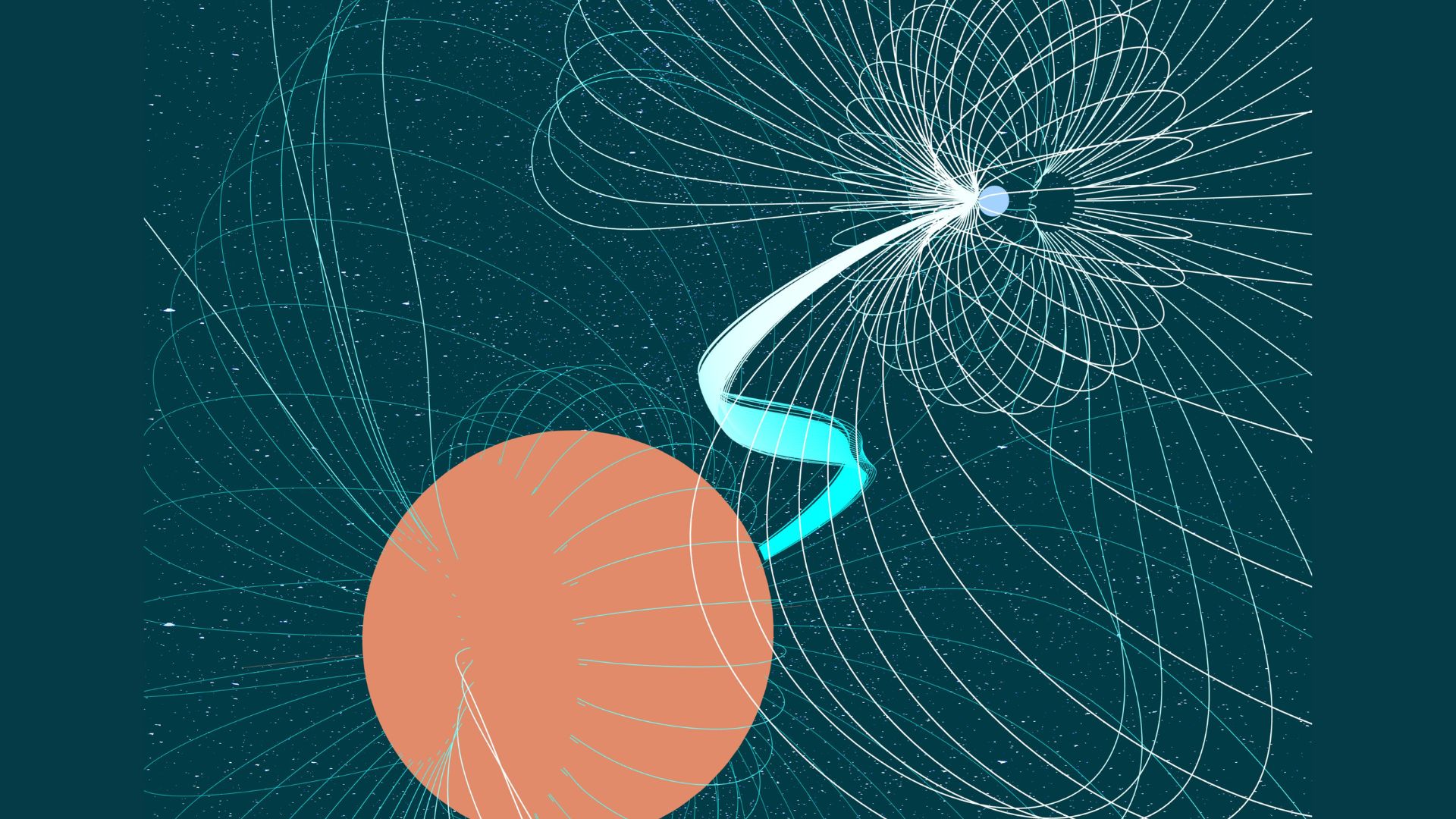
An illustration of a white dwarf star pulling matter off of its companion. Such a process could explain mysterious bursts of radio energy that have been puzzling astronomers. (Image credit: Carl Knox (OzGrav/Swinburne) and Dr. Joshua Preston Pritchard (CSIRO))
Share this article Join the conversation
Follow us Add us as a preferred source on Google Newsletter Subscribe to our newsletter
A pair of spiralling stars could be a blueprint for decoding mysterious bursts of radio energy coming from space, according to new research.
Long-period transients have puzzled radio astronomers since they were first detected in 2022. These objects emit strong pulses of radiation every few minutes or hours, each burst lasting only a few seconds. They are much slower than the likes of fast radio bursts, which are intense bursts of energy that flicker for mere milliseconds.
There are many theories about what these transients are and what powers them. It's possible they are slowly rotating remnants of dead stars (pulsars) or the revolving cores of collapsed stars (white dwarfs). Previous work on other long-period transients has suggested that they could be white dwarfs in a slow dance with another object.
Now, a recent study published Jun. 1 in the journal Nature Astronomy argues that a newly discovered long-period transient named ASKAP J1745−5051 is a type of star system called a magnetic cataclysmic variable. This type of variable is a binary system, in which a white dwarf is stripping material off its companion star. It is the first time a long-period transient has been confirmed in an accreting system, where one object is stealing material from another.
The discovery is "a Rosetta Stone to help us decipher the missing bits of information in other long-period transients, both in the dozen or so that we've discovered, and the new ones that we're going to keep discovering," Kovi Rose, lead author on the study and a doctoral candidate at the University of Sydney, told Live Science. (The Rosetta Stone is an ancient Egyptian slab of stone that helped scholars to decipher hieroglyphics.)
Something unexplained
Rose analyzed more than 3 million sources of radio waves using the Australian SKA Pathfinder telescope (ASKAP), and whittled that number down to 100 sources whose light was circularly polarised, meaning it corkscrews as it travels toward Earth.
Out of those candidates, there were two objects Rose couldn't immediately identify. The first turned out to be an ultra-cool brown dwarf, which is only as hot as a pizza oven. The second was ASKAP J1745−5051. It was "something we couldn't explain, and when we eventually managed to explain it, it was more interesting than we could have hoped for," Rose said.
Sign up for the Live Science daily newsletter now
Get the world’s most fascinating discoveries delivered straight to your inbox.
Contact me with news and offers from other Future brandsReceive email from us on behalf of our trusted partners or sponsors
Using data from several radio telescopes, as well as optical and X-ray observations, Rose and collaborators showed that the object produces powerful bursts of radiation in both radio waves and X-rays every 1.3 hours. The object is more than a thousand light-years away.
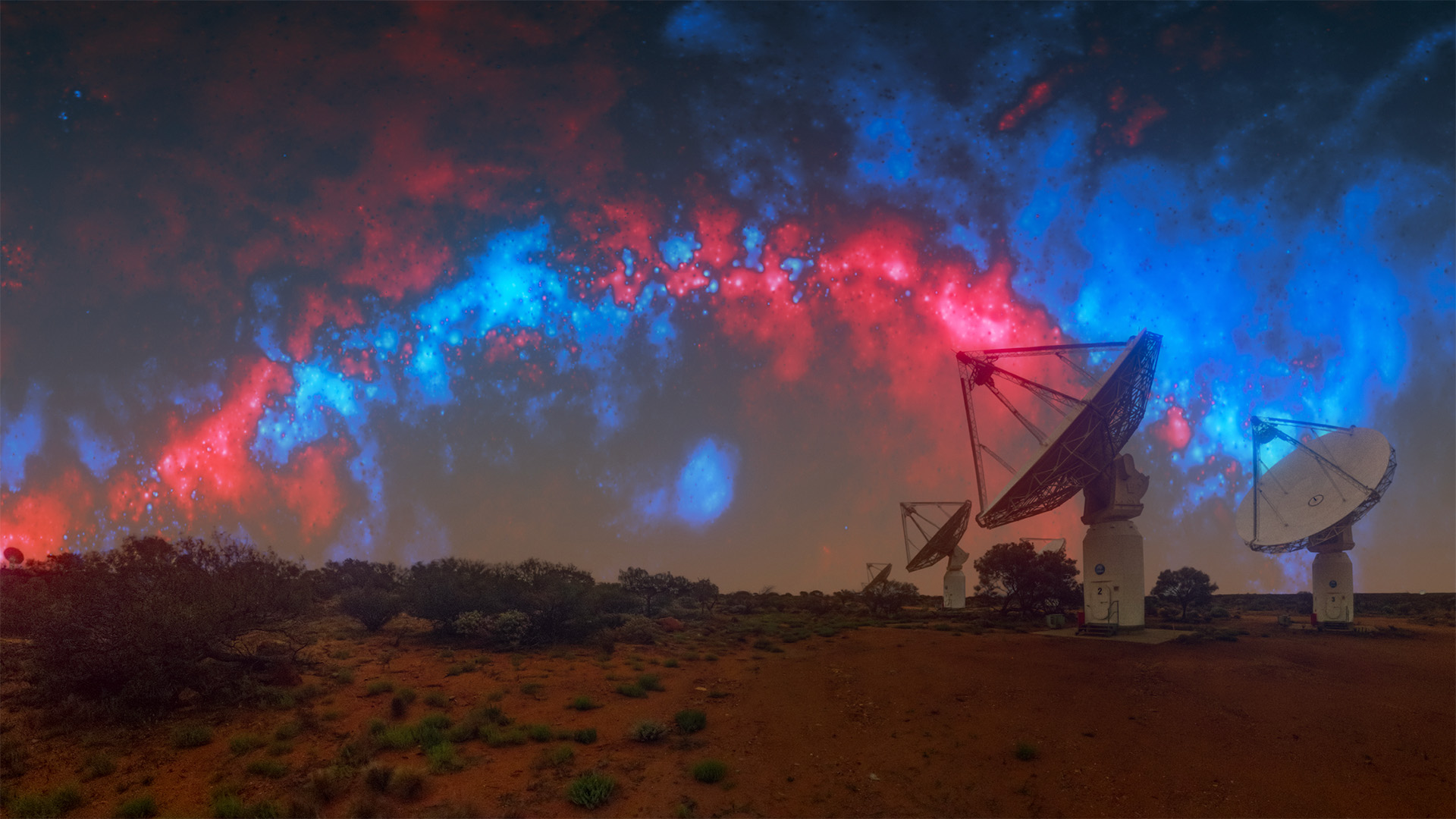
The ASKAP radio telescope (foreground) seen over a radio view of magnetic fields in the night sky (background). The array was instrumental in decoding the radio signals observed in the new study.
(Image credit: CSIRO/Alec Thomson et al./Alex Cherney/Sam Moorfield)
"You’d see these beautiful pairs of pulses – pulse-pulse, pulse-pulse, pulse-pulse, and then it switched off," Rose explained.
However, there were a few strange features in the system that have helped researchers uncover what is behind the periodic signals.
For one thing, the radio waves and X-rays peaked at different times, showing that they originate in different parts of the system, Rose said. The team argued that the radio emissions are produced when the stars' magnetic fields meet and interact with the material that is being stripped off the smaller star. This material emits X-rays as it is heated up by the white dwarf.
Further analysis showed that the emissions pointed to the presence of helium and hydrogen, and they drifted in frequency. "The wavelengths would shift to higher frequencies and then back to lower frequencies, which is a tell-tale sign of a binary system," Rose said. That was a "smoking gun," indicating that it was two stars circling each other.
"This paper gives us a strong connection for at least some long period transients with white dwarf binary systems," Marcin Glowacki, an astronomer with the Royal Observatory, Edinburgh at the University of Edinburgh who was not involved in the research, told Live Science in an email. "We also see new behavior in this [transient], which has only been seen in one other [transient] to date, with emission drifting up and down in frequency. This behavior can give us important clues on the immediate plasma or accretion environment" of this long-period transient.
However, he was surprised that ASKAP J1745−5051 was identified as a cataclysmic variable. "As the paper states, 50 other cataclysmic variables have been seen to produce radio emissions, but none with periodic behavior as seen here and they are typically much fainter."
Related stories
Patrick Woudt, an astronomer at the University of Cape Town in South Africa who specializes in cataclysmic variables and who was not part of the study, told Live Science in an email that ASKAP J1745-5051 provided a bridge between long-period transients and cataclysmic variables.
"ASKAP J1745-5051 is a few orders of magnitude brighter than the compact variables observed at radio frequencies, so what makes ASKAP J1745-5051 so unique amongst the magnetic CVs?" he asked. "That is a very interesting question to address with future observations, not only at radio frequencies, but also at UV, optical, X-ray wavelengths."
Going forward, Rose said that he plans to investigate ASKAP J1745−5051's X-ray behavior and further characterize the system to find out what other secrets it's keeping.
Article Sources
Rose, K., Pritchard, J., Murphy, T., Driessen, L. N., Kaplan, D. L., Caleb, M., Wang, Z., Zic, A., Andreoni, I., Carney, J., Barlow, B. N., Dobie, D., Gu, M., Heald, G., Huber, D., Lenc, E., Leung, J. K., Lu, W., Momose, R., . . . Zahedy, F. (2026). Periodic radio and X-ray emission from an accreting white dwarf binary. Nature Astronomy. https://doi.org/10.1038/s41550-026-02882-x
 Sarah Wild
Live Science Contributor
Sarah Wild is a British-South African freelance science journalist. She has written about particle physics, cosmology and everything in between. She studied physics, electronics and English literature at Rhodes University, South Africa, and later read for an MSc Medicine in bioethics.
Since she started perpetrating journalism for a living, she's written books, won awards, and run national science desks. Her work has appeared in Nature, Science, Scientific American, and The Observer, among others. In 2017 she won a gold AAAS Kavli for her reporting on forensics in South Africa.
View More
You must confirm your public display name before commenting
Please logout and then login again, you will then be prompted to enter your display name.
Logout