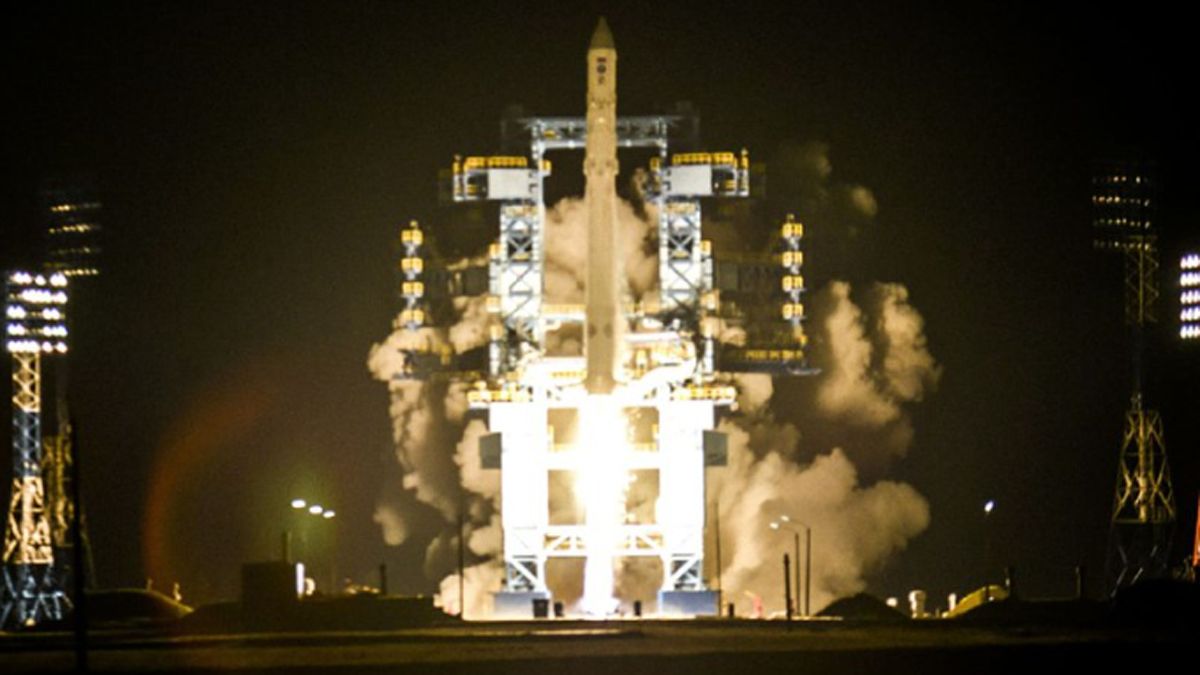
 An Angara rocket launches the COSMOS 2560 satellite from Plesetsk Cosmodrome on Oct. 15, 2022. Another trio in the COSMOS series — COSMOS 2581, 2582 and 2583 — launched in February 2025 and has performed sophisticated rendevzous operations in orbit. (Image credit: Roscosmos) Share this article 0 Join the conversation Add us as a preferred source on Google Newsletter Subscribe to our newsletter
 Two Russian spacecraft just demonstrated a very particular set of orbital skills.
The satellites, known as COSMOS 2581 and COSMOS 2583, got within just 10 feet (3 meters) or so of each other on April 28, according to COMSPOC, a Pennsylvania-based space situational awareness company.
"This wasn't a coincidental pass — COSMOS 2583 performed several fine maneuvers to maintain this tight configuration," COMSPOC wrote in a May 1 X post, which featured an animation of the rendezvous.
🛰️Russian satellites multi-object proximity event in LEORadar tracking data via @LeoLabs_Space, processed through COMSPOC SSA Suite.This week we observed a complex proximity event involving Russian satellites: COSMOS 2581, 2582, 2583, and Object F (a subsatellite released by… pic.twitter.com/3nDkcOmTuDMay 1, 2026
The two satellites and a third one, COSMOS 2582, launched to low Earth orbit in February 2025 atop a Soyuz rocket. According to COMSPOC, all three of them were involved in the recent rendezvous and proximity operations (RPO), as was "Object F," a subsatellite previously deployed by COSMOS 2583.
During the 10-foot close approach, "COSMOS 2582 trailed the formation at sub-100 km range, while Object F passed within 15 km of 2582 and within 10 km of 2581 — neither maneuvered," wrote COMPSOC, which analyzed radar tracking data gathered by the California company LeoLabs.
"For context: in late 2025 to now, we tracked these same COSMOS satellites performing 3-object RPO," COMSPOC added in the May 1 X post. "Whatever Russia is testing, it's sophisticated."
Such sophisticated orbital maneuvering is not exactly surprising; we've seen similar things from Russia before. For example, according to outside observers, the nation has operated multiple "inspector satellites," including COSMOS 2542, which made a close approach to a U.S. spy satellite in 2020.
The other major space powers have such capabilities as well. American and Chinese satellites have also been observed checking out other nations' spacecraft high above Earth.
View MoreYou must confirm your public display name before commenting
Please logout and then login again, you will then be prompted to enter your display name.
Logout Mike WallSpaceflight and Tech Editor
Michael Wall is the Spaceflight and Tech Editor for Space.com and joined the team in 2010. He primarily covers human and robotic spaceflight, military space, and exoplanets, but has been known to dabble in the space art beat. His book about the search for alien life, "Out There," was published on Nov. 13, 2018. Before becoming a science writer, Michael worked as a herpetologist and wildlife biologist. He has a Ph.D. in evolutionary biology from the University of Sydney, Australia, a bachelor's degree from the University of Arizona, and a graduate certificate in science writing from the University of California, Santa Cruz. To find out what his latest project is, you can follow Michael on Twitter.