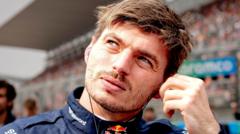
To play this video you need to enable JavaScript in your browser.
This video can not be played
Media caption,Maybe Verstappen needs a break from F1? - Hill
ByAndrew BensonF1 Correspondent in Suzuka- Published1 hour ago
- 346 Comments
Max Verstappen said after the Japanese Grand Prix that he was considering quitting Formula 1 - and then said that the bosses of the sport "know what to do" to keep him in it.
Verstappen's issue is with the new rules. He has been clear all year that the new form of driving and racing the new hybrid engines have created is not to his taste. And he repeated that opinion after the race in Suzuka, as well as before it.
The four-time champion said he was "not enjoying the whole formula behind it, it doesn't feel natural to a racing driver".
He added: "Of course I try to adapt to it, but it's not nice the way you have to race. It's really anti-driving. Then at one point, yeah, it's just not what I want to do."
Verstappen made it clear in the interview with BBC Sport in which he made his powerful remarks that his opinion was not based on his lack of competitiveness this season as his Red Bull team struggle.
That will be bad news for Red Bull team principal Laurent Mekies, who said that he and Verstappen were "focusing on the competitive picture" and "having zero discussions about the other aspects".
Mekies added: "I'm sure by the time we give him a fast car, he will be a much happier Max. And by the time we give him a car he can push and make the difference with, he will also be a happier Max."
Verstappen is the most outspoken of the drivers about the new rules, but he is far from the only one unhappy. Most of the drivers have misgivings on one level or another.
Before Japan, the general consensus among F1 bosses seemed to be that the new power-units and their 50-50 split between internal combustion and electrical power, and consequent focus on energy management, had had a beneficial impact on racing.
But it was accepted that they had had a detrimental effect on qualifying - where the drivers have almost universally complained that energy recovery was diminishing the challenge of some of the sport's fastest corners by lowering the speeds they take through them because of the need to recover energy.
However, the Japanese race highlighted a problem about which drivers have been warning in racing, too.
Haas' Oliver Bearman had a frightening high-speed crash at Spoon Curve, caused by a 50km/h speed differential between his car and that of Franco Colapinto's Alpine.
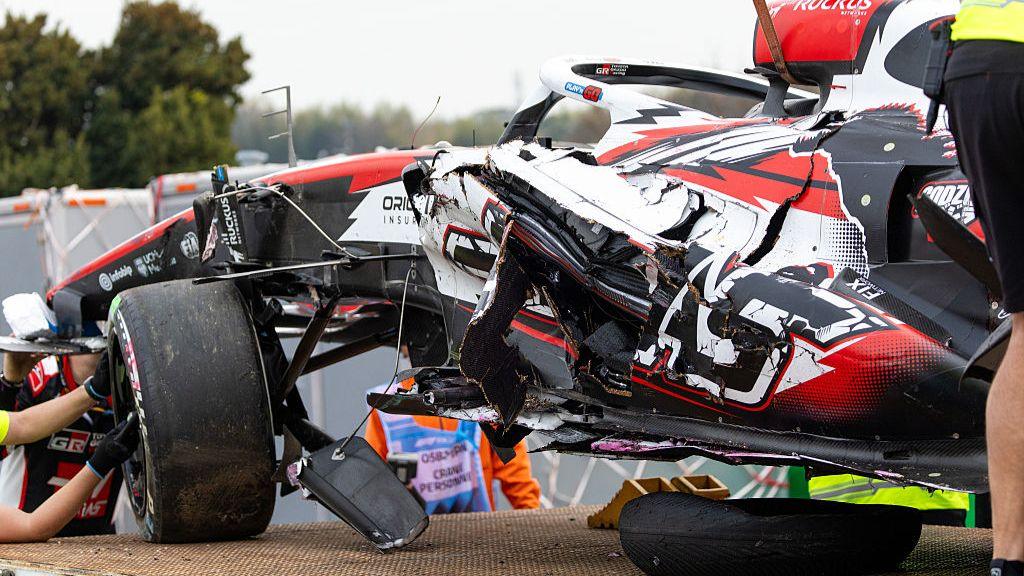 Image source, Getty ImagesImage caption,
 Oliver Bearman limped out of his Haas after his 50G crash
Other drivers spoke of similar situations they had experienced during the race.
Williams' Carlos Sainz, a director of the Grand Prix Drivers' Association, said: "There were a lot of big moments in the first three laps while we were all sorting out our energies with the closing speeds we have with the boost button. It was only a matter of time before the first crash happened."
F1 now faces a tricky situation, not least because some of the potential solutions that have been considered for improving qualifying could also feed into similar sorts of issues in races.
For example, there is a desire to change a rule that limits the amount of energy recovery possible when travelling at full throttle but when the electrical power has run out, a phenomenon known in F1 jargon as "super-clipping".
At the moment, this is limited to 250kW (335bhp). There is talk of allowing this to be lifted to the maximum recharge rate of 350kW (470bhp). But of course that would mean a bigger speed differential between a driver recovering energy and one still deploying.
But the problem is that there are good safety reasons for allowing the 350kw super-clip, as it lessens the need for another energy-harvesting strategy known as lift and coast.
This is when a driver lifts off the throttle to recover energy - and when that happens the front and rear wings close. They open on the straights to increase speed to help with energy recovery under braking. When they close, the car slows much more quickly.
'Is it worth it?' - Verstappen considering F1 future
- Published4 hours ago
Piastri impresses, Gasly excels - Japanese GP driver ratings
- Published2 hours ago
Antonelli wins to become youngest title leader
- Published6 hours ago
McLaren team principal Andrea Stella said: "In general, the reason for adding a 350kW super-clip is that we would like to avoid drivers having to do a lift and coast. Because if there is a lift and coast, there is an even bigger speed differential with the car that is following.
"It is a case that should be studied with a certain level of analytical approach. I don't think a simple solution exists.
"It is in the agenda of (governing body) the FIA in terms of the aspects of these 2026 regulations that should be improved. We don't want to wait for things to happen to put actions in place. We have a responsibility to put in place the actions that, especially from a safety point of view, should be implemented."
There has been an effort from F1, and by extension from the teams, to emphasise the positive aspects of the new regulations, as some see them.
Mercedes F1 boss Toto Wolff pointed out after the previous race in China that he and F1 president Stefano Domenicali had discussed the positive reaction from the audience to the new form of racing, which in all three races so far has featured cars passing and re-passing for several laps before the positions stabilise.
Wolff said in Japan on Sunday: "Nobody can complain about the lack of good racing. Would you agree? Yeah or not?"
When the assembled media paused in responding, Wolff said: "Experts. Old-school traditionalists."
But that remark could also be addressed at some of the drivers. Verstappen has likened the new F1 to the "Mario Kart" computer game. Fernando Alonso has called it "the battery world championship".
Sainz said: "The racing is OK because maybe they are having fun watching on TV. But from a driver's standpoint you realise there can be 50km/h speed delta. That is not racing. There is no (other) category in the world with these closing speeds. It's when these accidents can happen."
McLaren's Oscar Piastri, second behind race winner Kimi Antonelli on Sunday, said: "We understand as a sport there's a lot of things we need to tweak, a lot of things we need to change. And especially on safety grounds, yes, there's some things that need to be looked into pretty quickly."
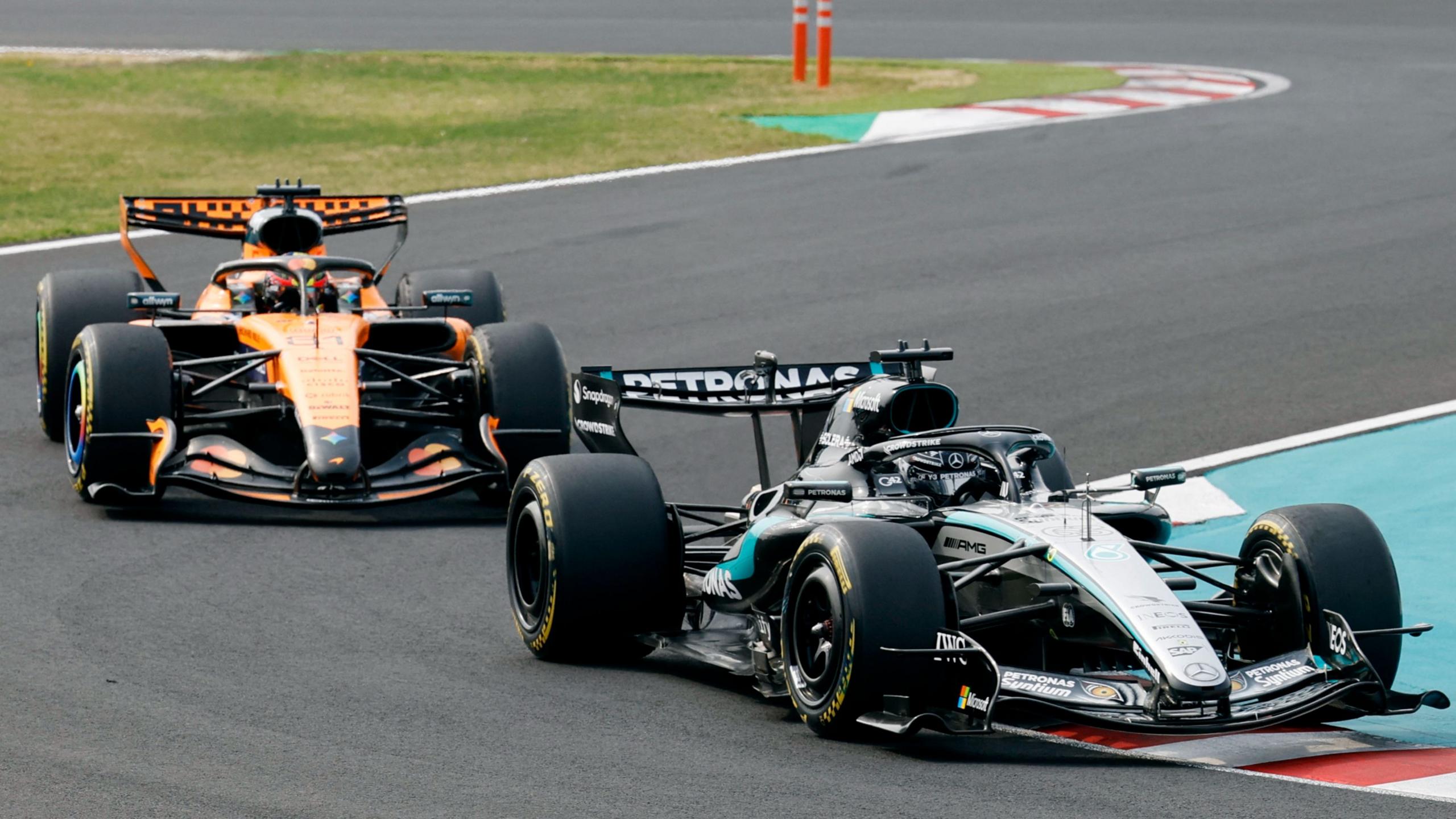 Image source, ReutersImage caption,
 McLaren's Oscar Piastri and Mercedes' George Russell were just two of the drivers who swapped positions more than once at Suzuka
'High-speed corners now charging station for car'
Alonso is also in the driver chorus about the damage the rules are doing to qualifying, saying in Japan that the challenge of Suzuka, regarded as perhaps the most demanding race track on the calendar, was "gone".
The two-time champion added: "I told you in Bahrain (testing) the chef could drive the car now. Maybe not the chef, but 50% of the team members I think, at least, can drive in Suzuka, because as I said a few times already the high-speed corners now became the charging station for the car.
"So you go slow there, you charge the battery in the high speed and then you have the full power on the straight. So the driver's skill is not really needed any more.
"You just need to back off the throttle or turn down the battery and you charge the thing. So no more challenge in the high speed."
Alonso is exaggerating to make his point, but other drivers, such as world champion Lando Norris, would - and have - fundamentally agreed with what he is saying.
F1 finds itself in something of a tangled web. The issue of closing speeds between cars in different power modes is something of which governing body the FIA has long been aware. It is one of the reasons why the two different levels of recharge were introduced.
But that is only one of many rule complexities that have followed, and unravelling them to improve qualifying without affecting the perceived positive impacts on racing will not be easy.
As for Verstappen, his issue is that whatever is decided will not fundamentally change the issues with which he is unhappy.
Energy management will remain a central part of the sport - with a 50-50 split between internal combustion and electrical power that cannot go away this season.
Changes can be made to that for next season. One of the proposals is to alter the ratio, and increase the performance of the internal combustion engine by increasing the fuel-flow rate, and make the power ratio more like 65-35 or 70-30.
But that will require a political agreement between the engine manufacturers, and the governance procedures will not make that easy to conclude.
"I want to be here to have fun and have a great time and enjoy myself," Verstappen said. "At the moment that's not really the case.
"Of course I do enjoy certain aspects. I enjoy working with my team. It's like a second family. But once I sit in the car it's not the most enjoyable unfortunately.
"I'm trying. I keep telling myself every day to try and enjoy it. It's just very hard."