
 AP via Getty Images
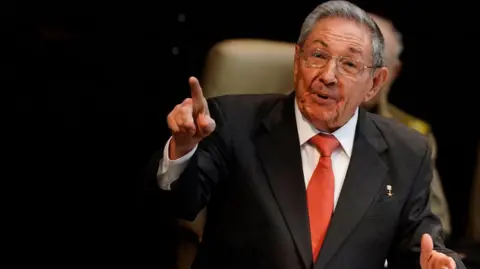
The US justice department is reportedly preparing to indict aging Cuban leader Raúl Castro in the coming days over the shooting down of two aircraft three decades ago.
The reported charges, which would need to be approved by a US grand jury, emerged as the director of the CIA travelled to Cuba to meet officials in Havana.
Castro, 94, stepped down as Cuban Communist Party leader in 2021, ending his family's more than half a century in power. He led the country for 15 years, stepping in after his brother, Fidel, resigned.
The potential indictment is the latest move in a US pressure campaign that has included an oil blockade and widespread sanctions.
The charges are said to centre on the 1996 downing of two planes operated by the US activist-humanitarian group Brothers to the Rescue.
Unnamed US Department of Justice (DoJ) officials told US media the indictment could come as soon as next Wednesday.
Watch: Expectant mothers in Cuba struggle under fuel blockadeAsked on Friday about the reported indictment plan, President Donald Trump told reporters on Air Force One: "I'll let DoJ comment on it."
He added: "But [Cubans] need help, as you know. And you talk about a declining country. They are really a nation, a country in decline."
Trump has issued an oil blockade against Cuba, which has exacerbated fuel shortages. This week the island's energy minister acknowledged that Cuba has, in essence, run out of fuel oil.
Potential charges against Raúl Castro were unclear, but officials said the investigation centred on an attack on two small planes, which happened on 24 February 1996 while Fidel was president and Raúl was armed forces minister.
Four people aboard were killed in the incident.
Brothers to the Rescue, a Cuban exile group that searched for rafts carrying migrants from Cuba to the US, had previously dropped anti-Castro leaflets near the Cuban coast.
The Cuban government - including Fidel Castro, who died in 2016 - said Brothers to the Rescue had repeatedly violated Cuban airspace, although the International Civil Aviation Organization found the attack took place over international waters.
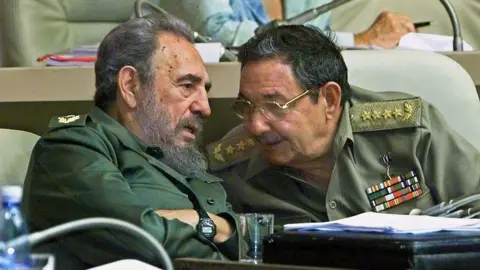 AFP via Getty ImagesRaúl Castro took over leading Cuba after his brother, Fidel Castro (left).
 In March, the attorney general in Florida announced in a news conference that the state was reopening an investigation into Raúl Castro's alleged role in the incident.
Florida's Governor Ron DeSantis praised the possible criminal charges on Friday, calling them "long overdue".
Cuba has not officially commented on the reports of an indictment, but Foreign Minister Bruno Rodriguez struck a defiant tone on Friday.
"Despite the [US] embargo, sanctions and threats of the use of force, Cuba continues on a path of sovereignty towards its socialist development," he said, according to Reuters news agency.
In order for charges to be filed, prosecutors would have to convince a grand jury, made up of members of the public, that probable cause exists to believe a crime has been committed.
Acting US Attorney General Todd Blanche, who leads the US justice department, has declined to confirm reports of an impending indictment.
"If and when there's a time to talk about about that, we will, obviously," Blanche told Fox News.
Trump has said the US wants to change Cuba's communist leadership. He told crowds at a recent rally that the US would be "taking over" the Caribbean island nation, which lies 145km (90 miles) from the US state of Florida.
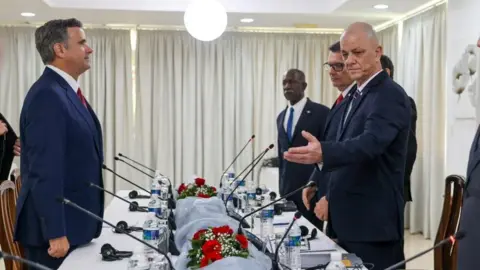 CIACIA Director John Ratcliffe in Havana
On Thursday, CIA director John Ratcliffe met his Cuban counterpart at the interior ministry in Havana. Raúl Rodríguez Castro, grandson of Raúl Castro, was at the meeting.
A CIA official told the BBC's US partner CBS that Washington was prepared to engage on economic and security issues, "but only if Cuba makes fundamental changes".
A Cuban statement said the meeting was an attempt to improve dialogue and that Havana was not a threat to US national security.
It came after American officials renewed an offer of $100m (£74m) of aid to ease the effects of its oil blockade.
Washington has focused more on Cuba in recent months after the US indicted Venezuelan leader Nicolás Maduro in January then removed him from power in an overnight operation.
Analysts say any similar attempt by US special forces to arrest Castro could meet stiff opposition in Cuba, particularly among government loyalists.
How destabilising Cuba could backfire disastrously on USWilliam LeoGrande, professor of Latin American politics at the American University in Washington, told the BBC the potential indictment was "one more element of the pressure campaign" that Trump has kept up since returning to office last year.
But further destabilising the island could backfire on the US, said LeoGrande, who wrote the book Back Channel to Cuba: The Hidden History of Negotiations between Washington and Havana.
"If the Cuban economy and social order collapses, it would actually be a disaster for the United States, because it's likely to touch off a mass migration crisis," the professor said.
He said it looks like the US "is sending a warning to Raúl Castro that he should use his influence to get the government to make concessions".
"Or else the US military may be coming for him, just like it came for President Maduro in Venezuela."