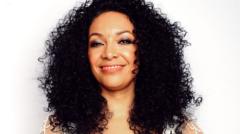

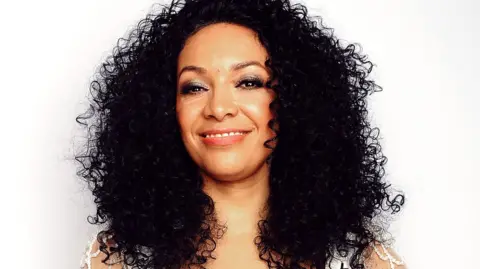
 Getty ImagesKanya King founded the Mobo Awards in 1996
Mobo Awards founder Kanya King, who worked tirelessly to champion black musicians' contribution to British culture, has died at the age of 57.
She was best known as the tenacious founder of the Music of Black Origin awards, which celebrated their 30th anniversary earlier this year in Manchester.
Speaking at the ceremony, she told the BBC she had funded the first event out of her own pocket, "against my mother's judgment... but it paid off".
King died on Wednesday after "a courageous and characteristically determined battle with colon cancer", the Mobo Organisation said in a statement. "She was surrounded by her family, close friends and love."
Launched in 1996, the Mobos became globally renowned for their recognition of black talent - platforming upcoming stars and pushing to break industry boundaries.
King defied expectations as a teenage mother who dropped out of school to gatecrash the predominantly white male music industry.
She studied English literature at London's Goldsmiths College and later, while working as a TV researcher, spotted a gap in the market for a black-focused awards show.
But success did not come easily.
"I remember being told, 'You've got a chip on your shoulder, why are you talking about race all the time?'" she told Music Week in 2021.
By 1999, King had been awarded an MBE for services to music as the Mobos grew from scrappy underdog to music industry fixture, holding its own against the long-established Brit Awards.
Its musical spectrum remains uniquely broad - giving early support to UK garage at the turn of the millennium, alongside R&B, soul, reggae, jazz, Afrobeat and broader African music, and championing grime before its mainstream explosion.
Against all odds
King's upbringing inspired her forthright passion for change and entrepreneurial spirit.
Growing up as the youngest of nine children in a cramped council flat in Kilburn, north London, from the age of eight she juggled schoolwork and part-time jobs to earn pocket money.
Born on February 12 1969 to an Irish mother and Ghanaian father, she was influenced by the discrimination her parents faced.
"My father had a strong African accent, he struggled to get a job," King told Music Week. "You'd watch things at Christmas time, like Zulu, and the images of Africans were of savages – the very opposite [of reality]. My father was very elegant."
His death from leukaemia when she was just 13 had a profound effect on King, who also saw her mother held back by their circumstances.
"Seeing people not have the opportunity to achieve their dreams, that's what motivates and drives me, " she said, echoing an ethos that later became the foundation of the Mobos.
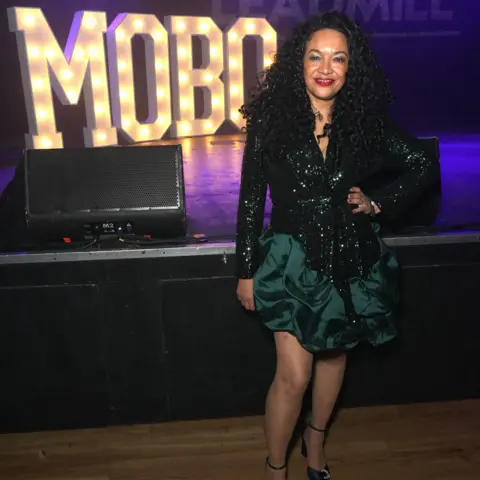 Getty ImagesKing at the 2024 Mobo Awards in Sheffield
 But at 16, life grew more challenging when she gave birth to a son, dropping out of school and splitting with the child's father a year later.
She told the Evening Standard she felt "written off" when she became a mother, recalling a careers adviser suggesting her best prospect was managing a local Sainsbury's.
"That put a fire in my belly and gave me the motivation to say 'Why should I not have ambition'," she added.
Acting on these goals did not come naturally. King told BBC Radio 1Xtra's Sarah Jane Crawford that growing up she was shy and lacked confidence. She was often overlooked for promotion in her early career working in PR.
"I soon realised that... being quiet and working hard wasn't going to be enough," she said. "It's also about people seeing you are working hard and learning to promote yourself.
"Success in life isn't always about having the right education or the most money," she would later reflect. "Sometimes it's about having the right mindset".
Mobo magic
This attitude was both tested and perfected in King's formative years.
After struggling to juggle lecture attendances, childcare and multiple jobs, she eventually bought her first property - a milestone of independence she deeply craved after her chaotic childhood home.
Around this time she decided to take the plunge with the Mobos.
Her aim, she would later write for The Times, was to "bridge the gap" between the "real music divide" that existed at the time, with R&B and hip-hip "completely ignored" by award shows.
Getting it off the ground wasn't easy, especially as someone attempting to reshape the industry from the outside.
"Rejection became normalised," she told Music Week. "People didn't want to take my calls".
But she made it happen through persistence; eventually gaining support from the few black industry executives of the time, like Dej Mahoney and Stevie Wonder's former manager Keith Harris.
"My bedroom was my office," she explained to 1Xtra. "I was answering the phone saying 'Mobo Organisation'.
"People didn't need to know I had clothes everywhere and the room was in disarray!".
Her tenacity paid off. The first televised event, held at the Connaught Hotel in London, appeared to come out of nowhere - just seven weeks after her pitch was accepted.
But the ceremony made headlines when Labour's soon-to-be Prime Minister Tony Blair attended with his wife Cherie, walking the red carpet alongside King.
At the ceremony itself, Lionel Ritchie accepted the Mobo's first-ever lifetime achievement accolade on stage with Tina Turner.
King's mother, meanwhile, spent the evening asking Blair if he could find her daughter a job in the government. It wasn't until 1999, when King received her MBE, that her mother finally accepted the awards as more than a passion project.
Gatekeeping questions
Speaking to press at the inaugural ceremony Blair emphasised the Mobos' focus on music of black origin - recognising style and influence over skin colour.
For King, this was intentional. She told BBC News in 2001: "We've always said it's about the music... an event that celebrates music of black origin doesn't seek to separate artists according to skin colour".
The Mobos' televised ceremonies soon became star-studded occasions, where UK acts like Craig David, Kano, Amy Winehouse and Stormzy rubbed shoulders with international stars, from blues legend BB King to Destiny's Child, Usher, Janet Jackson and Rihanna.
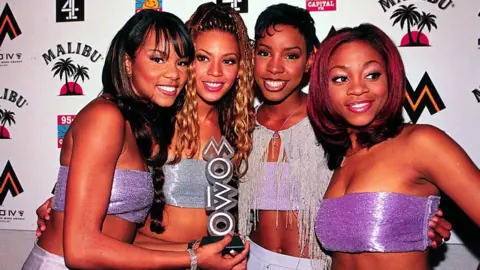 Getty ImagesBeyonce attended in 1999 as part of Destiny's Child, who won best international R&B act
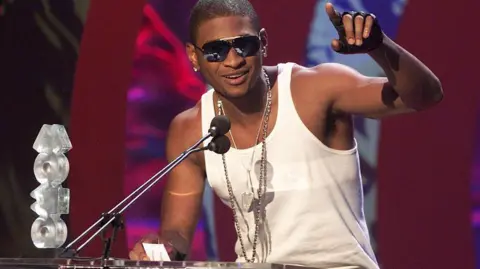 Getty ImagesUsher giving an acceptance speech at the 2001 ceremony
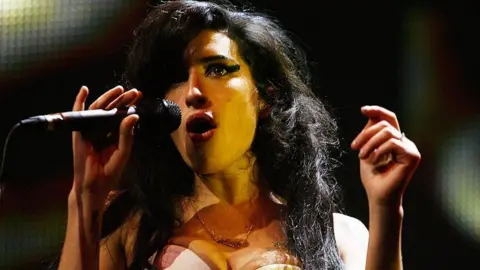 Getty ImagesAmy Winehouse performing at the 2007 awards
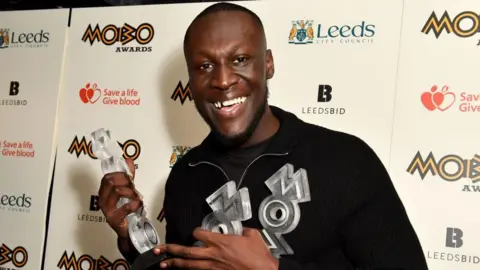 Getty ImagesStormzy swept multiple awards at the Mobos in 2017, two years before headlining Glastonbury festival - the first black British solo artist to do so
But with this increasing mainstream appeal came complications. Negative media coverage nearly ended the event, particularly in 2002, when headlines falsely implicated violence at an unaffiliated after-show party.
As sponsors fled, King remortgaged her home for a second time to avoid the awards collapsing.
The ceremony has also drawn criticism for awarding prizes to popular white artists, including Jamiroquai and Simply Red's Mick Hucknall. The accusations persisted, especially when Sam Smith swept four awards in 2014.
In 2009, the Mobo awards moved out of London for the first time and since then has moved around the UK.
King announced the awards would take gap year in 2017, which extended to 2020.
BBC Newsbeat reporter Jimmy Blake described the absence as a "missed opportunity" at a breakthrough time from grime, with Stormzy headlining Glastonbury and Dave winning the Mercury Prize. The Brits had also diversified its voting structures and outlook to better reflect black music.
Legacy
King, who was awarded a CBE in 2018 for her contributions to music and culture, later told The Guardian that the hiatus was not down to funding but asking: "Is Mobo still needed?".
The answer, she decided, was a resounding yes. The Mobos returned with a revamp supporting emerging artists, not just in music but in film, television and other areas of the arts.
King's active defiance in defending black interests also extended beyond music. She launched Mobolise to tackle what she called the "scary underrepresentation of black talent" across influential industries.
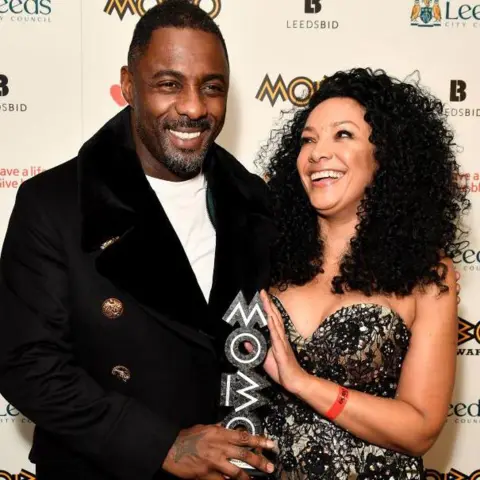 Getty ImagesKing posing in the winners room with Idris Elba, the recipient of the Mobo paving the way award in 2017
It mirrored her own expanding influence in numerous committees and advisory groups, including the Creative Industries Council and UK Music Diversity Task Force.
At the height of the Black Lives Matter movement in 2020 she penned an open letter titled "An inconvenient truth" to then-Culture Secretary Oliver Dowden reflecting on her experiences fighting systemic racism.
"I just want to see action. That's what I want to see. The question I asked myself is: 'What do I have to do? What do I have to prove to get a seat at that table?'" she concluded.
In December 2024, King announced her stage four bowel cancer diagnosis on Instagram, the same night as receiving a LIVE foundation lifetime achievement award for her work over almost three decades.
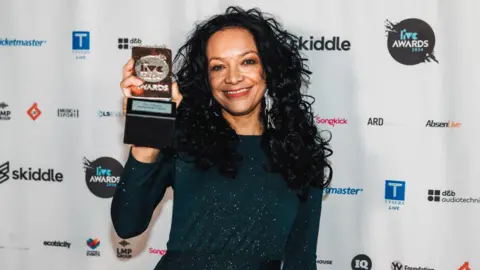 Emily MarcovecchioKing with her LIVE foundation lifetime achievement award, the same night she announced her cancer diagnosis
"While this journey will undoubtedly be challenging, I've always believed in finding meaning through adversity," she said.
"If my story can save just one life, then it's a story worth telling."
She was last seen on the red carpet at this year's Mobo Awards in Manchester.
On stage, Pharrell Williams, who received the global songwriter award, paid tribute to King's determination to keep working through her cancer treatment.
"When you love what you get to do, you're never working, you're just having the time of your life."
Music


