Get the world’s most fascinating discoveries delivered straight to your inbox.
Become a Member in Seconds
Unlock instant access to exclusive member features.
Contact me with news and offers from other Future brands Receive email from us on behalf of our trusted partners or sponsors By submitting your information you agree to the Terms & Conditions and Privacy Policy and are aged 16 or over.You are now subscribed
Your newsletter sign-up was successful
Want to add more newsletters?
Join the club
Get full access to premium articles, exclusive features and a growing list of member rewards.
Explore An account already exists for this email address, please log in. Subscribe to our newsletter 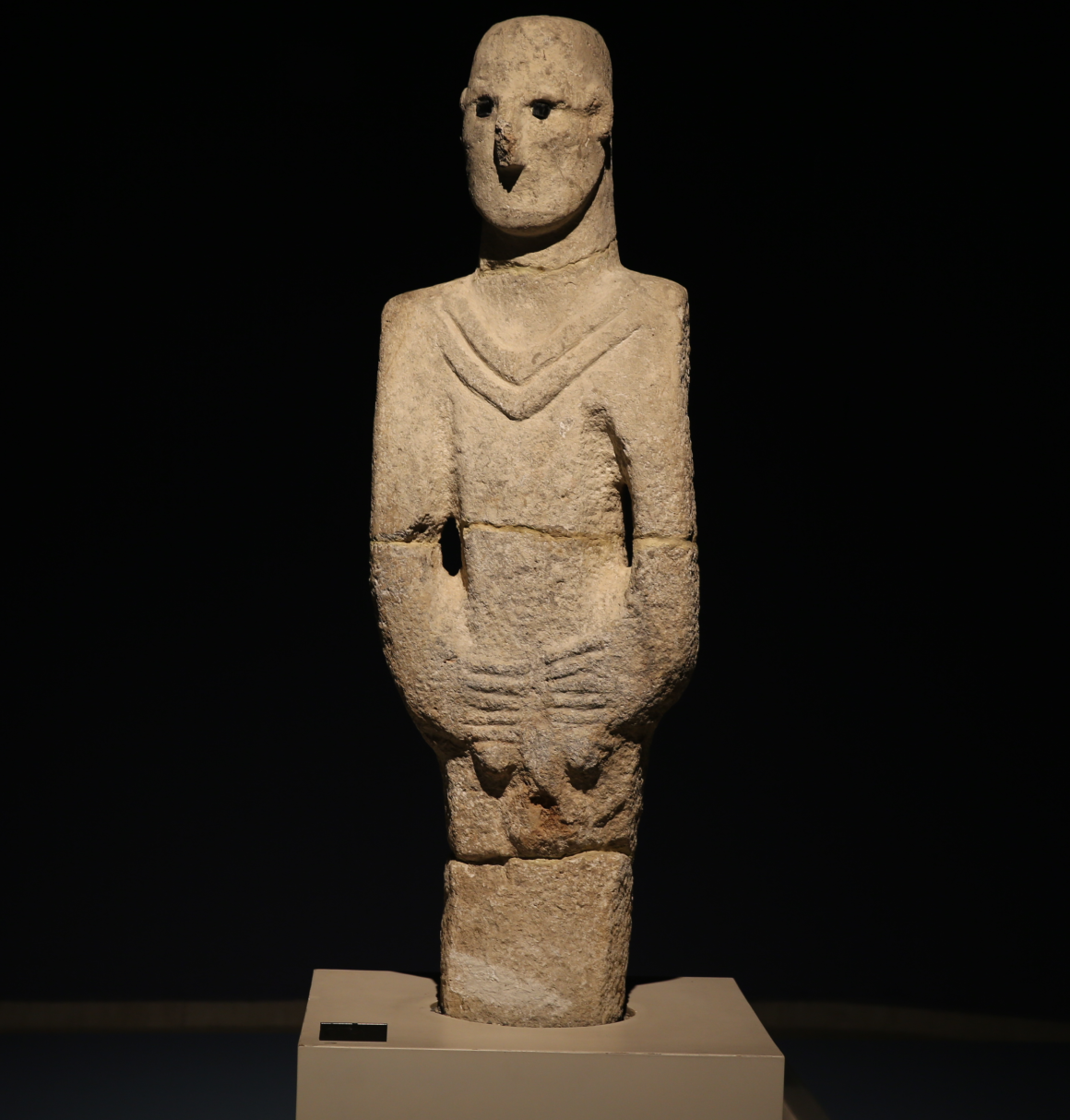
Name: Urfa Man
What it is: A limestone statue
Where it is from: Şanlıurfa, Turkey
When it was made: Circa 9500 B.C.
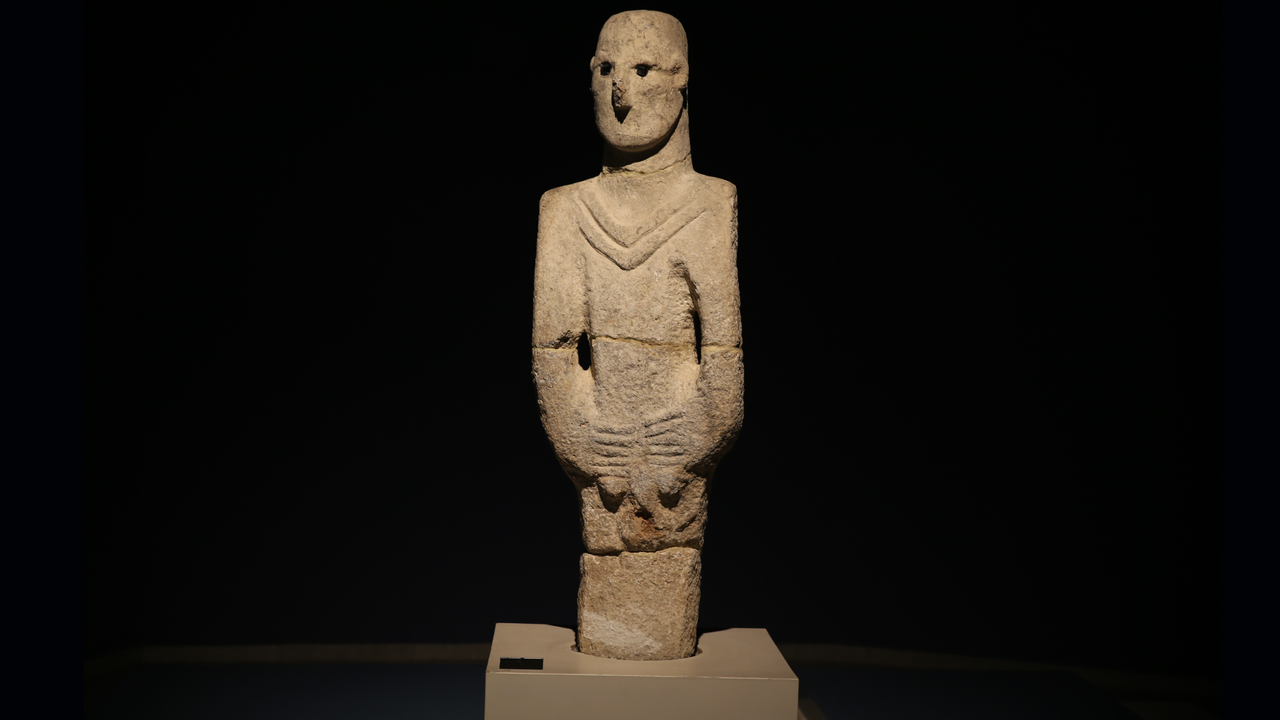
Over 11,500 years ago, people in what is now southern Turkey began crafting life-size human statues for the first time. Urfa Man, also known as the Balıklıgöl statue, is the oldest example of this sculptural tradition, but much about it remains a mystery.
According to the Şanlıurfa Archaeological Museum, which owns the statue, Urfa Man was discovered accidentally during construction work in the Balıklıgöl district of Şanlıurfa in 1993.
Urfa Man was carved out of limestone and stands 5 feet, 11 inches (180 centimeters) tall. His face features deep-set eye sockets filled with chunks of black obsidian, a partially broken nose and no mouth. The V-shaped lines around his neck likely represent a necklace. Aside from this accessory, Urfa Man is completely nude. His hands are clasped in front of him, holding his erect penis. Instead of legs, Urfa Man has a U-shaped lower half, likely designed to fit into a recess.
Article continues belowAccording to archaeologist Bahattin Çelik, the statue probably came from a Neolithic settlement that archaeologists call Yeni Mahalle, after the modern district in Şanlıurfa. Excavations at Yeni Mahalle in 1997 revealed the remains of two circular buildings with floors made from terrazzo — a cement-like material filled with chips of granite, quartz, glass or other material — along with flint arrowheads, sickle blades and obsidian flakes. Using radiocarbon analysis of carbonated plant remains, archaeologists dated the site to around 8600 B.C.
Whether Urfa Man is related to other ancient sites with life-size male statues is unclear.
Located about 10 miles (16 kilometers) northeast of Şanlıurfa, the archaeological site of Göbekli Tepe is known for having the world's oldest temples, which consist of monumental communal structures with distinctive T-shaped limestone pillars and numerous animal carvings. A ritual human statue was discovered at the site in 2025.
MORE ASTONISHING ARTIFACTS—Lady of Elche: A 2,400-year-old bust of a mysterious 'highborn' woman from pre-Roman Spain
Archaeologists have also uncovered statues of men holding their phalluses at nearby sites that date back 11,000 years, including Karahan Tepe and Sayburç. One interpretation of the human statue at Karahan Tepe is that the person depicted is dead and represents an important ancestor associated with the building. This also may be the case for Urfa Man, as archaeoastronomer Alistair Coombs has argued.
Sign up for the Live Science daily newsletter nowContact me with news and offers from other Future brandsReceive email from us on behalf of our trusted partners or sponsors"The feature of his absent mouth," Coombs wrote in a 2016 study, "forms part of a stylistic design that symbolically insinuates the presence of the dead." Urfa Man's lack of a mouth is clearly intentional and may convey that he was intended to depict "a communicator from a supernatural world of the dead to the world of the living in a realistically human shape," according to Coombs.
For more stunning archaeological discoveries, check out our Astonishing Artifacts archives.
TOPICS Kristina KillgroveStaff writer
Kristina Killgrove is a staff writer at Live Science with a focus on archaeology and paleoanthropology news. Her articles have also appeared in venues such as Forbes, Smithsonian, and Mental Floss. Kristina holds a Ph.D. in biological anthropology and an M.A. in classical archaeology from the University of North Carolina, as well as a B.A. in Latin from the University of Virginia, and she was formerly a university professor and researcher. She has received awards from the Society for American Archaeology and the American Anthropological Association for her science writing.
View MoreYou must confirm your public display name before commenting
Please logout and then login again, you will then be prompted to enter your display name.
Logout LATEST ARTICLES 1A new twist on matter? Strange 'Half-Mӧbius' molecule has rare properties chemists have never seen before
- 2Why do some people still believe that aliens shaped ancient civilizations?
- 3A secret weapon to fight carbon emissions was just discovered: Beavers
- 4Rare star spotted in its original galaxy could answer a key question about the ingredients of life: Space photo of the week
- 5Why do animals have different pupil shapes?