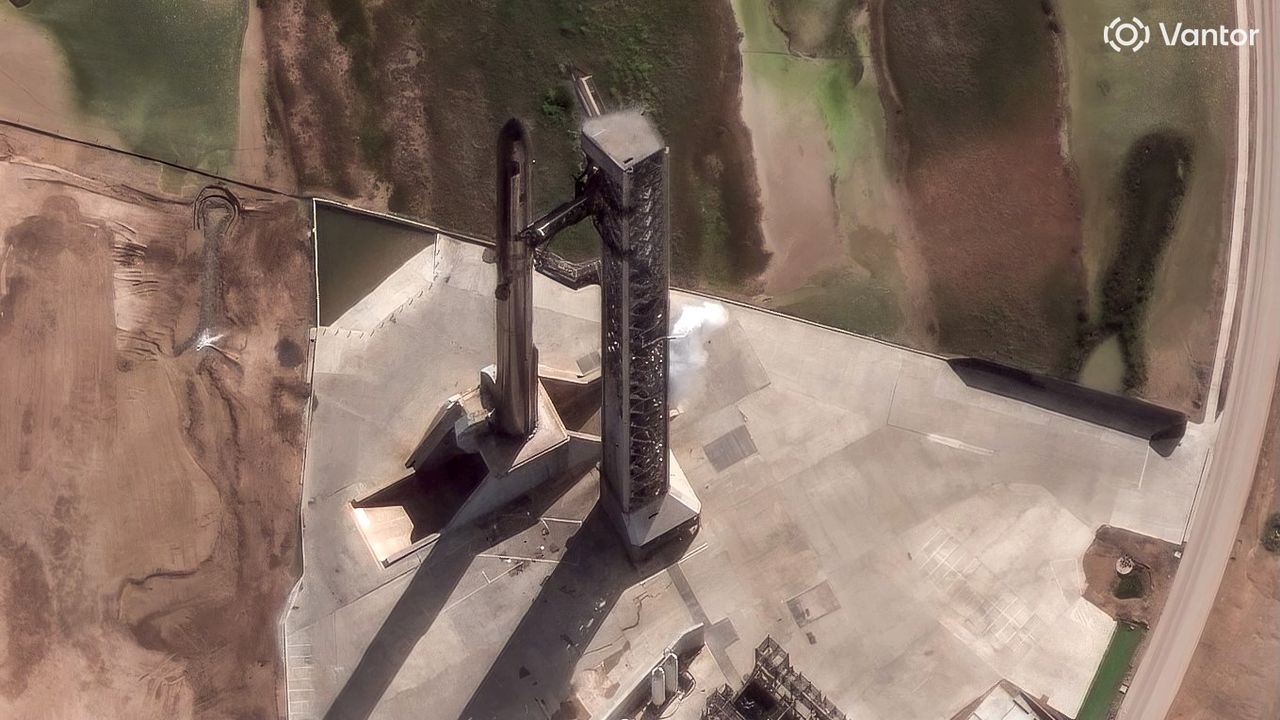
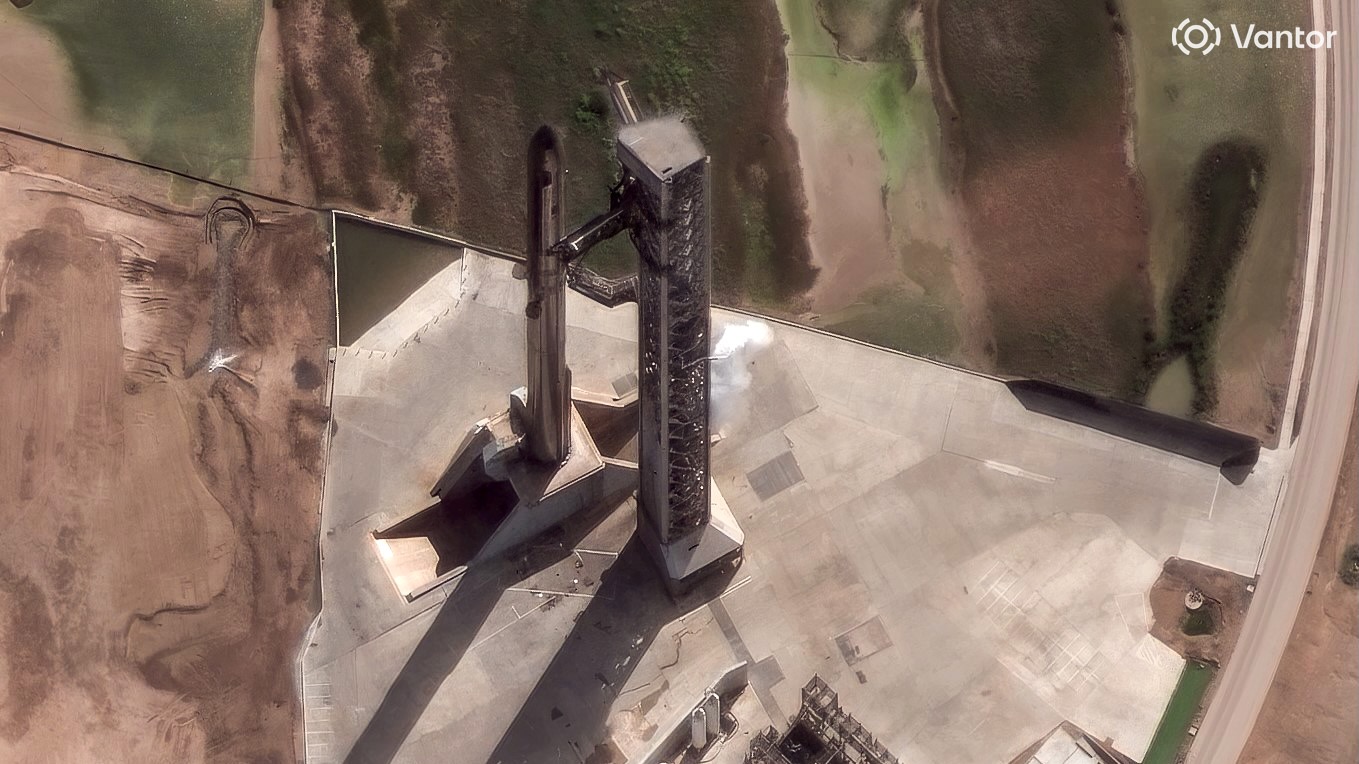
 One of Vantor's WorldView Legion satellites captured this photo of SpaceX's first Starship V3 on the pad at Starbase, Texas on May 21, 2026. (Image credit: Vantor) Share this article 0 Join the conversation Add us as a preferred source on Google Newsletter Subscribe to our newsletter
 A sharp-eyed satellite captured an amazing photo of SpaceX's first Starship V3 megarocket on the pad Thursday (May 21), just before it was supposed to lift off.
SpaceX aimed to launch Starship V3 — the biggest and most powerful version of the megarocket yet — for the first time ever on Thursday (May 21), from the company's Starbase site in South Texas.
An eye in the sky was on hand to chronicle the moment — one of Vantor's WorldView Legion satellites, which snapped a great shot of the 408-foot-tall (124.4-meter-tall) rocket from low Earth orbit.
In a few minutes, @SpaceX is set to launch Starship from Boca Chica, Texas, continuing one of the most ambitious campaigns in modern spaceflight. At 4:52 p.m. CDT—barely an hour ago—Vantor captured this high-resolution image of Starship on the launchpad with one of our WorldView… pic.twitter.com/vKi6z6IWa0May 21, 2026
"Wishing SpaceX lots of luck for today's launch. At Vantor, we're continuing to watch the future of space from space," Vantor wrote in an X post on Thursday that shared the photo.
Starship wasn't able to get off the ground on Thursday, however; several technical issues cropped up late in the countdown, and SpaceX had to call off the attempt.
SpaceX is now targeting a liftoff today (May 22), during a 90-minute window that opens at 6:30 p.m. EDT (2230 GMT). You can watch the action live here at Space.com.
The suborbital test flight will be the 12th overall for Starship, which launched for the first time in April 2023. It will be the first liftoff, however, for Starship V3, an upgraded variant designed to take the megarocket out of the test phase and into operational flight.
Indeed, V3 is the iteration that will land astronauts on the moon during NASA Artemis missions, SpaceX representatives have said. The company still has some work to do to make that happen — for example, get the vehicle to Earth orbit, demonstrate key capabilities like in-space refueling and install a life-support system.
Vantor (previously known as Maxar Intelligence) currently operates six WorldView Legion satellites. The Earth-observing spacecraft orbit our planet at an altitude of about 322 miles (518 kilometers) and can resolve features on the ground as small 11.8 inches (30 centimeters) — or about 0.24% the height of Starship V3.
View MoreYou must confirm your public display name before commenting
Please logout and then login again, you will then be prompted to enter your display name.
Logout Mike WallSpaceflight and Tech Editor
Michael Wall is the Spaceflight and Tech Editor for Space.com and joined the team in 2010. He primarily covers human and robotic spaceflight, military space, and exoplanets, but has been known to dabble in the space art beat. His book about the search for alien life, "Out There," was published on Nov. 13, 2018. Before becoming a science writer, Michael worked as a herpetologist and wildlife biologist. He has a Ph.D. in evolutionary biology from the University of Sydney, Australia, a bachelor's degree from the University of Arizona, and a graduate certificate in science writing from the University of California, Santa Cruz. To find out what his latest project is, you can follow Michael on Twitter.