
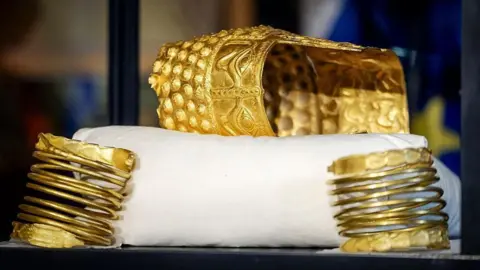
 ANP/AFPTwo of the recovered bracelets were exhibited with the crown, but one bracelet is still missing
Three men who stole a 2,500-year-old Romanian golden helmet from a Dutch museum have each been sentenced to nearly four years in prison.
The Coțofenești helmet, which dates back to around 450BC, was snatched by an armed gang who broke into the Drents Museum in Assen more than a year ago. Three gold bracelets were also taken in the raid, prompting outrage in Romania and raising questions about security for artefacts on loan to other countries.
In April, the Dutch authorities announced they had recovered the helmet and two of the three bracelets after striking a bargain with two of the suspects.
The third bracelet is still missing and the search for it is ongoing.
The men were arrested within days of the gang using explosives to break into the museum, but by then there was no trace of the items, considered to be among Romania's greatest treasures.
Prosecutors eventually struck a plea bargain with two of them - identified as Jan B, 21, and Douglas Chesley W, 37 - for the return of the loot.
As part of this deal, the prosecution called for a 44-month sentence for the pair, news agency AFP reported.
The other suspect, identified as 35-year-old Bernhard Z, refused a deal with the authorities. Prosecutors had demanded he should face a 66-month sentence.
The process of reaching a deal with the two suspects was "long, intensive and complex", prosecutors said.
But the Dutch court imposed the same sentence of 47 months on the trio, despite the plea agreements, local media report.
"Given the nature and gravity of the offences, only a substantial prison sentence will suffice," said the court in Assen, in the north of the country.
The treasures had been on loan from Romania's national history museum when they were stolen, as part of an exhibition telling the story of the Dacia civilisation and people who lived in present-day Romania before the Roman conquest in 106AD.
The former head of the national history museum in Bucharest, Ernest Oberländer-Târnoveanu, faced considerable domestic criticism for loaning the gold objects abroad and lost his job within days of the theft.
Art experts have suggested that the helmet and bracelets were stolen to order by a criminal gang.
The theft prompted a spat between the two governments that led to the Dutch government paying a reported €5.7m (£5m; $6.5m) in insurance compensation.
Romanian officials previously refused to discuss what would happen to that money now a large chunk of the treasure had been recovered.
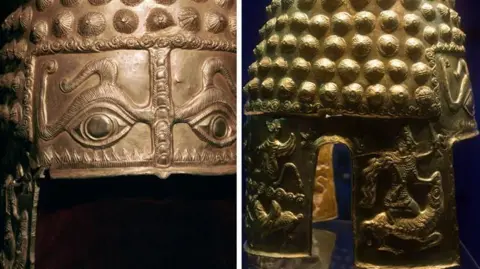 Getty ImagesThe helmet was finally returned to authorities in April, a year and two months after it was stolen
 Several Dutch provincial museums have been targeted in recent years because of the difficulty in providing adequate security for culturally significant artefacts. The helmet and bracelets were in a glass case that provided little resistance to the armed group.
When the helmet and two of the bracelets were revealed to have been recovered, Robert van Langh, director of the Drents Museum, said the helmet had been slightly dented but could be restored. The bracelets remained in perfect condition, he added.
On their return, Romanian prosecutor Rareș-Petru Stan spoke of the "major impact" the theft had had in his home country, and praised his Dutch colleagues for their "hard work and keeping the faith".
"We are continuing the investigation to find the last bracelet," he said, adding: "And we are grateful that we will be able to return this treasure to the Romanian people."