
 N’raeah, seven, who has won a fully funded scholarship to one of the UK’s most prestigious musical institutions. Photograph: Graeme Robertson/The GuardianN’raeah, seven, who has won a fully funded scholarship to one of the UK’s most prestigious musical institutions. Photograph: Graeme Robertson/The GuardianThe south London community where ‘pioneering’ scholarship choristers are made
St John the Divine, Kennington has built one of UK’s largest youth choral programmes in area marked by deprivation
St Paul’s Cathedral school, one of the UK’s most prestigious private schools, has long been associated with the musical elite. So was seven-year-old N’raeah, from south London, nervous about auditioning for its internationally renowned choir?
“No,” she said, beaming. “Everybody’s counting on me to sing beautifully.”
And sing beautifully, she did. N’raeah is the fourth chorister from St John the Divine, Kennington (SJDK) to win a fully funded scholarship to one of the UK’s most prestigious musical institutions in recent years.
Other choristers from the church have secured scholarships at Westminster Abbey, King’s College, Cambridge and St John’s College, Cambridge, with some going on to perform at national events including the coronation of King Charles III.
The achievement is striking given the challenges facing the local community. SJDK serves an area of Lambeth marked by high levels of deprivation and youth violence. Many families from migrant backgrounds have also lived through years of anxiety linked to the Windrush scandal and hostile immigration policies.
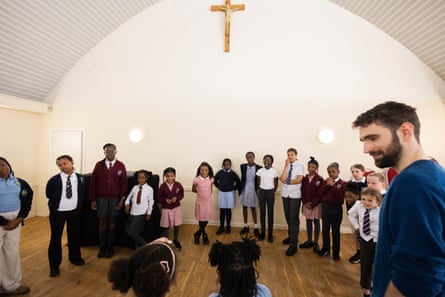 SJDK director of music Joe Tobin (right) with members of St John the Divine girls choir. Photograph: Graeme Robertson/The Guardian
The local church primary school, from which many choristers are recruited, faced closure before being saved by a fierce campaign from parents and the wider community.
Yet from this corner of south London, the church has built one of the country’s largest youth choral programmes. Since 2013, about 1,000 children have passed through its choirs, with the parish working to remove barriers that often keep working-class children out of classical music.
Joe Tobin, the director of music at SJDK, said: “The great success early on was that the church was able to create a model that worked really well for this area.”
Tobin said church choirs had traditionally been formal and demanding, with families expected to organise their lives around a rigid schedule. “We really try to make it something that can work really well for families,” he said. “We pick children up from local schoolsand take them to rehearsal and give them snacks.”
Ed Picton-Turbervill, an award-winning composer, organist and keyboard teacher, said every primary school he worked with had a specialist music teacher when the programme began 12 years ago.
“Now, none of those schools has a specialist music teacher,” he said.
Picton-Turbervill, who was himself a scholarship pupil, said he was worried access to music education was becoming increasingly tied to privilege. But the team at SJDK realised early on that even a small intervention, sometimes just 15 minutes of singing a week, could help bridge gaps between privileged children and those from more deprived backgrounds.
Picton-Turbervill is acutely aware that a life-changing opportunity can rest on a 10- or 15-minute audition. He still vividly remembers travelling with another chorister and her mother to an audition in Cambridge. Meeting them at King’s Cross station, the mother told him neither of them had ever taken a train out of the city before.
Moments before the audition, the girl burst into tears. “I said: ‘Do you want me to come in with you for this?’” Picton-Turbervill recalled. “She said no. Then she walked in on her own to the audition. We sat outside and I just thought: wow, this is powerful. That seven-year-old has just strode confidently into her future.”
As well as meeting the musical and academic demands, some children have also had to overcome racial prejudice. Picton-Turbervill recalled one person in a position of authority telling him that black children could not sing the high notes.
Picton-Turbervill described the scholarship choristers as “pioneers”. Pointing to John Denny, a former mayor of Lambeth and member of the congregation, who came to Britain from Barbados in 1956, he said: “This is the next frontier of integration. These brave, talented children are opening a broader pathway for everybody.”
N’raeah’s mother, Shauna-Rae, was overwhelmed when she heard her daughter had got into St Paul’s Cathedral school.
“This is an opportunity that a lot of people from our community, our background, don’t get,” Shauna-Rae said.
 N’raeah’s mother says she was overwhelmed when she heard her daughter had got into St Paul’s Cathedral school. Photograph: Graeme Robertson/The Guardian
And when opportunities did arise, she said, some families could feel hesitant about stepping into institutions historically seen as closed off to people from their backgrounds. “I was breaking that chain of thinking.”
While the family is musically gifted, Shauna-Rae admits the classical music her daughter sings is very different to what she grew up with. “It’s not really my world musically, but I love that it opens different doors and different worlds for her.”
So, what advice does N’raeah have for others who might be too shy to sing? “Don’t be scared. It’s really nice to sing,” she said. “And if you sing, everybody will look at you and think that you’re great.”
Explore more on these topicsShareReuse this content