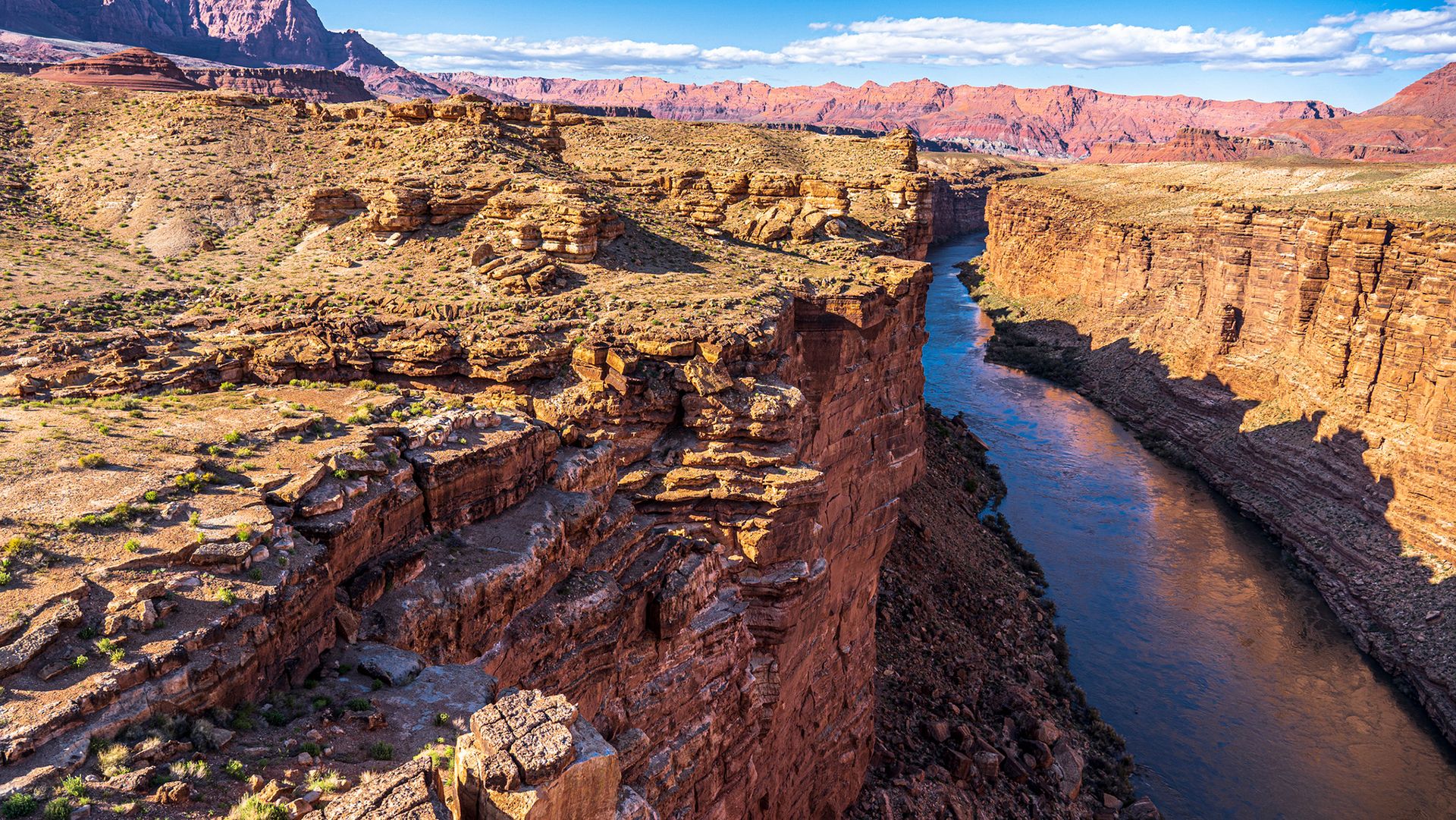
More than a billion years of geological history is missing from the walls of the Grand Canyon, and now, scientists may know why.
In the canyon's sides, ancient metamorphic and igneous rocks that formed 1.7 billion years ago sit directly under younger sedimentary rocks laid down 500 million years ago. The 1.2 billion-year chunk of history in between wasn't preserved — leaving a geological gap known as the Great Unconformity.
This missing period was a very important time in Earth's history, because it was just before and during the Cambrian explosion, which saw a huge diversification of life on Earth. The Great Unconformity is not only at the Grand Canyon; there are big gaps in the rock layers of that time across North America, the Baltic region of Europe and in northern China. Researchers have long debated why this unconformity exists.
The unconformity is sharply evident in the transition between Cambrian Tapeats Sandstone and Proterozoic Brahma Schist in the Grand Canyon. (Image credit: UCG via Getty Images)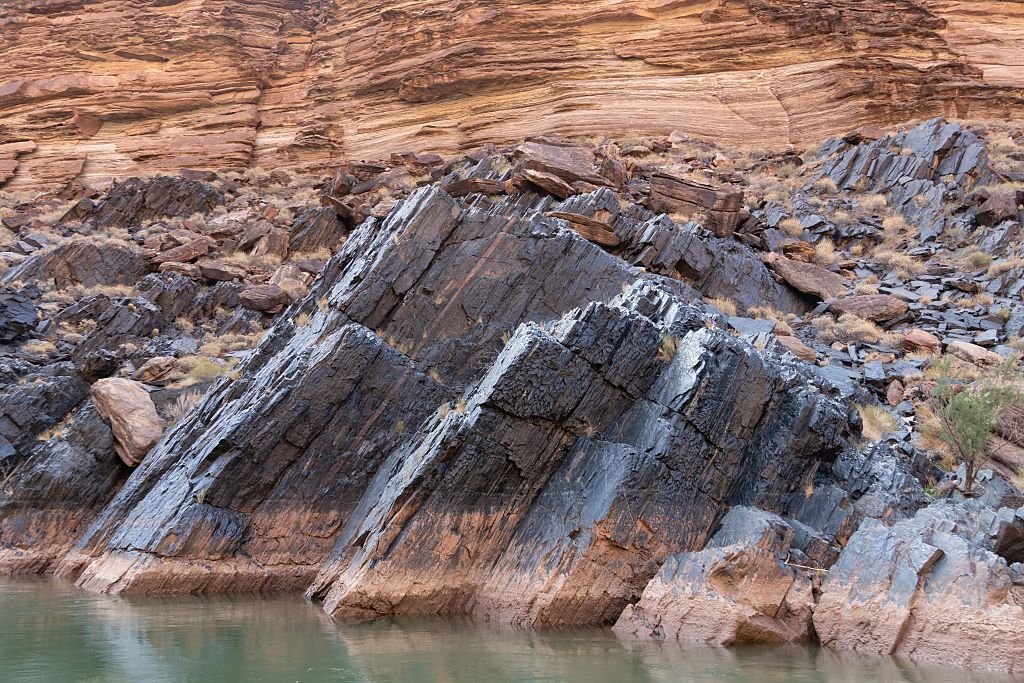
Now, a new model of the movement of Earth's middle layer, the mantle, has revealed an explanation: The slow, heat-driven circulation of the mantle pushed these three regions upward during the time when the Great Unconformity was formed, according to new research published Nov. 4 in the journal Nature.
This uplift would have helped facilitate erosion, meaning sediments formed at that time sloughed off the continents and landed in the ocean. Importantly, the model also shows that in the past 540 million years, these same areas started sinking instead of rising, creating areas for sediments to get caught and then keep piling up in neat layers on the continents — marking the point where the Great Unconformity ends. This matches what geologists can see in North America, the Baltics and northern China.
"We looked at, where are the best places that the mantle would help create a Great Unconformity?" study co-author Nicolas Flament, a geoscientist at the University of Wollongong in Australia, told Live Science. "And these three places turned out to be three places where it's known to be quite extensive."
Erosion during Neoproterozoic times, followed by sedimentation during early Phanerozoic times, formed the Great Unconformity. Bottom: Dynamic uplift was followed by subsidence for Laurentia ('LAU'), Baltica ('BAL') and North China ('NCH'). (Image credit: Author provided, CC BY-ND)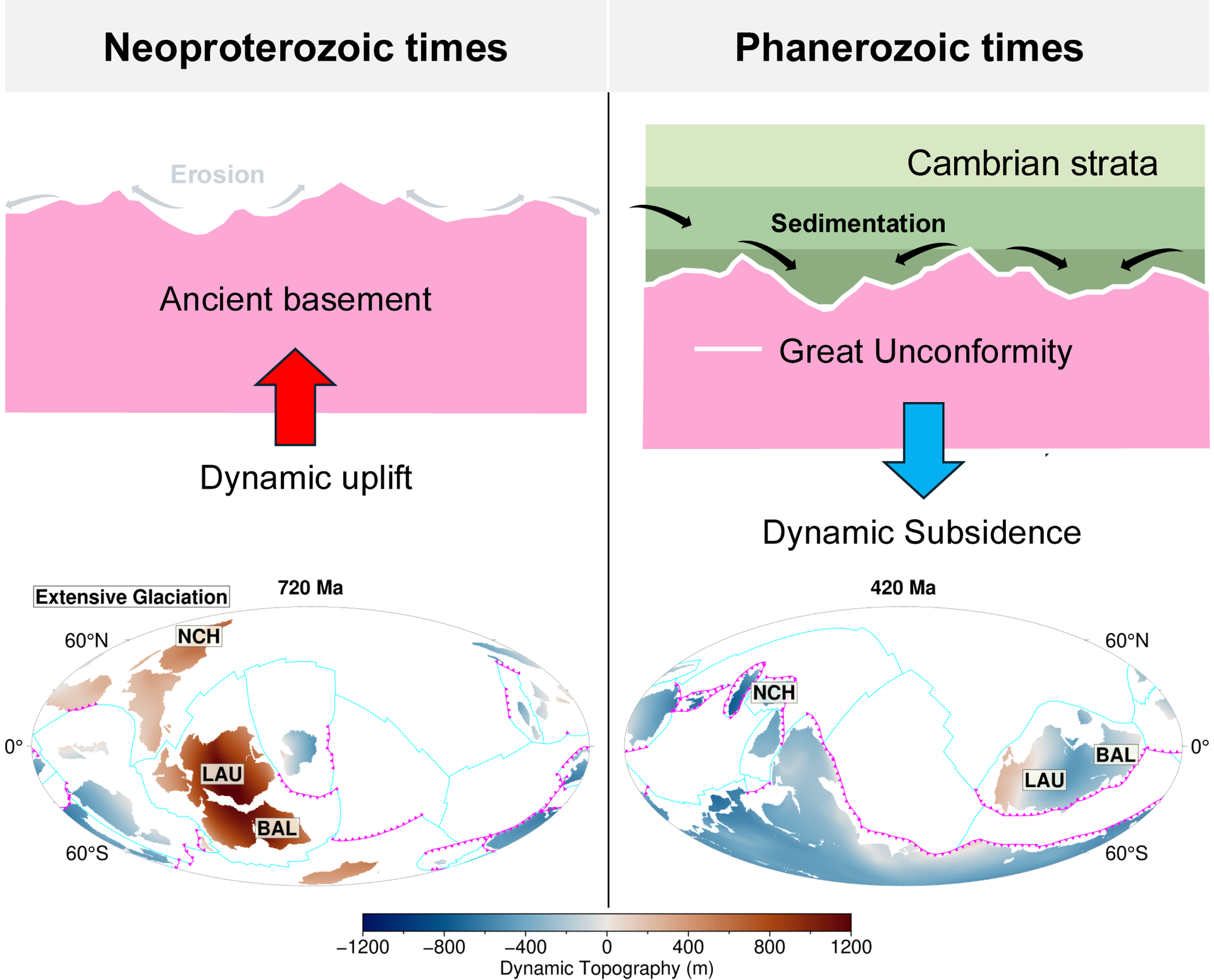
The cause of the Great Unconformity is hotly debated, with some arguing that a global deep freeze known as Snowball Earth could have shoveled sediment off the continents in this period. Glaciation probably played a major role in erosion, Flament said, but the new study suggests that the key driver was deep within the planet. Without the mantle pushing the continents upward, glaciers and other erosive forces would have had no slope to push sediments down, he said.
Constant flux
Earth is in a constant state of recycling crust through plate tectonics, said Shanan Peters, a geologist at the University of Wisconsin-Madison who was not involved in the study. Oceanic crust sinks back into the mantle through the process of subduction — when one tectonic plate dives beneath another. The chemicals it carries down with it get released back into the atmosphere via volcanic eruptions, linking the mantle with the atmosphere.
And tectonics aren't steady. As continents break up and join back together over eons, different materials get pushed into the crust. For example, the ancient Paleo-Tethys ocean, which lapped off the shores of the supercontinent Pangaea until it closed about 200 million years ago, was rich in carbon-bearing sediments that eroded from the continents, Peters, said. When the ocean floor was subducted back into the mantle, this carbon was pushed into the depths of the planet.
It contributes to the environment in which complex life evolved.
Nicolas Flament, geoscientist at the University of Wollongong in Australia
Today, in contrast, most of Earth's subduction is around the Pacific Rim, and much of the Pacific seafloor is remote from continents, the seafloor is relatively starved of carbon. What's getting pushed into the mantle now is therefore a different chemical composition than what existed 200 million years ago.
In that sense, referring to the Great Unconformity as "missing information" isn't accurate, Peters told Live Science. Instead, the absence of a rock record in those places at that time reveals something about the processes going on back then — and hints at how geology might have been affecting the atmosphere, and thus life's evolution.
The geological processes occurring during the time of the Great Unconformity may have set the stage for the Cambrian explosion, Peters said. For example, the crystalline rocks exposed on the surface at that time may have released elements like potassium, iron, manganese and carbon into the seas at an increased rate, prompting marine life to invent biomineralization — shells — in response and possibly shifting the composition of Earth's atmosphere to be more oxygen-rich, Peters said.
Flament agreed that the geological changes had significant knock-on effects for life. "It contributes to the environment in which complex life evolved," Flament said.
What's particularly interesting about the Great Unconformity is how it reveals not just a period of erosion but also a switch back to the deposition of sediments. The new paper provides an explanation for both, Peters said, and changes in the mantle are just the planetary-scale process to explain this big-picture phenomenon.
Related stories- 'Missing link' found in ancient rocks of Colorado show that Snowball Earth really happened
- A billion years of geologic history is missing from the Grand Canyon
- Huge layers of rocks on early Earth vanished, and stealthy scientists may have finally found them.
"This seems to me to be the only reasonable way to go back and forth between this state over time," he said.
There are still questions about what else the continents were doing in this time period. Peters leads an effort called Macrostrat that is pulling together observations of rock layers around the world, and Flament said he hopes that database will help ground-truth the new models' findings.
"So far in Africa and Russia, we don’t have as comprehensive a database," he said. "Once that is done, we can go and check whether the idea works."