If you're approaching menopause, you are likely being bombarded by online ads for treatments promising relief for everything from hot flashes to brain fog. Some of these therapies have been approved by the Food and Drug Administration (FDA) and have strong evidence to support them — but one hormone-based treatment that's gaining in popularity has much less science to back its use for menopause.
More doctors are writing their menopausal patients prescriptions for testosterone therapy. A 2026 study conducted in the U.S. recorded over 90,000 off-label prescriptions for testosterone to women in 2025, mainly among women ages 45 to 64 and those with diagnoses of menopause. This marked a 58.7% increase from 2024.
These prescriptions are "off-label" because the FDA has not yet approved testosterone as a treatment for menopause, perimenopause (the transition into menopause) or postmenopause (the time period afterward).
So, does scientific evidence support the use of testosterone to alleviate menopause symptoms? Or is it too soon to say?
While testosterone treatment for menopause has gained popularity, there's limited evidence to back up its use, experts say. (Image credit: Bloomberg via Getty Images)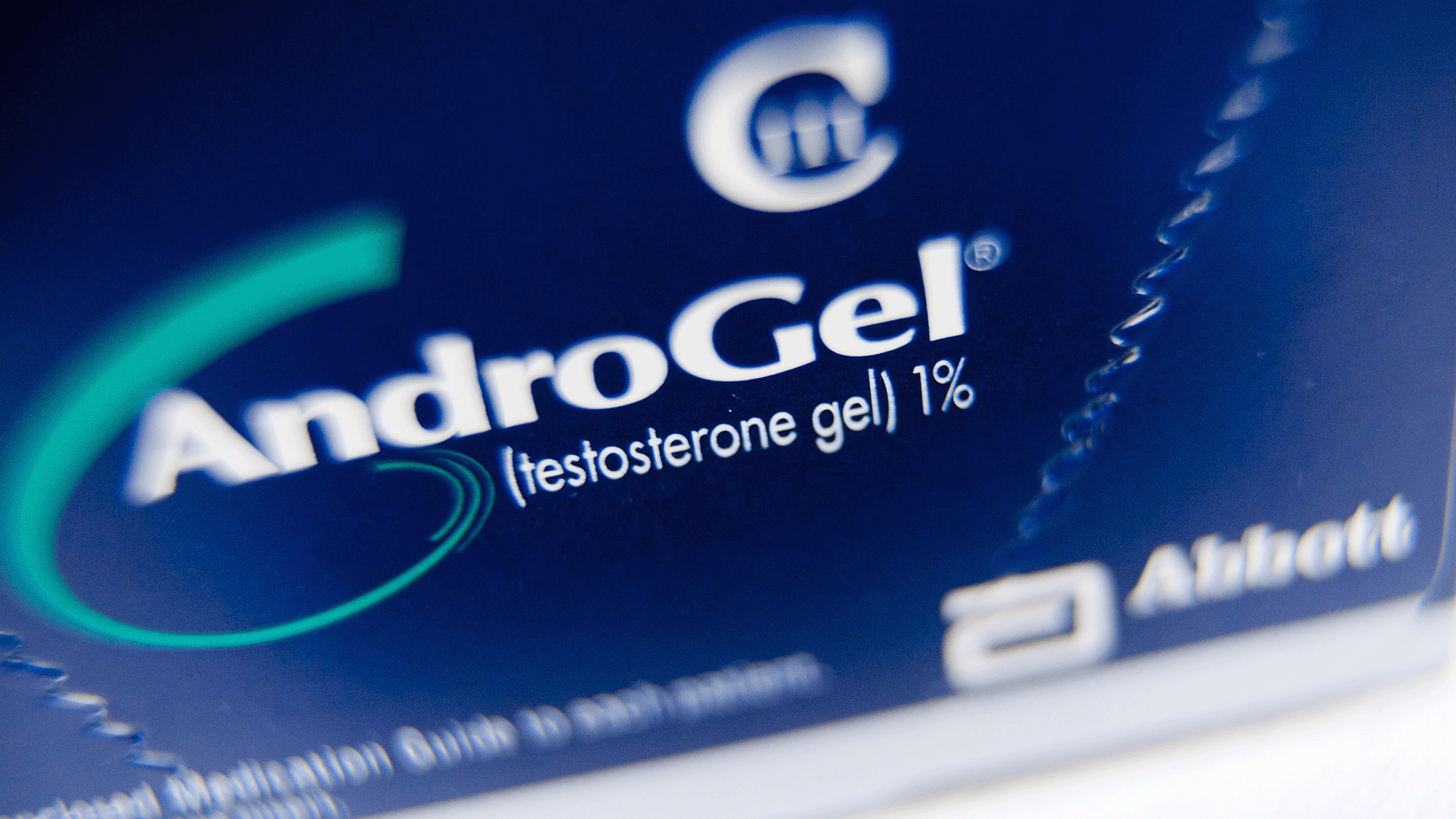
No direct link to menopause symptoms
Although often called a "male" hormone, testosterone is also produced by females, albeit at lower levels than in males, on average.
There's a common misconception that females experience "androgen deficiency" — a marked decline in testosterone and related hormones — leading up to menopause, said Susan Davis, a professor of endocrinology and the head of the Women's Health Research Program at Monash University in Australia. This is not the case.
Rather, in females, testosterone levels tend to drop slowly between ages 20 and 60, and there's a slight rebound from age 60 onward. Menopause, which generally occurs around age 51 to 52, is not linked to a marked decline in testosterone. Estrogen and progesterone fluctuate during perimenopause and then decline sharply, and these changes clearly contribute to the telltale symptoms of perimenopause and menopause.
Placebo-controlled trials have not been able to show that testosterone treatment helps to alleviate brain fog or improve well-being, mood, bone density or muscle function in menopausal patients, said Davis, who has conducted a number of these trials herself.
"Telling women that fatigue, low mood, brain fog are symptoms of androgen deficiency is completely untrue," she emphasized.
On Sept. 17, the FDA held a public workshop to evaluate the evidence for testosterone therapy for menopause, concluding that more evidence is needed to fully assess the use of the hormone as a menopause treatment.
Testosterone for low sex drive?
There is some evidence to suggest that testosterone might help to treat a condition called hypoactive sexual desire disorder (HSDD) in postmenopausal women. HSDD describes when a person has little to no sex drive and it causes them distress. Men and women of many ages experience it, so the condition is not unique to menopause. But it can sometimes develop in perimenopausal and postmenopausal women.
A review of 36 randomized trials involving 8,480 participants found that testosterone treatment delivered with skin patches was associated with 0.85 additional satisfying sexual events per month in postmenopausal women, compared to a placebo. This observed effect is not huge, Dr. Nanette Santoro, a professor of obstetrics and gynecology at the University of Colorado School of Medicine, told Live Science in an email.
Of all the studies done to date, if there was a screaming benefit, you think you would have seen it.
Susan Davis, head of the Women's Health Research Program at Monash University
Lately, anecdotal accounts of postmenopausal women having "fantastic sexual awakenings" after taking testosterone have been floating around, Santoro said. But these anecdotes haven't been backed by hard data yet. "Patients are being bombarded with a tsunami of information providing them with the most sky-high expectations imaginable," she said.
Notably, testosterone is not FDA approved as a treatment for HSDD in menopause yet. A drug called flibanserin, which affects serotonin in the brain, is approved to treat HSDD for pre- and postmenopausal women under age 65.
Placebo effects muddy the data
The placebo effect — when patients perceive an improvement in their health or well-being despite receiving a treatment with no active ingredient — can also complicate testosterone trials.
Davis said that in her patient groups, it's common for about 1 in 3 trial participants to report an improvement of their symptoms even though they are taking a placebo. Other trials have reported similar findings in their placebo groups, with about 30% to 40% experiencing some improvement in sexual desire and satisfaction, for example.
"I wouldn't say that there is definitely not a benefit," Davis said. "It's just that a benefit has not been shown."
One study trying to address this gap is the U.K. National Institute for Health and Care Research's ESTEEM trial. This large-scale, gold-standard trial aims to recruit hundreds of menopausal women and test whether using testosterone cream can reliably improve their quality of life. The cream will deliver testosterone through the skin and be applied to the lower abdomen and thighs. (Doctors often advise women to apply the creams in this way because those body parts are easy to hide if the treatment causes localized hair growth that the patients would prefer to conceal.)
The trial runners will track participants' symptoms linked to menopause, looking at sleep quality, memory performance, feelings of anxiousness, migraines, body mass, and overall well-being. The results of that trial are currently expected by 2028.
In the meantime, though, there isn't strong evidence that testosterone directly improves symptoms of menopause beyond HSDD. "Of all the studies done to date, if there was a screaming benefit, you think you would have seen it," Davis said.
Females' testosterone levels generally decline throughout adulthood, with a slight increase after age 60. However, there isn't a sharp dip in testosterone around the time of menopause. (Image credit: KATERYNA KON/SCIENCE PHOTO LIBRARY via Getty Images)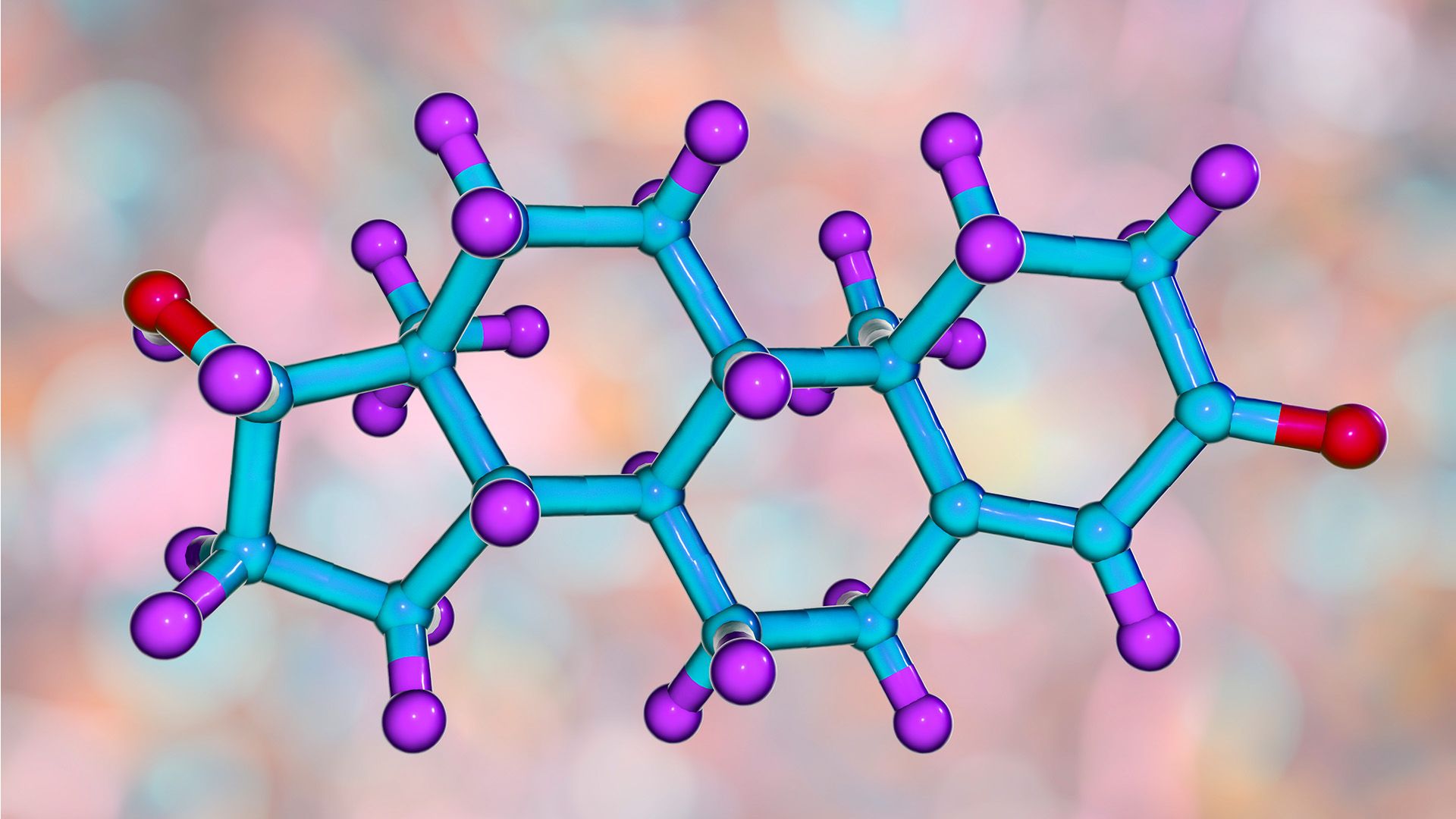
Could taking testosterone for menopause be harmful?
Testosterone treatments available in most countries are not necessarily dosed for use in female patients. Only four countries — Australia, South Africa, New Zealand and the United Kingdom — have authorized a testosterone cream that's specifically formulated and dosed for women. These products differ from testosterone therapies for men in that they contain lower doses of the hormone. They are available to postmenopausal women with HSDD, specifically.
In other countries, such as the U.S., doctors are left trying to adapt medication dosed for males for their female patients, which can lead to a wide variation in dosing. And the effects of these different dosing regimens are poorly understood for female patients. "It is not necessarily unsafe to use male preparations for women, it's just that much, much less must be used," Santoro said.
Excessive doses raise concern about unwanted masculinizing effects, such as clitoral enlargement, voice deepening, hair thinning, baldness, and rapid growth of facial and body hair, Santoro said. (These masculinizing effects might be sought after in the context of gender-affirming care for transgender men and transmasculine people, but would often be undesirable for cisgender women.)
Additionally, the potential impacts of extra testosterone on cardiovascular health and breast cancer risk are poorly understood, Santoro noted. At lower doses, testosterone can cause mild acne, oily skin, and some increase in facial and body hair growth in postmenopausal women, trials have found; if these symptoms remain mild, they are generally considered acceptable.
Testosterone is being used off-label in the U.S., which means the "safety, efficacy and appropriate dosing for that use have not been evaluated and approved by the FDA," a spokesperson for the agency told Live Science in an email. The dosages and formulations approved for males "may differ substantially from what might be appropriate for women, whose testosterone levels and metabolic profiles are clinically distinct," the spokesperson said.
Exclusive to Live Science Pro- Could psilocybin treat brain injuries? Neuroscientist explains how psychedelics could fill a gap in head trauma care
- Adversity shaped our evolution as a species. People raised in it may have underrecognized strengths because of it.
- 'The right diagnosis is unbelievably powerful': It can take years to diagnose rare diseases, and scientists are trying to fix that
Anecdotally, Santoro encountered one female patient who had received very high levels of testosterone through an implant placed under the skin, which had been prescribed to her by a different doctor. She started losing her hair and seeing sizable growth in her clitoris, while her breasts started "shrinking away."
"Women are being prescribed some very big doses in North America, and no one studied the safety of these," Santoro said.
At the end of the day, Davis argues that women deserve to be given accurate information, given that navigating menopause can already feel like "swimming through wet cement." Good menopause care not only involves discussing potential pharmacological treatments, but also evaluating a patient's lifestyle, such as diet and exercise, and discussing societal pressures that often affect menopausal people. For instance, they may face pressure to maintain an active sex life and younger-looking physique.
When it comes to hyped therapies like testosterone, she said, "just be cautious about people who tell you they've got the answer that no one else has got."
This article is for informational purposes only and is not meant to offer medical advice.
Help us improve Live Science Pro: We're always trying to make our content better. Leave us feedback about Pro here.