Latest
Pinned Updated Nov. 14, 2026, 3:34 p.m. ETReporting from SpaceX’s Starbase launch site in South Texas
Here’s the latest.
After launching on Friday and circling Earth for the better part of a day, the latest test flight of Starship, SpaceX’s spacecraft, is set to make history. The orbital craft is expected to re-enter Earth’s atmosphere on Saturday afternoon and, for the first time, return to the launchpad where it started.
At about 4:18 p.m. Eastern time, if all goes as planned, it will slow to a hover next to the launchpad tower and slide between two giant mechanical arms that will grab it out of midair.
This maneuver is crucial to making Starship a reusable rocket.
The flight so far: Liftoff from SpaceX’s Starbase launch site in South Texas occurred at 5:47 p.m. Eastern time on Friday. It was almost flawless. Once in orbit, the upper-stage Starship spacecraft deployed 26 of the company’s next-generation Starlink satellites. Read more ›
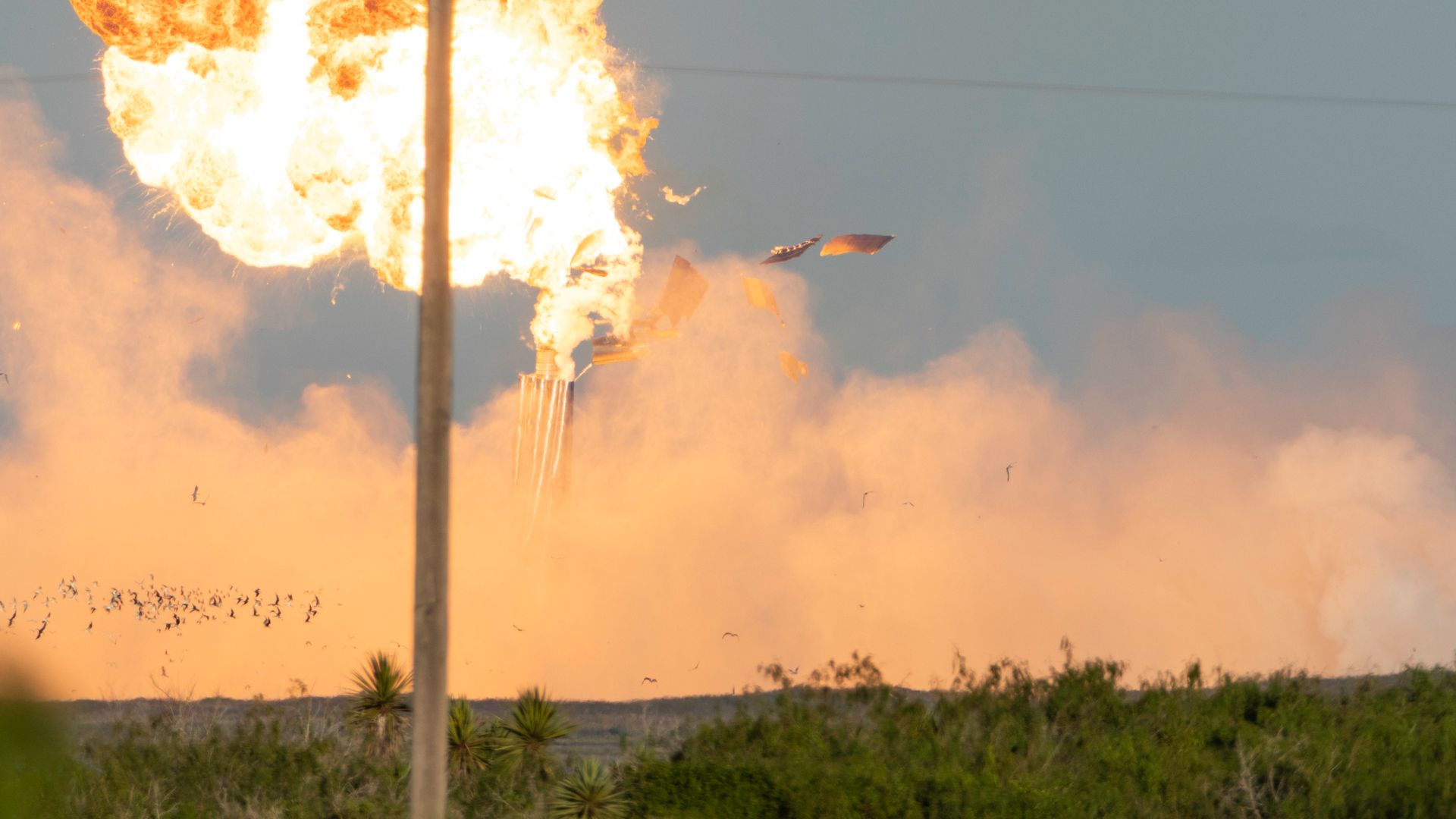
No booster catch: SpaceX had hoped to catch the bottom half of the rocket, the giant booster stage known as Super Heavy. After finishing its part of the flight two minutes after liftoff, the booster dropped away and headed back toward the launchpad. However, the booster detected a problem with its guidance and navigation control and instead performed a simulated landing over the Gulf of Mexico.
Heat shield: In an overnight update on its webcast, SpaceX reported that data from cameras on the ground and on two of the deployed Starlink satellites showed that the tiles that protected the underside of the Starship spacecraft from the fiery temperatures of re-entry were in good condition.
Nov. 14, 2026, 3:59 p.m. ETReporting from SpaceX’s Starbase launch site in South TexasAt the press viewing site, a SpaceX employee just handed out foam ear plugs. The returning spacecraft is expected to create a loud sonic boom.
 Nov. 14, 2026, 3:58 p.m. ET
So how will Starship make it home? SpaceX will fire the spacecraft’s engines to slow it down, so it can fall out of orbit. Then it will fall through the atmosphere, “a bit like a skydiver,” said Alistair John, the aerospace engineering director at the University of Sheffield in England.
Similar to a skydiver moving his arms and legs, four flaps deployed on the spacecraft will allow for slight steering. Air resistance slows it down in a big belly flop through the atmosphere. At the end, the engines will relight to flip the spacecraft vertically into a hover — and then hopefully right into the tower’s mechanical arms.
Advertisement
SKIP ADVERTISEMENTNov. 14, 2026, 3:45 p.m. ETReporting from SpaceX’s Starbase launch site in South TexasHow Starship will play a big role in Artemis III.
ImageAn Orion spacecraft sitting on top of the Space Launch System rocket before the Artemis II mission. During Artemis III, Orion will try to dock with Starship.Credit...Kenny Holston/The New York TimesSpaceX’s Starship is slated to participate in its first NASA mission sometime in the second half of next year, as part of the space agency’s efforts to return humans to the moon.
NASA’s Artemis program aims to land astronauts on the lunar surface by the end of 2028, but the next mission, Artemis III, will stay in orbit around Earth. The main objective of this flight is to practice docking with two prototype lunar landers.
Artemis III is similar to what NASA did half a century ago with Apollo 9. That often overlooked mission provided a crucial check that the lander would work as designed.
During Artemis III, which is expected to last 14 to 17 days, four astronauts will launch inside the Orion capsule atop a Space Launch System rocket from Florida. Once in orbit, Orion will try to dock with the Blue Moon spacecraft built by Blue Origin, the space company started by Jeff Bezos. The astronauts will be able to enter a crew cabin on Blue Moon.
On the sixth day of the mission, SpaceX will launch a Starship. This spacecraft will largely be a run-of-the-mill version pulled off SpaceX’s assembly line, but with a docking port attached at the top.
The spacecraft will not include modifications like a crew cabin or a life support system, which will be needed for the lunar lander version. That means the Artemis III astronauts will not be able to enter Starship.
However, a successful docking will offer data on a change that SpaceX is seeking for the moon mission. Instead of Starship and Orion traveling separately to lunar orbit and docking there, SpaceX wants the two spacecraft to dock in low-Earth orbit, and then Starship would provide the propulsion to get them to the moon.
On the eighth day of the mission, Orion is expected to dock with Starship for two hours, in order to test whether the combined spacecraft will perform, considering that Orion was not originally designed for that configuration.
“It gives us critical data and allows us to really understand the forces of docking, how we’re going to push, how we’re going to work together,” Jeremy Parsons, NASA’s Artemis program manager, said during a news conference in October.
Parsons said he was also interested in another crucial demonstration that was planned for early next year, showing that ultracold liquid methane and liquid oxygen propellants can be transferred from one Starship to another.
Because Starship uses up most of its propellant just to reach orbit, it will need to refill its tanks before heading to the moon.
“This is going to be a first-of-its-kind SpaceX mission where they’re going to launch two starships in quick succession,” one from Texas and one from Florida, Parsons said.
Show moreNov. 14, 2026, 3:37 p.m. ETReporting from SpaceX’s Starbase launch site in South TexasYou might notice “DON’T PANIC” on the side of Starship. This is a reference to Douglas Adams’s “The Hitchhiker’s Guide to the Galaxy.” This particular ship is No. 42 off the production line, and in Adams’s book, 42 was the answer to the ultimate question of life, the universe and everything.
Nov. 14, 2026, 3:31 p.m. ETReporting from SpaceX’s Starbase launch site in South TexasUnlike yesterday’s launch weather, which was warm with cloudless skies and bright sunshine, today is cool, breezy and gray. It seems there are fewer spectators.
Advertisement
SKIP ADVERTISEMENTNov. 14, 2026, 3:31 p.m. ETReporting from SpaceX’s Starbase launch site in South TexasDan Huot, the SpaceX commentator, says SpaceX has another option to avoid flying over land, if the team determines it’s risky for the spacecraft to fly over populated areas. SpaceX could command Starship to tumble into the atmosphere, which would bring it down in the Pacific.
Nov. 14, 2026, 3:30 p.m. ETReporting from SpaceX’s Starbase launch site in South TexasInside Starfactory, where Starships are born.
ImageSpaceX gave reporters a tour of the Starship manufacturing facility in Texas on Friday, but did not allow any photographs or videos to be taken inside.Credit...Kenneth Chang/The New York TimesOn Friday, SpaceX gave reporters a rare tour of its Starship manufacturing facility in Texas, named Starfactory.
SpaceX did not allow any photographs or videos to be taken during the visit. But it is hard to imagine the million-square-foot factory that builds Starship without walking through it.
Each rocket is more than 400 feet high and 30 feet wide, and the numbers do not convey the immensity.
Even though it is building the biggest rocket ever, Starfactory is more like a toy factory or an automobile assembly line than a traditional aerospace factory, said Justin Styer, senior director of Starship launch at SpaceX.
“Traditionally, rockets, airplanes, whatever, have been these extremely precious, artisanal, one-off creations,” Styer said. “SpaceX works really differently. Our whole idea is to kind of incorporate automotive methods, incorporate just general, more mass-manufactured things, to the rocket space.”
“We’re trying to make it very normal, very sort of pedestrian with its consistency so that humanity can take advantage of it like any other transport system,” he added.
The SpaceX factory in Hawthorne, Calif., where the company makes its Falcon 9 rockets, was originally a factory for airplane fuselages. The Texas site was built from the bottom up for the company’s rockets.
In the Starfactory entrance lobby, a giant globe of Mars hangs from the ceiling, a reminder of Elon Musk’s ultimate destination for Starship.
Five floors of office space in the front of the building include walkways that overlook the bright, cavernous space of Starfactory. Almost everything, including the floors and girders rising to the ceilings, is gleaming white, with some swaths of black. It seems that an unofficial uniform for SpaceX employees consists of a black T-shirt and jeans.
Pieces of the rocket in various stages of manufacture line up along the assembly line. Half of the factory is devoted to the Super Heavy booster and half is “Shipland,” an area set aside for building the upper-stage spacecraft that goes into orbit. A wide-open aisle extends the length of the floor between the two.
It takes seven to eight months to complete one booster or one Ship, but there are so many under construction simultaneously that one booster is completed every four weeks and one Ship every two weeks, said Danny Fain, director of booster production.
Once finished, they are taken to nearby tall buildings known as megabays where the Raptor engines are installed.
Fain said it used to take five to six hours to attach one engine. Now, SpaceX has sped up the process to 30 minutes, he said.
SpaceX’s goal is to make space travel seem “extremely lame,” Styer said — something ordinary and common, not rare and expensive.
“We hope to unimpress you with the normalcy after seeing a lot of rocket parts,” he told the reporters.
Show moreNov. 14, 2026, 3:26 p.m. ETReporting from SpaceX’s Starbase launch site in South TexasOne of Starship’s engines just fired briefly. That was enough for the spacecraft to drop out of orbit.
Advertisement
SKIP ADVERTISEMENTNov. 14, 2026, 3:15 p.m. ETReporting from SpaceX’s Starbase launch site in South TexasAbout an hour ago, SpaceX gave a final “go” for trying to catch the Starship spacecraft at its Texas launch site. If anything had looked wrong, there was one last opportunity to re-enter early and splash down in the Pacific near Hawaii. If anything goes wrong at this point, Starship could still divert its path and come down in the Gulf of Mexico, as the booster did yesterday.
Nov. 14, 2026, 3:02 p.m. ETReporting from SpaceX’s Starbase launch site in South TexasHow Boca Chica Village became Starbase.
ImageA Starship prototype in Boca Chica Village, Texas, in 2019.Credit...Callaghan O'Hare/ReutersIn 2019, the first time I drove out of Brownsville, Texas, east along State Highway 4, there was almost nothing here among the marshy grasslands. I remember seeing something tall and silvery in the distance, “like a giant, shiny and pointy grain silo,” I described it.
This was a prototype of Starship — just the top part, the upper stage that is now often referred to as Ship — sitting outside next to the highway. The factory was basically just a tent, a supersize version of a wedding pavilion.
Next door was a clump of about 30 houses named Boca Chica Village. For the residents, this was a quiet refuge surrounded by a wildlife sanctuary. It was so far from anything else that it was easier for the county to truck in water, filling up big black containers on the front lawns, rather than build water lines.
It is very different now.
Instead of a tent, SpaceX now has Starfactory, a gleaming, million-square-foot manufacturing facility that churns out Starships like an automobile assembly line.
ImageA prototype of Starship looming above houses in Boca Chica Village, Texas, in 2019. The town consisted of about 30 houses, before SpaceX built up its campus in what is now known as Starbase, Texas.Credit...Marie D. De Jesus/Houston Chronicle, via Getty ImagesImageSpaceX built a campus that includes Starfactory, a manufacturing facility producing Starships, and incorporated Starbase into an official city with its own fire and police departments.Credit...Jordan Vonderhaar for The New York Times“On any given day, there’s around 8,000 people working somewhere on campus,” said Sheila McCorkle, a SpaceX vice president who serves as the general counsel for local issues.
The surrounding area is now Starbase, an official city that was incorporated in May last year. It includes a police department, a fire department and a soon-to-open public library. Brand-new houses have popped up. Water lines have been installed.
“Everything you see here, SpaceX has built from the ground up,” McCorkle said. “It was a sandbar when we started. I like to think of it as a little bit ‘Mad Max’ back in the day. People living in tents and building rockets in tents. Now we have schools, clinics.”
Starbase has about 800 full-time residents, mostly SpaceX employees, although a few of the original Boca Chica residents remain. Most of the city employees are spouses of the SpaceX employees, McCorkle said, adding that her husband runs the economic development corporation for the city.
“Sometimes I call it like a capitalist commune,” McCorkle said. “We’re well funded, so the commune part actually works. Like we’re all in it together.”
Show moreNov. 13, 2026, 9:30 a.m. ETSpaceX’s latest starship launch skipped the attempt to catch the booster.
Video SpaceX Calls Off Attempt to Catch Rocket Booster The Starship booster splashed down in the Gulf of Mexico soon after the launch.CreditCredit...Ricardo Arduengo/Agence France-Presse — Getty Images
SpaceX will have to wait until its next test flight of Starship to recover all parts of the giant rocket in a single mission.
The company had hoped to execute a milestone “double-catch” maneuver during the flight that launched on Friday from South Texas. That will be a key step toward SpaceX’s goal of developing a fully reusable rocket.
Until recent years, rockets have generally been expensive, single-use throwaways. If all of Starship, which is the largest rocket ever built, can be repeatedly flown, it would revolutionize the space industry, enabling launches of bigger, heavier satellites and other cargo at lower costs.
In addition, NASA is counting on a version of Starship to serve as a lunar lander for its Artemis program. The catches are not needed for NASA’s Artemis III mission next year, but any failures would make it even more unlikely that NASA could meet its goal of landing astronauts on the moon in 2028.
When is the launch, and how can I watch it?
Starship launched on schedule at 5:47 p.m. Eastern time from its Starbase site outside Brownsville, Texas, into a clear azure sky, even as the Federal Aviation Administration issued a nationwide ground stop for air travel.
You can watch SpaceX’s coverage in the player above.
As the booster headed back to the launchpad, the commentators on SpaceX’s webcast said the attempted catch was called off. Instead, the booster made a simulated landing over the Gulf of Mexico, which ended with a loud explosion.
What is Starship?
At 407 feet tall, Starship is the largest and most powerful rocket ever built. It consists of two pieces: a powerful booster stage with 33 engines known as the Super Heavy, and an upper-stage spacecraft, also called Starship and often shortened to Ship.
“It’s designed for not just full reusability but also rapid reusability, like an aircraft,” Elon Musk, the founder and chief executive of SpaceX, said in September during the All-In Summit, a business and technology conference.
A previous Starship test flight in September was the first to enter orbit around Earth. The mission successfully deployed 26 of SpaceX’s newest Starlink satellites, which will become operational pieces of the internet communications network.
What is happening during this flight?
This is the 15th test flight of Starship. After launching from the southern tip of Texas, the rocket headed eastward over the Gulf of Mexico.
The SpaceX webcast commentators said they did not know why the booster catch attempt was called off.
The upper-stage Ship continued upward to orbit, about 170 miles above Earth, where it deployed another batch of 26 Starlink satellites.
After 22 hours and about 14 trips around the planet, Ship will drop out of orbit and head back to the launch site, where it is to be caught by the mechanical arms on the launch tower.
ImageA still image from a SpaceX livestream of a Super Heavy booster about to be caught with mechanical arms as it returned from a launch in 2024.Credit...SpaceX/EPA, via ShutterstockIs there any danger as Ship crosses the United States toward landing?
During Flight 14, SpaceX showed that it could restart an engine on the upper-stage Ship, allowing the craft to first enter a circular orbit and then to drop out of orbit.
If something on the spacecraft is not performing quite as expected, the return schedule can be moved up so that it will land in an empty swath of the Pacific Ocean.
That is what happened during Flight 14. Although SpaceX was not going to try to catch the Ship, it did plan to re-enter over the United States and then simulate a landing over the Gulf of Mexico. However, because one of the upper-stage engines had failed during ascent, SpaceX decided to be cautious and have the Ship return early, splashing down in the Pacific.
What comes after this test flight?
Flight 16 could be the first Starship launch from SpaceX’s revamped launchpad at NASA’s Kennedy Space Center in Florida. The launch site in Texas is not sufficient to serve SpaceX’s planned acceleration of Starship launches. Another Florida launchpad is under construction at the nearby Cape Canaveral Space Force Station, and SpaceX has announced plans to build a huge launch complex in Louisiana.
SpaceX could also hit a major milestone next year if it can launch two Starships in quick succession, dock them together in orbit and then move liquid methane and liquid oxygen propellants from one Starship to the other.
The refueling maneuver is essential for Starship to leave low-Earth orbit and head to more distant destinations like the moon and Mars. That is because by the time the upper-stage Ship reaches orbit, its tanks are almost empty.
SpaceX’s plan is to put up the equivalent of an orbital gas station. A series of tanker Starships will bring propellants to fill up the station. When it is full, the Starship that is headed to the moon or elsewhere beyond low-Earth orbit will launch, dock with the gas station, refuel and then continue on its journey.
Why is Starship important for NASA?
In the second half of 2027, NASA plans to undertake its Artemis III mission. That trip will not go to the moon but will remain in orbit around Earth to practice docking procedures. Like the Artemis II mission that flew to the moon and back this year, the Artemis III astronauts will sit inside an Orion spacecraft, launched atop of NASA’s Space Launch System rocket.
After they reach orbit, the astronauts will practice docking with prototype moon landers, first with the Blue Moon spacecraft built by Jeff Bezos’ Blue Origin company and then with Starship.
NASA has not yet decided which lander it will use for Artemis IV, which will try to land two astronauts on the moon near its south pole.
Wasn’t Starship supposed to be heading to Mars already?
In March last year, Mr. Musk said on X that Starship would be heading to Mars by the end of 2026. The two planets line up to provide an optimal trajectory every 26 months.
On board would be Optimus humanoid robots built by Tesla, Mr. Musk’s car company.
But failures during Starship test flights last year meant that the craft would fall behind schedule. The Optimus robots have appeared in demos but do not appear to be ready for official space missions, either.
Corrected on Nov. 13, 2026:An earlier version of this article misstated the status of the Starlink satellites deployed during the Starship test flight in September. They are not yet operational.
We acknowledge mistakes in our reporting with corrections. If you spot an error, please let us know at [email protected].Learn more.
Show more