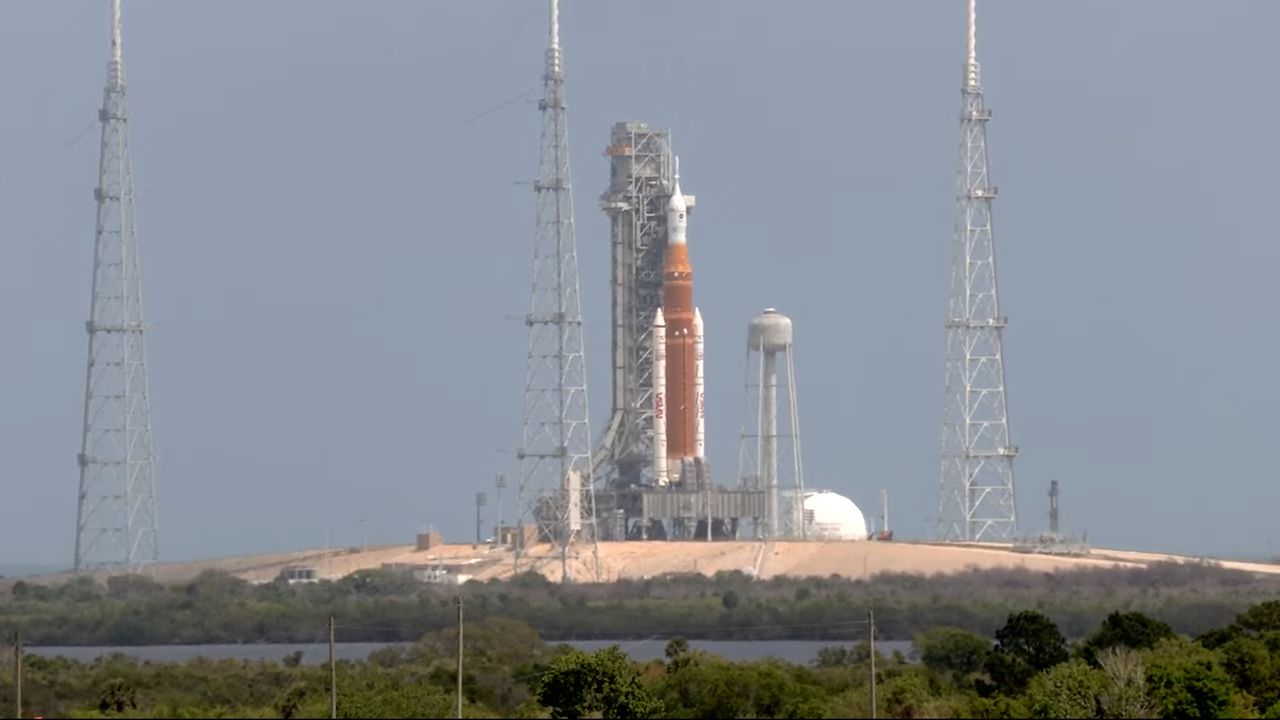
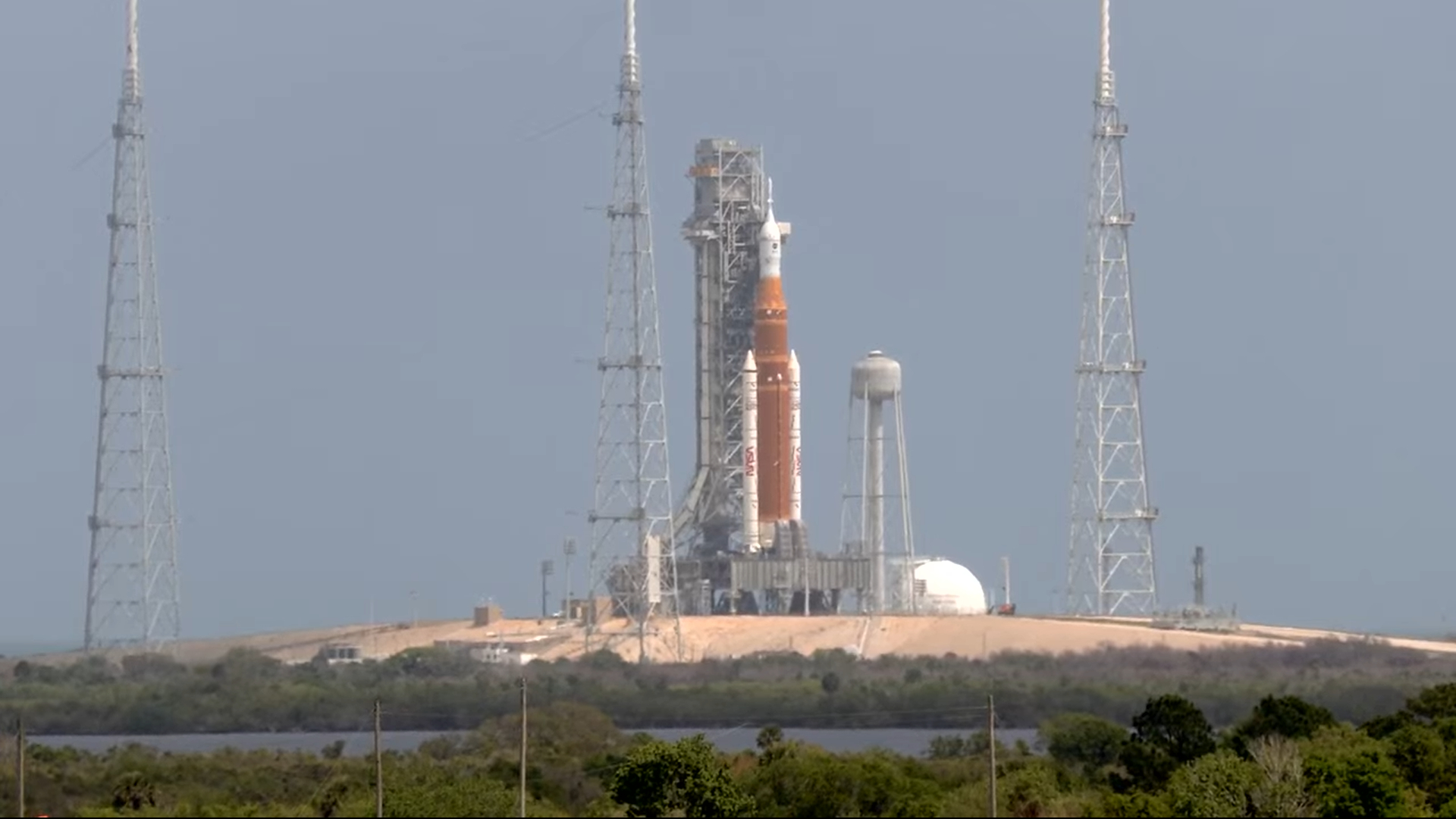
 A live view of the Artemis II rocket sitting on the launchpad at Kennedy Space Center in Cape Canaveral, Florida. (Image credit: NASA) Share this article 0 Join the conversation Follow us Add us as a preferred source on Google Newsletter Sign up for the Live Science daily newsletter now
 Get the world’s most fascinating discoveries delivered straight to your inbox.
Become a Member in Seconds
Unlock instant access to exclusive member features.
Contact me with news and offers from other Future brands Receive email from us on behalf of our trusted partners or sponsors By submitting your information you agree to the Terms & Conditions and Privacy Policy and are aged 16 or over.You are now subscribed
Your newsletter sign-up was successful
Want to add more newsletters?
Join the club
Get full access to premium articles, exclusive features and a growing list of member rewards.
Explore An account already exists for this email address, please log in. Subscribe to our newsletterNASA's Artemis II moon mission has cleared one of its biggest hurdles yet: After a full flight readiness review and other checks, teams gave the first crewed Artemis flight the green light to launch as soon as Wednesday (April 1).
"Something really big is going to happen," said launch director Charlie Blackwell-Thompson at a March 30 news conference.
Article continues belowThe weather is leaning in the mission's favor, with the latest forecast showing an 80% chance of acceptable conditions for liftoff Wednesday.
Artemis II is NASA's first chance to test the life-support equipment aboard the Orion crew capsule with astronauts on board, as well as its first crewed mission beyond low Earth orbit in over 50 years. If all goes well, the roughly 10-day flight will help prove the agency's moon-to-Mars hardware is ready for even riskier missions ahead, including crewed lunar landings and a future lunar base.
A long road to the launchpad
The mission did not reach this point in a straight line. Artemis II has worked through technical snags, including earlier trouble with liquid hydrogen leaking and a helium-flow issue in the rocket's upper stage. These issues forced extra work in the Vehicle Assembly Building before the rocket was rolled back out to Launch Pad 39B at Kennedy Space Center in Cape Canaveral, Florida. NASA said those issues were addressed as teams pushed through final integration, countdown rehearsals and launch prep.
Sign up for the Live Science daily newsletter nowContact me with news and offers from other Future brandsReceive email from us on behalf of our trusted partners or sponsorsNow, the focus is narrowing to launch day. NASA's latest update says cloud cover and possible strong ground winds are the main weather concerns for launch criteria, but the overall picture looks favorable. Teams at Kennedy Space Center began countdown activities Monday at 4:44 p.m. EDT, with the agency targeting a launch time no earlier than 6:24 p.m. EDT Wednesday.
RELATED STORIES—Artemis II: NASA is preparing for a return to the moon, but why is it going back?
This launch window runs through April 6, with April 30 being the last date for a backup attempt.
Artemis II will carry NASA astronauts Reid Wiseman, Victor Glover and Christina Koch, along with Canadian Space Agency astronaut Jeremy Hansen, on a free-return path around the moon, and it is expected to break several records. Although the mission won't land on the moon, it will help photograph the dark side of the moon like never before and pave the way for the Artemis III and Artemis IV missions as the U.S. eyes a more sustained human presence on its celestial satellite.
How much do you know about the history of missions to the moon? Try our moon landing quiz now!
TOPICS Kenna Hughes-CastleberryContent Manager, Live Science
Kenna Hughes-Castleberry is the Content Manager at Live Science. Formerly, she was the Content Manager at Space.com and before that the Science Communicator at JILA, a physics research institute. Kenna is also a book author, with her upcoming book 'Octopus X' scheduled for release in spring of 2027. Her beats include physics, health, environmental science, technology, AI, animal intelligence, corvids, and cephalopods.
View MoreYou must confirm your public display name before commenting
Please logout and then login again, you will then be prompted to enter your display name.
Logout LATEST ARTICLES 1Pig semen molecule could deliver chemotherapy to hard-to-reach eye cancer, mouse study suggests
- 2'We are getting very, very close': NASA makes final Artemis II preparations as expectation grows for Wednesday launch
- 3Farthest, fastest and most diverse: 6 major records the Artemis II astronauts will smash as NASA returns to the moon
- 4Tudor Heart: A Renaissance gold necklace featuring a French-English pun on the love between Henry VIII and his first wife, Katherine of Aragon
- 5Saturn's chaotic atmosphere revealed in most comprehensive view yet by James Webb and Hubble telescopes