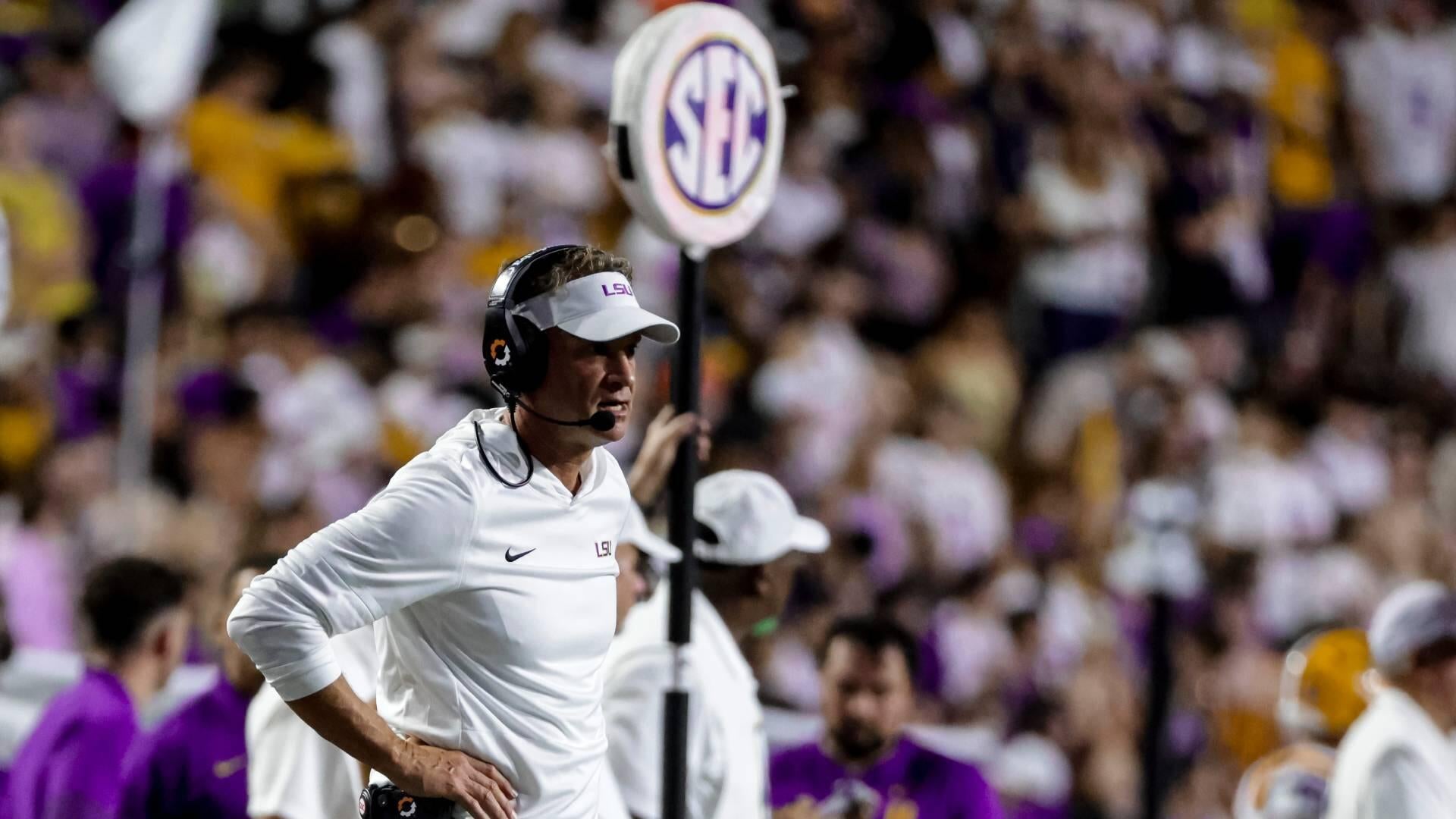
The SEC is seeking legal authority to expel LSU, according to an updated court filing obtained by CBS Sports' Brandon Marcello. The language is part of a federal suit first filed last week as the conference seeks legal coverage to enforce rules prohibiting pro athletes from returning to college sports.
"Forced association with a member whose conduct is antithetical to the SEC's mission and core values violates the Conference's fundamental First Amendment rights," reads the SEC's updated filing. "LSU has rejected those core values repeatedly and publicly. An injunction is necessary to prevent the irreparable harm that the SEC will suffer if it cannot remove a member to avoid association of the Conference's name, brand, championships, and media properties with the conduct and views that the Conference and its member institutions have condemned for decades."
While booting the Tigers from the conference would still be an extraordinary step, CBS Sports' John Talty reported last week that multiple sources believed the league had the necessary votes to do so should the Tigers refused to de-escalate the situation.
Amid rising tensions, LSU did not include Dae'Quan Wright and Zxavian Harris on its roster for its Saturday night beatdown of Clemson. The two are at the center of a legal battle over whether players who have signed professional contracts should be able to return to college sports.
A Louisiana judge granted a preliminary injunction clearing the way for them to play, a move that defies SEC rules. But the SEC's federal suit keeps their long-term eligibility in jeopardy. With two open spots on its roster, LSU could still roster the duo at some point this season.
The league's amended suit cites a Thursday "Special Meeting of the Conference" during which "potential termination" could be addressed.
In a Tuesday statement, the SEC asserted that its stance is necessary to "preserve the Conference's ability to govern competition among its members"
"The SEC and its member universities have the right to established, through agreed-upon governances procedures, the rules under which they voluntarily compete and to expect those rules to be followed," the league's statement said. "A commitment to those rules, and to the core principles of the Southeastern Conference, is an essential element of SEC membership."
LSU coach Lane Kiffin's efforts to roster players that the league classifies as former professionals is a central theme in the SEC's legal complaint. Kiffin's name is mentioned 32 times in a 44-page filing with numerous references to Kiffin's public statements about his recruiting efforts.
An Aug. 25 article by CBS Sports' Talty and Chris Hummer is referenced in which it was reported that Kiffin had "reached out to multiple players on NFL rosters or their representatives" with the purpose of getting them to pursue litigation that could enable them to return to college.
The SEC is testing its legal latitude
This marks a significant escalation from the SEC's side after the political machine in Louisiana essentially taunted the conference last week amid a state-level ruling in LSU's favor. That defiance does not appear to be sitting well with the league, even after the Tigers opted against rostering Wright and Harris for the Clemson game.
The question now is whether the league's hardened stance in federal court will be enough to get LSU to back down and drop the issue entirely. But there are also larger factors at play, as the scope and context of this SEC vs. LSU battle extends beyond the mere issue of whether Wright and Harris will play for LSU on the field in 2026.
This case is a test of the scope of the SEC's authority.
If a federal judge allows the SEC to take action against LSU, it could provide the legal basis for the conference to police itself moving forward. Want to buck an SEC rule? Fine, but you'll risk expulsion or significant penalty.
As the national landscape continues to shift in college sports, the legal enshrinement of conference authority would mark a significant development.
With uncertainty over whether the Protect College Sports Act might eventually pass and restore national-level uniformity, the concept of conference "self-governance" has become more important. The NCAA has been proven powerless in its effort to enforce nationwide rules, leaving individual leagues to weigh their appetite and legal ability to police eligibility issues (among other things).
If the SEC expelled a valuable and athletically successful charter member, it would mark a landmark moment — not just for the conference but for college sports as a whole.
In the 94-year existence of the SEC, the only instances of divorce between the league and member schools have been driven by the departing institutions. The most recent came in 1966 when Tulane left.
Never have conference members voted to expel another school. In fact, the only 21st century example of a power conference voting a program out came when the Big East gave Temple the boot following the 2004 season for allowing its football program to fall into disrepair.
Add CBS Sports on Google Join the Conversation comments