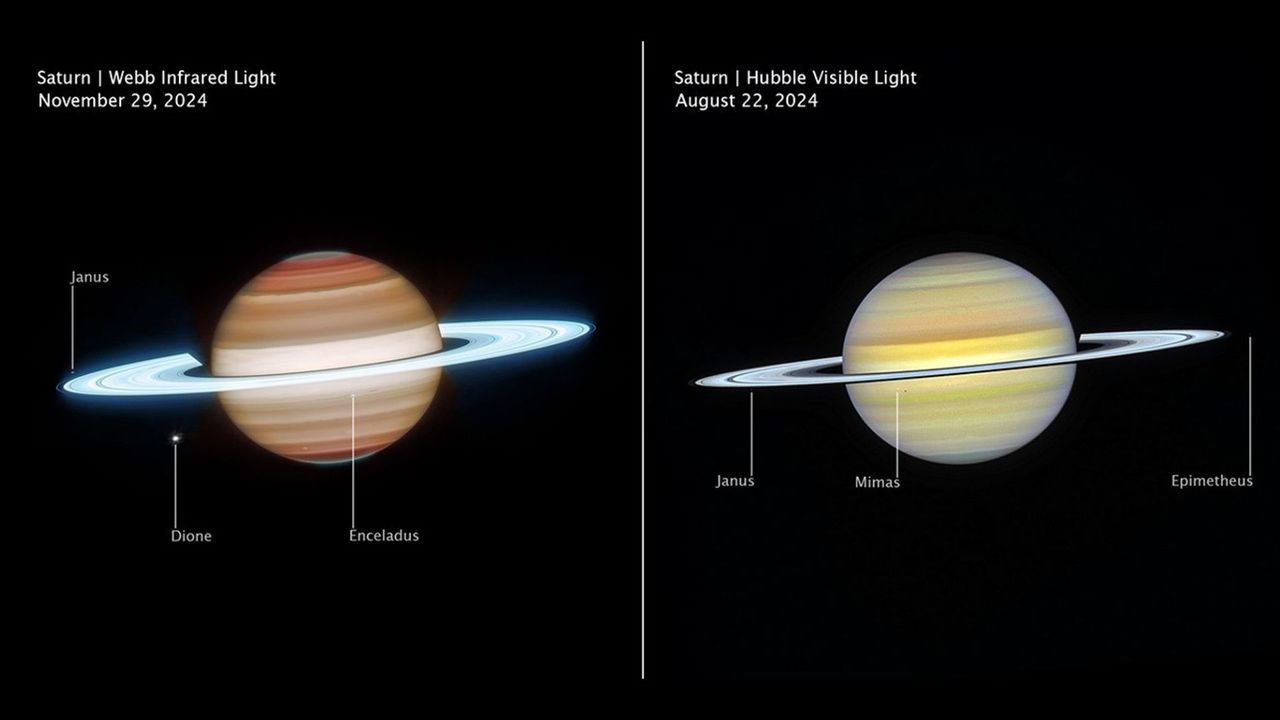
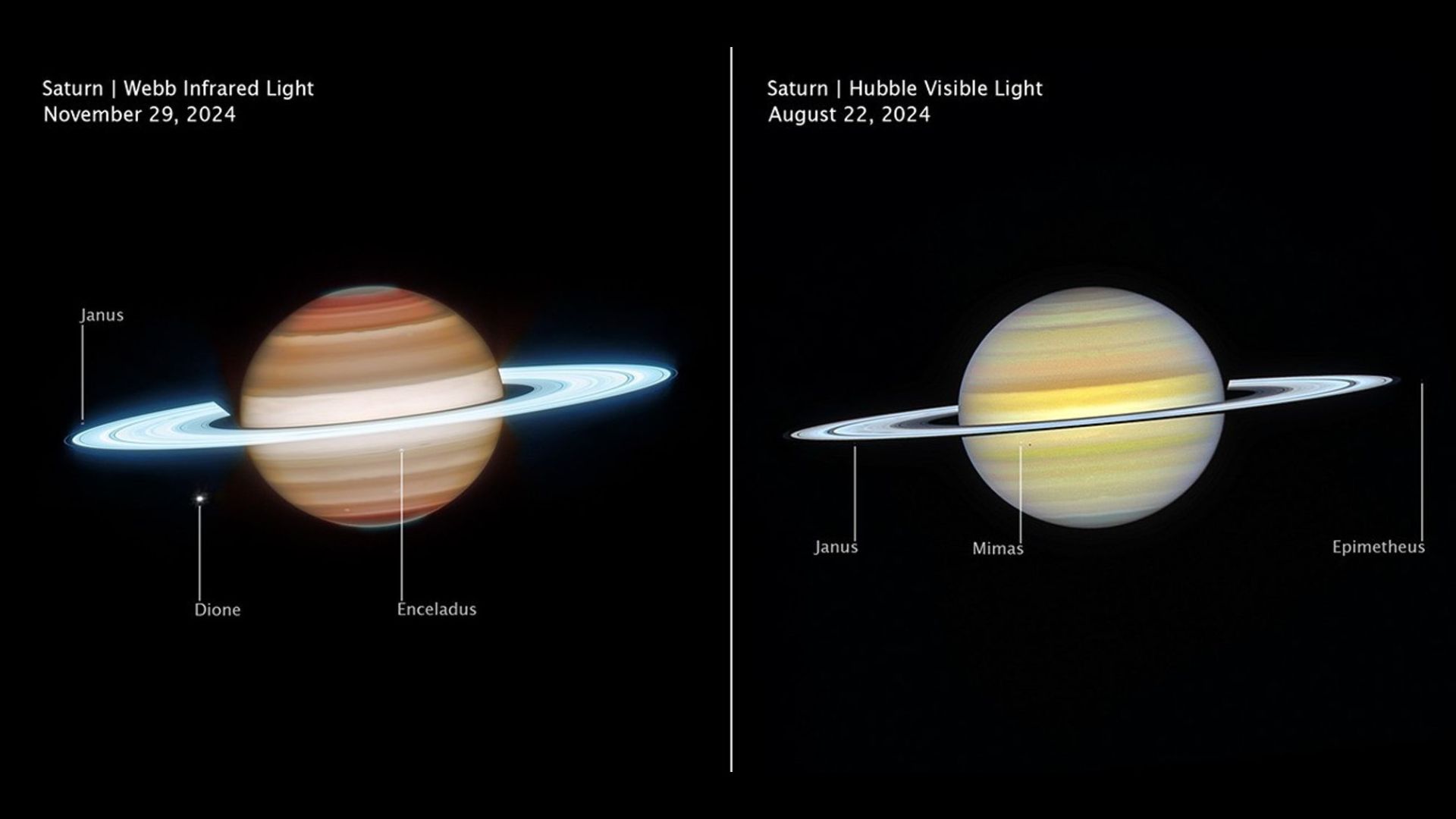
 Two images of Saturn from NASA's James Webb Space Telescope and Hubble Space Telescope show different aspects of the planet, from its atmosphere to its orbiting moons. (Image credit: NASA, ESA, CSA, STScI, Amy Simon (NASA-GSFC), Michael Wong (UC Berkeley); Image Processing: Joseph DePasquale (STScI)) Share this article 0 Join the conversation Follow us Add us as a preferred source on Google Newsletter Sign up for the Live Science daily newsletter now
 Get the world’s most fascinating discoveries delivered straight to your inbox.
Become a Member in Seconds
Unlock instant access to exclusive member features.
Contact me with news and offers from other Future brands Receive email from us on behalf of our trusted partners or sponsors By submitting your information you agree to the Terms & Conditions and Privacy Policy and are aged 16 or over.You are now subscribed
Your newsletter sign-up was successful
Want to add more newsletters?
Join the club
Get full access to premium articles, exclusive features and a growing list of member rewards.
Explore An account already exists for this email address, please log in. Subscribe to our newsletterSaturn may be famous for its rings, but it has long fascinated scientists for another reason: its restless atmosphere, which is shaped by fierce winds, stubborn megastorms and strange weather patterns that can linger for years.
Now, two new views from the James Webb and Hubble space telescopes are cutting through the ringed planet's clouds, giving researchers what NASA calls the "most comprehensive view of Saturn to date." Together, the images let researchers "slice" through Saturn's atmosphere at different heights.
Article continues belowStudying Saturn's atmosphere not only allows scientists to understand how large, planet-size storms grow and thrive but also gives further insight into how the planet formed and evolved over billions of years.
A planet seen two ways
In August 2024, Hubble took its visible-light image of Saturn as part of the Outer Planet Atmospheres Legacy program, a decade-long project that tracks the outer planets annually. The James Webb Space Telescope (JWST) captured its infrared image a few months later, in November 2024. Those observations, taken 14 weeks apart, showed the ringed planet shifting from northern summer toward its 2025 equinox.
RELATED STORIES—'Completely unexplained': James Webb telescope finds strange 'dark beads' in Saturn's atmosphere
—Saturn's largest moon may actually be 2 moons in 1 — and helped birth the planet's iconic rings
—We might have been completely wrong about the origin of Saturn's rings, new study claims
The two telescopes saw very different Saturns.
While Hubble captured Saturn's pale-yellow bands and brilliant-white rings, JWST's infrared image revealed even more striking details. In the infrared view, Saturn's rings transformed into glowing blue "because they are made of highly reflective water ice," NASA representatives said in a statement. Saturn's poles also shone a strange gray-green, emitting light at wavelengths of about 4.3 microns. These emissions could be from either light scattering off of high-altitude aerosols or auroras, NASA suggested. (The telescope recently caught giant auroras shining on Uranus.)
Sign up for the Live Science daily newsletter nowContact me with news and offers from other Future brandsReceive email from us on behalf of our trusted partners or sponsorsAs Saturn tilts into its southern springtime, both space telescopes will continue to keep their eyes on its atmosphere, perhaps revealing more about the planet's weather dynamics. Until then, Saturn is keeping some of its most interesting secrets hidden in the clouds.
Solar system quiz: How well do you know our cosmic neighborhood?
See how well you know the planets in our solar system with our quiz!
TOPICS Kenna Hughes-CastleberryContent Manager, Live Science
Kenna Hughes-Castleberry is the Content Manager at Live Science. Formerly, she was the Content Manager at Space.com and before that the Science Communicator at JILA, a physics research institute. Kenna is also a book author, with her upcoming book 'Octopus X' scheduled for release in spring of 2027. Her beats include physics, health, environmental science, technology, AI, animal intelligence, corvids, and cephalopods.
View MoreYou must confirm your public display name before commenting
Please logout and then login again, you will then be prompted to enter your display name.
Logout LATEST ARTICLES 1AI systems are enabling mass surveillance in the US, and there is no national law that 'meaningfully limits' the use of this data
- 2Endometriosis messes with the immune system and causes 'ripple effects across the body'
- 3Hubble images taken 25 years apart show big changes in the iconic Crab Nebula — Space photo of the week
- 4What would happen to Earth if the sun suddenly vanished?
- 5Top 5 health and fitness products to buy during spring sales (and 2 to skip)