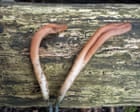
 The rare Microglossum cyanobasis was found sprouting at the Kingley Vale national nature reserve in West Sussex. Photograph: Liz FrostThe rare Microglossum cyanobasis was found sprouting at the Kingley Vale national nature reserve in West Sussex. Photograph: Liz FrostRare tongue-shaped fungus discovered in nature reserve in West Sussex
Microglossum cyanobasis – or blue-based earthtongue – is only the second such specimen ever to be found in Europe
The discovery of a rare, tongue-shaped fungus is being hailed as a sign of the crucial ecological value of England’s national nature reserves.
Never before recorded in the UK, the blue-based earthtongue, also known as Microglossum cyanobasis, was found sprouting at the Kingley Vale national nature reserve in West Sussex.
It is only the second such specimen ever to be found in Europe. Liz Frost, an amateur fungi enthusiast who frequently visits the site, made the discovery.
“I still can’t quite believe it,” she said in a blog on the Natural England website.
Frost had been exploring for fungi in the ancient yew woodland at Kingsley Vale in December when she “stumbled upon something extraordinary: a tiny tongue-shaped fungus poking up through the moss and leaf litter. Little did I know, I had just made the first ever UK sighting of Microglossum cyanobasis, and only the second recorded in Europe.”
Earth’s underground networks of fungi need urgent protection, say researchersRead moreAt about 45-55mm tall, with delicate, fragile stems, specimens of the small, well camouflaged fungus look just like their name suggests: small tongues emerging from the earth. But Microglossum cyanobasis has a rare and special feature that distinguishes it from other, more common earthtongues. The base of the stem has a distinctive cyan-bluish tinge.
“That’s actually where its name comes from – ‘cyanobasis’ meaning blue base,” said Frost. “It’s this feature that sets it apart from other earthtongues. Earthtongue fungi can act as indicators of high-quality habitats … Finding them tells us that a site has real ecological value.”
Natural England said the find was a reminder that careful stewardship of the environment could yield extraordinary results.
Rachel Guy, the manager of the Kingley Vale nature reserve, said: “The discovery of the earthtongue fungus shows off high-quality habitats and highlights the value of our 224 national nature reserves in England.
“These special places of exceptional ecological value are a credit to everyone who looks after them. The presence of the fungus signals undisturbed, nutrient-poor grasslands and long-established woodland soils. These environments are becoming increasingly rare due to fertilisation, drainage, ploughing, and land-use change.”
Microglossum cyanobasis was first discovered in northern Spain in 2009.
Explore more on these topicsShareReuse this content