Protesters outside the new US consulate in Nuuk. Photograph: Oscar Scott Carl/Ritzau Scanpix/AFP/Getty ImagesProtesters outside the new US consulate in Nuuk. Photograph: Oscar Scott Carl/Ritzau Scanpix/AFP/Getty ImagesProtests at new US consulate after Trump envoy says time for US ‘to put its footprint back’ on Greenland
 Prime minister says he will boycott opening, as protesters hold signs saying ‘stop USA’ and shout ‘go home’
Hundreds of people protested against the opening of a new US consulate in Nuuk after comments by the US special envoy to Greenland that it was time for Washington “to put its footprint back” on the Arctic territory.
Many Greenlandic politicians, including the prime minister, said they would not attend the official opening on Thursday.
Protesters carried Greenlandic flags and signs that read “USA Asu” (Stop USA) and shouted “Greenland belongs to Greenlanders” outside the Greenlandic parliament before shouting “go home” outside the US consulate.
The US special envoy, Jeff Landry, arrived in Nuuk uninvited with a delegation including a doctor, who caused fury by saying he was there to “assess the medical needs of Greenland”. Landry briefly attended a business conference with the US ambassador to Denmark, Kenneth Lowery, and left Nuuk on Wednesday night.
During his visit, Landry told Agence France-Presse he thought it was “time for the US to put its footprint back on Greenland”.
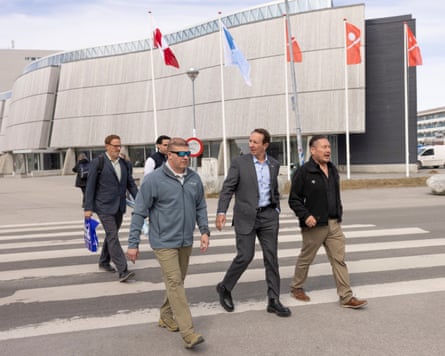 The US special envoy Jeff Landry paid an uninvited visit to Greenland on Wednesday Photograph: Christian Klindt Soelbeck/EPA
He said: “Greenland needs the US. I think that you’re seeing the president talk about increasing national security operations and repopulating certain bases in Greenland.”
Meanwhile, negotiations between the US, Greenland and Denmark are continuing, despite the fact Copenhagen is without a fully functioning government amid record-long coalition talks.
While Greenland’s prime minister, Jens-Frederik Nielsen, reiterated this week that the largely autonomous territory – a former Danish colony that remains part of the Danish kingdom – was not for sale, he also said Greenland was “obliged to find a solution” with the US.
The US already had a consulate in Nuuk, in a modest traditional-style building, but the move to new premises in a modern high-rise is symbolic of its growing presence.
Aqqalukkuluk Fontain, 37, an IT account manager who organised the protest because of the strength of feeling against the US presence in Nuuk, said: “It’s very important, now more than ever, to show the American people what we already said, that no means no, and that the future and self-determination of Greenland belongs to the Greenlandic people.”
Fontain added: “The protest itself is not to provoke Donald Trump or Jeff Landry but to show the world that Greenland has its own democracy.”
Map of Greenland in proximity to the US and DenmarkHe said the future of Greenland was a concern for the entire world. “It is very dangerous what the United States is trying to do, because if Greenland falls, the world will fall and it might lead to world war three.”
Christian Keldsen, the chief executive of Greenland Business Association, which organised the Future Greenland conference, said Landry did not get the reception he was hoping for.
“Three months ago Greenland was under threat of invasion and takeover and he [Landry] was one of the people supporting that statement,” he said. “Then three months later you show up here wanting to make friends, handing out chocolate to children and trying to hand out Maga caps.”
Among the conference speakers was Rufus Gifford, the US ambassador to Denmark between 2013 and 2017, who criticised comments by Landry to reporters that had suggested no high-level diplomats had visited Greenland before Trump became president.
In a video posted on social media, Gifford said: “He wants Greenlanders to be grateful to Donald Trump. You are way in over your head, man. Way in over your head. Go home.”
‘Under pressure’: Greenland’s PM gains fans at home and abroad after his rebuke of Trump Read moreTrump has repeatedly threatened to invade Greenland, which he claims he needs for US national security. As well as its location on the shortest route for missiles between the US and Russia, Greenland is also attracting global attention for its rare-earth minerals and its critical location for shipping as the polar ice melts.
A US Northern Command (Northcom) spokesperson told the Guardian last month the US was “evaluating options to strengthen homeland defence efforts in Greenland” and that any new defence areas would be established “in accordance with the 1951 agreement on the defence of Greenland”.
That included plans for “significant investment” in Pituffik, where the US already has a base, and the possibility of “expanding defence areas beyond Pituffik”. Among additional sites under consideration, the spokesperson said, was Narsarsuaq, a settlement in southern Greenland, but they said no final decisions had been made.
Northcom said the US was also looking at the use of deep-water ports and longer airfields, “particularly to support maritime surveillance and operations in the North Atlantic and to track activity past the Greenland-Iceland-UK Gap”.
They said they US was “coordinating with the kingdom of Denmark on site surveys and assessments”, which were expected to take several months.
While coalition talks between political leaders in Copenhagen have entered their eighth week after a general election in March, the foreign policy committee continues to meet. Denmark’s acting foreign minister, Lars Løkke Rasmussen, will attend Thursday’s Nato meeting of foreign ministers in Helsingborg, Sweden. The US secretary of state, Marco Rubio, will also be there.
In an interview with the Greenlandic newspaper Sermitsiaq, Landry appeared to try to capitalise on Greenland’s future hopes for full independence from Denmark.
“I think there are some incredible opportunities that can actually lift Greenlanders from dependency to independence,” he said. “I think that the president of the United States would like to see the country become economically independent. And I think it’s possible here.”
Get in touchContact us about this story
The best public interest journalism relies on first-hand accounts from people in the know. If you have something to share on this subject, you can contact us confidentially using the following methods:
Secure Messaging in the Guardian app
The Guardian app has a tool to send tips about stories. Messages are end to end encrypted and concealed within the routine activity that every Guardian mobile app performs. This prevents an observer from knowing that you are communicating with us at all, let alone what is being said.
If you don’t already have the Guardian app, download it (iOS/Android) and go to the menu. Select ‘Secure Messaging’.
SecureDrop
If you can safely use the tor network without being observed or monitored you can send messages and documents to the Guardian via our SecureDrop platform.Our guide at theguardian.com/tips lists several ways to contact us securely, and discusses the pros and cons of each.
Show moreExplore more on these topicsShareReuse this content