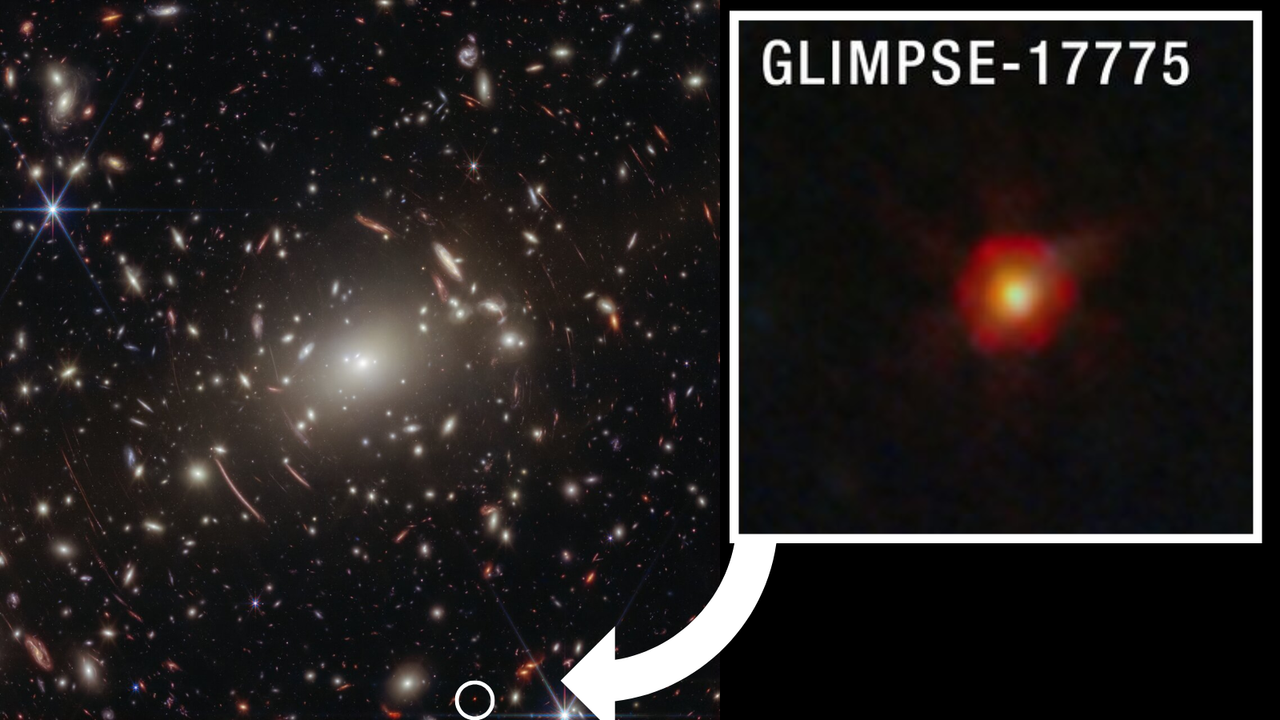
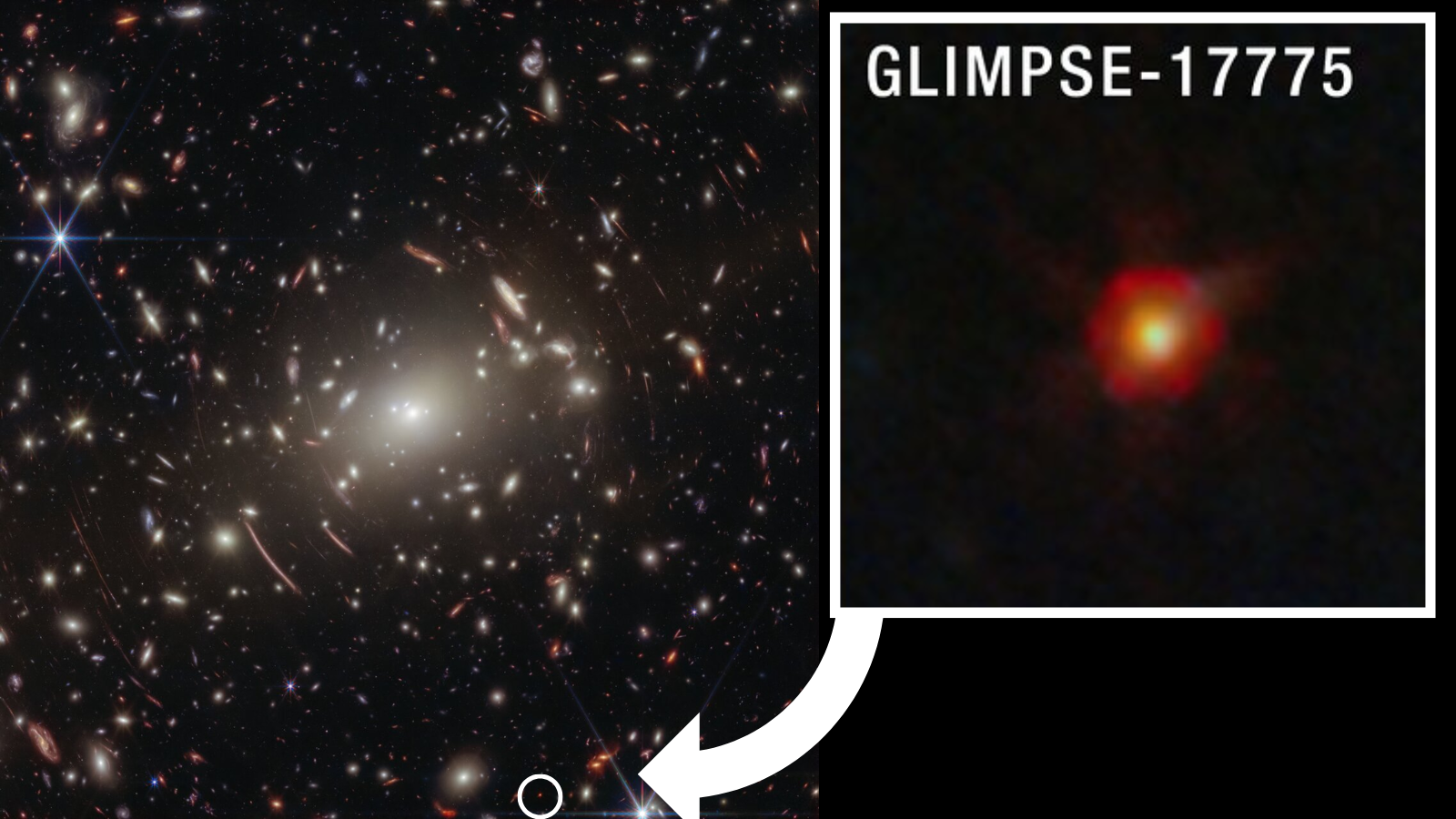
 An image of the galaxy cluster Abell S1063 and the little red dot known as GLIMPSE-17775. (Image credit: NASA, ESA, CSA, V. Kokorev (University of Texas at Austin), A. Pagan (STScI)) Share this article 0 Join the conversation Add us as a preferred source on Google Newsletter Subscribe to our newsletter
 Astronomers using the James Webb Space Telescope may be close to solving the mystery of "little red dots" in the early universe. The team has studied one of these strange objects, designated GLIMPSE-17775, finding evidence it is a black hole star — a ravenously feeding, growing supermassive black hole cocooned in a dense cloud of partially ionised gas.
Little red dots first started to turn up when the James Webb Space Telescope (JWST) began sending data back to Earth in the summer of 2022. They were said by some scientists to have "broken cosmology" because they appear in large numbers around 600 million years after the Big Bang, but they appear to disappear before the universe reaches 2 billion years old. Several explanations for little red dots have been proposed, but one that has emerged as a frontrunner is the concept of black hole stars. If black hole stars exist, the little red dot disappearance would be the result of their intense, short-lived growth spurts that cause them to burn out — or, because the growing supermassive black holes at their centers eventually clear away the dense gas and dust obscuring them, changing their appearance as they evolve into more typical active galaxies.
The problem is, however, that astronomers have been unable to gather observational evidence that little red dots are indeed black hole stars. That was until the JWST imaged little red dot GLIMPSE-17775, seen as it was just 1.8 billion years after the Big Bang, while making observations of the gravitational lens galaxy cluster Abell S1063. This data represents the deepest spectrum of light from a little red dot collected to date and, according to this team, contains multiple lines of evidence pointing to a black hole star.
"I think part of the scientific community is converging on a singular picture — that little red dots can be explained by black hole star models. But none of the previous little red dots have all of the pieces of evidence in the same place," Vasily Kokorev at the University of Texas at Austin said in a statement. "With GLIMPSE-17775 we can test these models because of how deep and amazing this source's spectrum is."
Solving the little red dot puzzle with a hand from Einstein
The JWST caught a glimpse of GLIMPSE-17775 while searching for the first generation of stars in our universe, somewhat confusingly called "Population III" stars. The telescope searched for these particular stars in the galaxies that comprise galaxy cluster Abell S1063.
Separately, Abell S1063 is a gravitational lens, meaning its massive gravitational influence actually curves the fabric of space and time (united as a single, four-dimensional entity called spacetime). This, in turn, means an object "behind" the galaxy cluster that's emitting light toward our vantage point would have its light path curved in tandem with the spacetime curve. This can create a magnifying effect.
The concept of gravitational lensing was first predicted by Albert Einstein in his theory of general relativity, and it's how scientists were able to observe GLIMPSE-17775 — essentially turning 30 hours of observing time into just about 80.
"When we saw the spectrum for the first time, it was like having all the pieces of a puzzle scattered on the floor," Kokorev said. "We picked up each piece of the puzzle, measured the lines, and started combining the different pieces into a mosaic. Maybe a few pieces looked like nothing at first, but then a couple of them came together, and we realized that there was something there."
The galaxy cluster Abell S1063, a gravitational lens seen by the JWST. (Image credit: NASA, ESA, CSA, V. Kokorev (University of Texas at Austin), A. Pagan (STScI))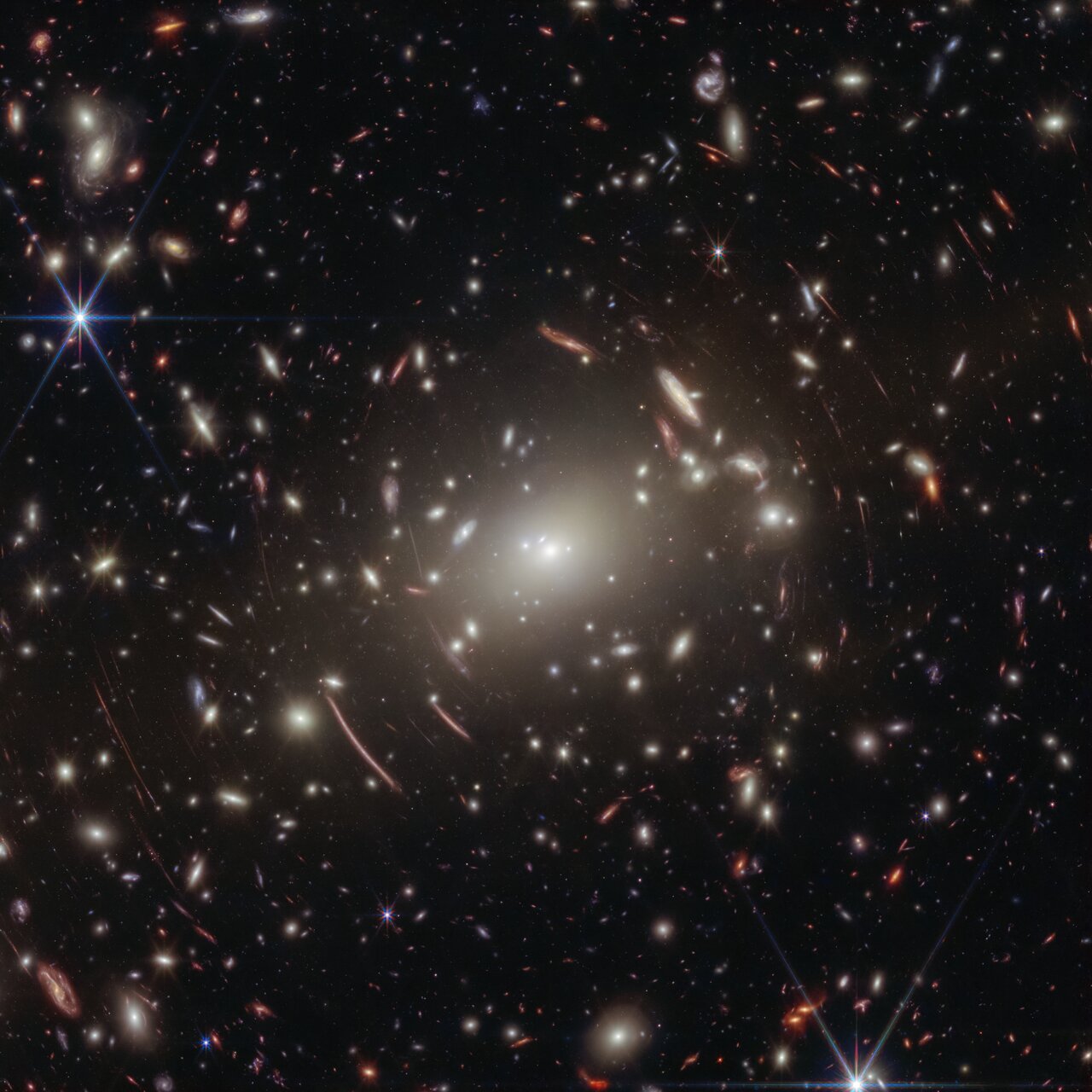
The team identified several lines of evidence in the JWST observations that indicate "little red dot" GLIMPSE-17775 is indeed a black hole star. This includes emissions from elements that don't conform with what would be expected in a rotating gas cloud. The emission lines instead indicate the scattering of electrons, which is expected when a source of radiation is enshrouded by a vast and dense cocoon of gas. Also indicative of a dense shroud of gas were signs of fluorescence and helium-absorbing radiation.
The team also saw spectral lines from iron, which the team dubbed an "iron forest." That is something expected as a result of the high-energy output of a rapidly feeding supermassive black hole: a black hole star.If little red dots are rapidly accreting supermassive black holes shrouded by dense gas envelopes, this would explain why these mystery objects are so faint in X-rays, as these cocoons should absorb this high-energy radiation.
There is something missing from observations of GLIMPSE-17775, however.
Little red dots usually have a strong characteristic dip in the spectra of light they emit, what's known as a "Balmer Break." The team thinks this feature is weaker for this little red dot than others because GLIMPSE-17775 is surrounded by a massive host galaxy. The team's data therefore fits as a missing piece of the puzzle of little red dots, slotting in nicely with our understanding of the evolution of the universe.
"Everything fits, nothing is broken, and I think that makes the puzzle that is our universe even better," Kokorev concluded. "Looking ahead, I’m eager to dive deeper and learn about what is powering the central engines of little red dots. While we think it’s a black hole, there are some other interesting theories being proposed, which is exciting. "Maybe in a year or two, we’ll have the final answer to what powers these sources."
The team's research was published on Wednesday (June 10) in The Astrophysical Journal.
View MoreYou must confirm your public display name before commenting
Please logout and then login again, you will then be prompted to enter your display name.
Logout Robert LeaSenior Writer
Robert Lea is a science journalist in the U.K. whose articles have been published in Physics World, New Scientist, Astronomy Magazine, All About Space, Newsweek and ZME Science. He also writes about science communication for Elsevier and the European Journal of Physics. Rob holds a bachelor of science degree in physics and astronomy from the U.K.’s Open University. Follow him on Twitter @sciencef1rst.