What looked like a foul by the Cavaliers would have sent Detroit to the foul line in the final seconds
 By Sam Quinn May 14, 2026 at 1:35 am ET • 11 min read
  Getty Images
 It's easy to consider a single call, or non-call, as the defining point in a close game. The Detroit Pistons probably feel that way after their stunning 117-113 overtime loss to the Cleveland Cavaliers in the second round of the Eastern Conference playoffs on Wednesday night. In a sense, they're right. They were deprived of a chance to win the game at the free-throw line with mere seconds remaining.
The play in question came after Pistons wing Ausar Thompson stripped Donovan Mitchell as he attempted a game-winning drive in the closing seconds. As both Thompson and Jarrett Allen went for the ball, Allen seemed to trip Thompson with time remaining on the clock and the game tied at 103. No foul was called. The ball went out of bounds as time expired, sending the game to overtime, where the Cavaliers pulled away for their first road win this postseason to take a 3-2 series lead.
The Pistons were in the bonus at the time of the controversial non-call, and it certainly looked like Thompson should have gone to the line for a chance to win the game.
Ausar Thompson should absolutely be at the FT line right now. pic.twitter.com/yZCVsvpwsk
— 𝔗𝔥𝔢 𝔇𝔢𝔱𝔯𝔬𝔦𝔱 𝔗𝔦𝔪𝔢𝔰 📰 (@the_det_times) May 14, 2026
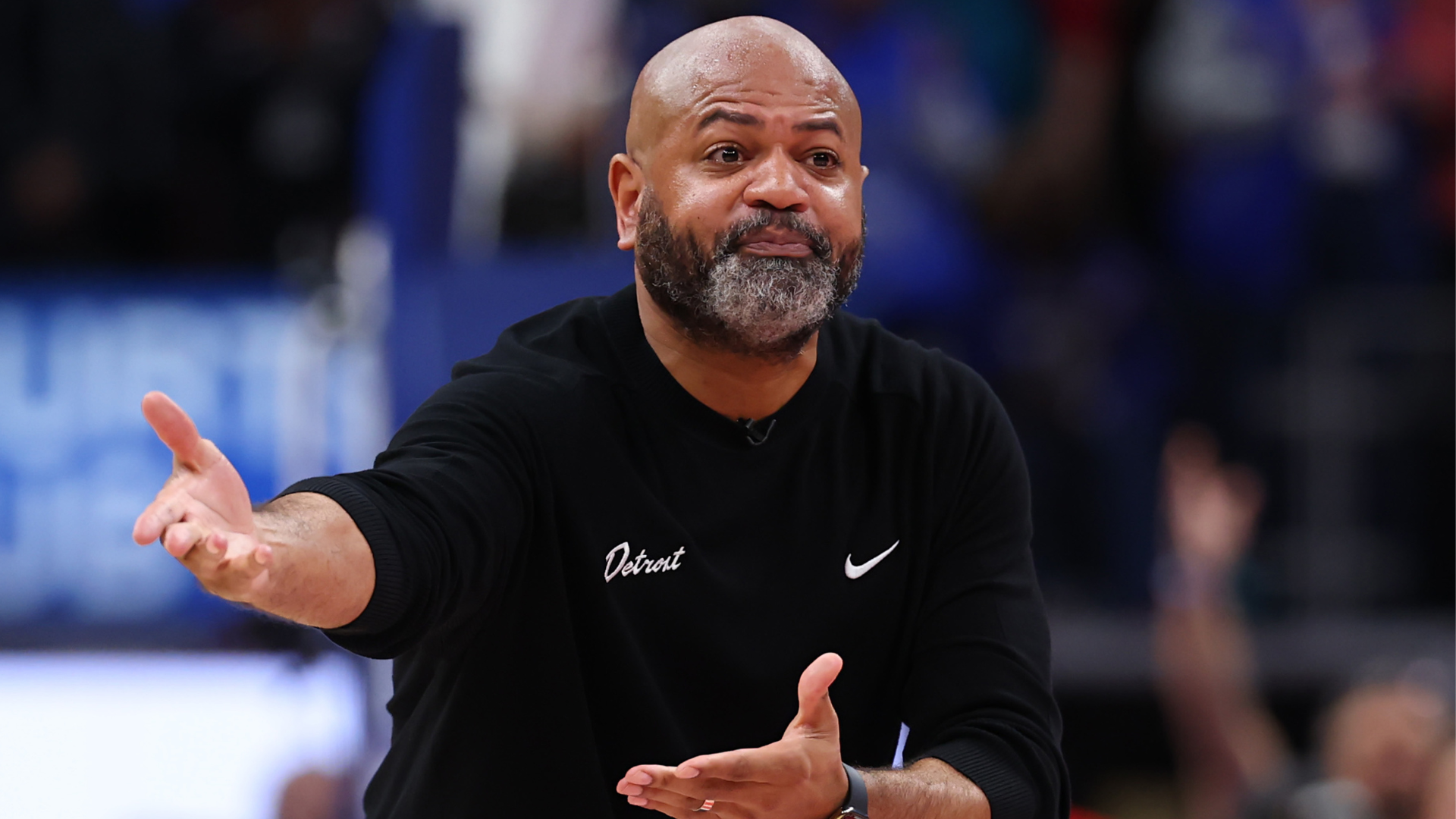
"He fouled Ausar," Pistons coach JB Bickerstaff said after the game. "It's clear. He trips him when he's going for a loose ball. End of game situation, that's tough."
Official Tony Brothers had a different interpretation of the play, viewing the contact between Thompson and Allen as "incidental."
"During live play, both players were going for the ball and there was incidental contact with the legs with no player having possession of the ball," Brothers told a pool reporter.
The play will be reviewed by the league in the Last Two Minute Report. If that report determines that a foul was missed, the Pistons will have a warranted gripe. While victory was by no means guaranteed -- Thompson is a 57.1% foul shooter -- they were potentially deprived of a deserved chance to win the game before overtime, where they lost and fell behind in the series 3-2.
And yet, to pin the loss on a single play feels disingenuous. With 3:03 remaining in the game, Tobias Harris drilled a 3-pointer to give the Pistons a 103-94 lead. The two teams had traded haymakers all night, but that shot felt like it would be a clincher. The Pistons would defend their home court, take the series lead and position themselves to close out the series on Friday. Instead, those were the last points Detroit's offense, shaky all season, would score in regulation. Their previously stout defense allowed Cleveland to close the gap and tie the game in about two minutes.
The Pistons had every opportunity to win the game before that poor call. They couldn't seal the deal. So let's look into how exactly their collapse happened.
Anatomy of a collapse, or, how James Harden saved the day
It's an oversimplification, but this game hinged on two things: James Harden heroics, and a weakened Pistons offense without Duncan Robinson squandering possessions and missing shots.
Let's start with Harden. Cleveland's late-game offense primarily relied on a single play: the Harden-Evan Mobley pick-and-roll. That's where seven of the nine points they needed for the comeback came from, with the other two being generated by a remarkable Mitchell save on a ball going out of bounds that turned into an easy Mobley dunk.
The first Harden-Mobley pick-and-roll led to Harden getting blocked, but with the first of his three massive offensive rebounds, Harden re-secured possession, passed the ball to Mitchell and immediately screened both Thompson and Cade Cunningham off of him. That freed Mitchell up to split the two of them and lay it in.
Their next pick-and-roll was far simpler. Detroit had put two on the ball for Harden-Mobley pick-and-rolls for much of the night. On several occasions earlier in the game, Harden and Mobley used those doubles to set up easy four-on-three lobs to Allen. On this play, though, the double freed Mobley up for a pick-and-pop 3.
The third of the three big pick-and-rolls resulted in a missed Harden runner. However, his second enormous offensive rebound gave him perhaps the biggest play of the postseason. While in the air, before even fully securing the ball, he managed to get a pass to Mitchell in the corner. The ball swung around from there before ultimately landing with Mobley. Detroit didn't even force him to get a shot up. No team fouled more than the Pistons this season, and Harris fouled Mobley on the floor, sending him to the line for two game-tying free throws. He sank both. Tie game.
That's where Cleveland's points came from. A single, spammable play designed to force Detroit's defense to make hard decisions with reliable counters. They did manage to get stops on some of those plays, but Harden's rebounding and playmaking turned those broken possessions into points.
Detroit's offense wasn't so simple. Robinson is the only Pistons player with significant shooting gravity. Without him, Detroit's late-game offense ground to a halt. Detroit spent too much time hunting for matchups it didn't quite know what to do with, and though the Pistons did manage to generate some good shots, this was a below-average half-court offense all season. Those shots didn't go in.
Take this first play following Mitchell's layup. Daniss Jenkins spends six seconds walking the ball up the court. Detroit spends another seven trying to screen Max Strus off of Cunningham to get Mitchell onto him with an empty side of the court to work with. Mitchell sees it and drives. However, as Thompson is a total non-shooting threat, Allen can take away the rim merely by turning and taking a light step. As soon as Cunningham turns to drive, Strus sprints off of Jenkins to deliver the double. Cunningham has nowhere to go, and pressed into a double in the corner, he has no good pass. So he has to go up with a contested jumper. He misses.
Cunningham seemed to learn from Cleveland's strategy, because on the offensive rebound, he predicts Strus' second double and hits Jenkins for a wide-open 3. But Jenkins has shot just 30% on wide-open 3s this postseason. He misses.
On Detroit's next possession, Jenkins dribbles out 15 full seconds of shot clock before much of anything actually happens. Eventually, he passes it to Cunningham off of a Paul Reed screen, but instead of getting Strus off of him, that triggers a late Allen double. Cunningham responds with a quick pass to Reed, who gets blocked by Mobley at the rim. By the time the rebound is secured, the shot clock expires.
No play better demonstrates how slowly the Pistons played offensively in these final minutes than Detroit's next one. Cunningham gets the ball up top with 15 seconds on the shot clock. Cunningham holds the ball as Mitchell, on Jenkins, slowly meanders his way into Cunningham's direction. He doesn't fully commit to the double for another six or seven seconds, and when he does, Cunningham hits an open Jenkins on the nail. Harden rotates over because, again, nobody is guarding Thompson, but Mobley wandered too far off of Harris. This should be a reprieve. Harris is having arguably the best offensive postseason of his career and Cleveland granted him an open 3.
But this is still Harris. The Pistons took some flak at the deadline for not improving on that position with a trade for a more prolific scorer like Michael Porter Jr., and two minutes after Harris made what looked like the biggest shot of the season, he missed the follow-up.
You can look at this as the Cavaliers making big plays and the Pistons missing shots, but there's a clear gap in the cogency of each team's offensive process.
Cleveland went into every possession with a very clear plan. They started with the Harden-Mobley pick-and-roll, understanding that a double would lead to one type of good shot, while other coverages would free up Harden to attack the rim. It's not as though each pick-and-roll generated easy points. It took two great follow-ups to misses on Harden's part to tie this game. But the process was sound even if those initial shots didn't go in.
The Pistons played slowly. They sought a specific matchup in Mitchell on Cunningham, yes, but they didn't exploit it effectively because of their own flawed personnel. They did generate some good shots, but given the players taking them, it's not terribly surprising that they didn't go in. Flaws that the Pistons have had all year reared their ugly head, while a future Hall of Famer in Harden made future Hall of Famer-type plays.
In around two minutes, a nine-point lead became a tie game. The Pistons still could have won in regulation, and perhaps should have, but if they had, they'd have been bailed out of a collapse they themselves were responsible for. Good teams win close games. Champions, at least more often, avoid them.
So the game went to overtime. The Cavaliers quickly took a seven-point lead. Detroit cut into it, getting as close as two. But Harden and Mobley made the free throws Cleveland needed to win. Now, a Cavaliers team that has yet to lose a playoff game in Cleveland returns home with a chance to clinch the series on Friday.
Where do the Pistons go from here?
It would be pretty helpful if the Pistons could get Robinson back for Game 6. Detroit's offense scored 101 points per 100 plays in the half-court with Robinson on the floor in the regular season, good for the 76th percentile in terms of efficiency. They scored 93.6 with him off of it, good for the 22nd percentile.
This half-court offense simply is not viable without Robinson's shooting. The entire team was designed that way. The Pistons are meant to win with turnovers and transition. They generated 20 points off turnovers in the first half and unsurprisingly led most of the half comfortably. They got seven in the second half and, well, you saw what happened.
Robinson is the only true shooting threat that the Pistons actually trust to play major minutes. Deadline acquisition Kevin Huerter played only three minutes in Game 5. Marcus Sasser held his own for 16, but isn't the same sort of weapon. Robinson may get hunted defensively when he's on the floor, but as that Harden-Mobley pick-and-roll showed, Cleveland has other ways of generating good shots, whereas the Pistons are going to struggle much more to do so without forcing the Cavaliers to account for Robinson's movement.
But there's another subplot here that bears watching: the complete and utter disappearance of Jalen Duren. Detroit's starting center is probably going to make an All-NBA team. He has also been invisible for most of the postseason. His scoring average dipped from 19.5 points per game in the regular season to 10.2 so far in the playoffs. He went from shooting 65% from the floor to under 50% in the postseason, yet his turnovers are up over 36% on a per-game basis.
What exactly is happening to Duren is complicated. Some of this is a result of Detroit's roster construction. As playoff defenses have keyed in on Detroit's shooting vulnerabilities, he's had virtually no space to work with. This has been especially notable with Thompson on the floor. When nobody is guarding Thompson, it frees up Duren's defender to break up entry passes and pack the paint. But as the playoffs have progressed, some of this seems mental from the outside. He's missing the looks he made all season. He hasn't looked nearly as physically dominant as he did in the regular season, either. Whether there's a hidden injury or a crisis of confidence, Duren has not been the same player in the playoffs as he was all year, and that might force the Pistons to make some hard decisions.
The Pistons lost Duren's 25 minutes by 16 points in a game that went to overtime. Isaiah Stewart played only 11 minutes, mostly in the first half, and Detroit won those minutes by 12 points. In one of the stranger coaching decisions I can ever recall in the playoffs, Reed, the team's third-string center, did not touch the floor for a single second in the first three quarters... and then played all 17 minutes of the fourth quarter and overtime consecutively. I can't say definitively if that has never happened in a close playoff game, but if it has, it's a rarity. If you trust Reed enough to play him with your season on the line, why aren't you using him at all in the first three quarters?
Given how bad the Duren situation has gotten, the Pistons might have to consider more extreme measures with their lineup decisions. If they trust Stewart and Reed but not Duren, then they might have to roll with Stewart and Reed over Duren in Game 6. It's an elimination game. Loyalty to a star player goes only so far. It's a tricky situation. Duren is a restricted free agent this offseason. Such a move could poison his relationship with the organization. It could also make him even harder to trust later in the playoffs if the Pistons do come back and win this series.
But the Pistons are out of room for error. As dominant as they were in the regular season, self-inflicted wounds cost them Game 5 far more than a single, bad call did, and if they're not careful, those mistakes will cost them this series.
Join the Conversation comments