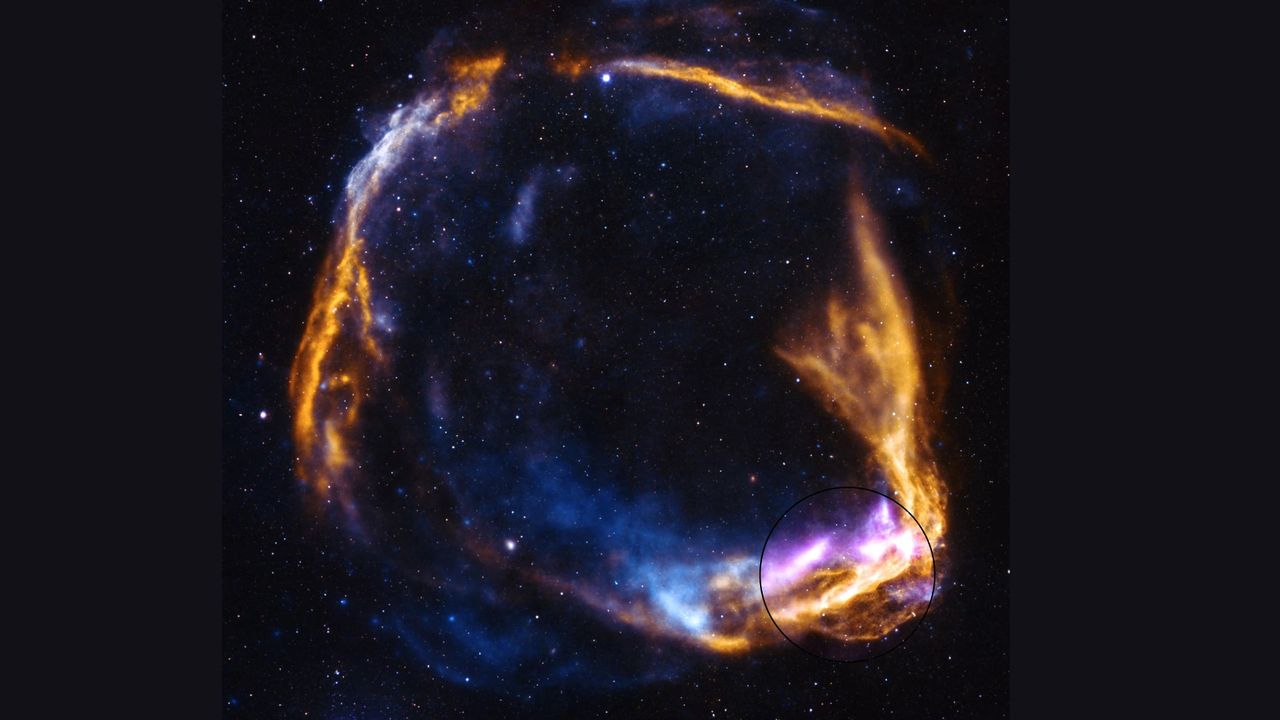
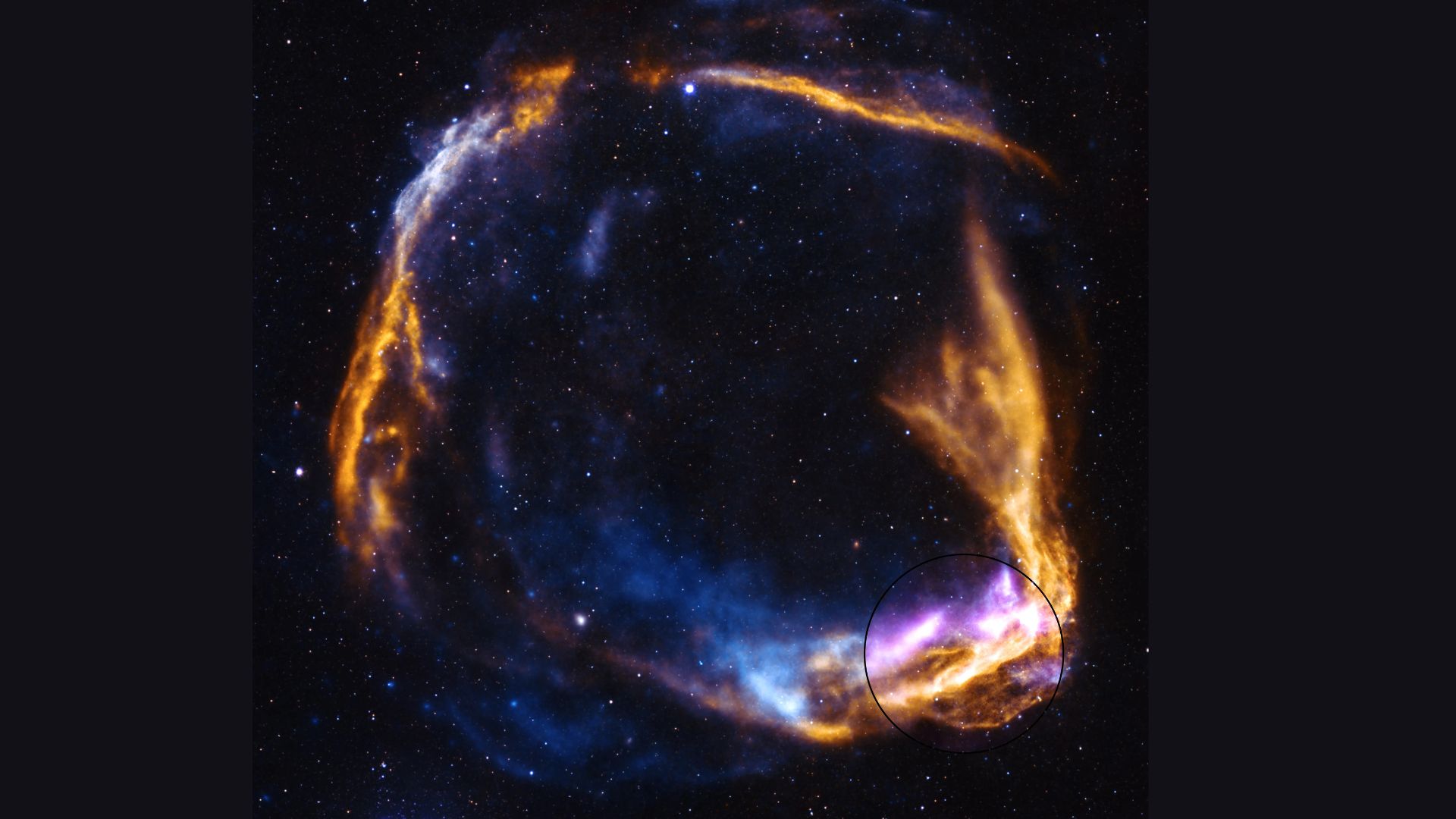
 NASA's Imaging X-ray Polarimetry Explorer observed the outer rim of the supernova remnant highlighted in purple in the inset. (Image credit: X-ray: Chandra: NASA/CXC/SAO, XMM: ESA/XMM-NEWTON, IXPE: NASA/MSFC; Optical: NSF/NOIRLab; Image Processing: NASA/CXC/SAO/J. Schmidt) Share this article 0 Join the conversation Follow us Add us as a preferred source on Google Newsletter Sign up for the Live Science daily newsletter now
 Get the world’s most fascinating discoveries delivered straight to your inbox.
Become a Member in Seconds
Unlock instant access to exclusive member features.
Contact me with news and offers from other Future brands Receive email from us on behalf of our trusted partners or sponsors By submitting your information you agree to the Terms & Conditions and Privacy Policy and are aged 16 or over.You are now subscribed
Your newsletter sign-up was successful
Want to add more newsletters?
Join the club
Get full access to premium articles, exclusive features and a growing list of member rewards.
Explore An account already exists for this email address, please log in. Subscribe to our newsletter Quick factsWhat it is: RCW 86, a supernova remnant
Where it is: 8,000 light-years away, in the constellation Circinus
When it was shared: March 24, 2026
One of the oldest recorded astronomical events observed by humans has gotten a fresh look from a new NASA space telescope. In A.D. 185, Chinese astronomers recorded the appearance of a "guest star" in the night sky. The star shone for about eight months in the direction of Alpha Centauri, one of the closest star systems to the sun.
This stellar visitor was a supernova — a large and extremely bright explosion marking the end of a massive star's life. It left a remnant — a ring of glowing debris — in the night sky that's now known as RCW 86. It's all that remains of the exploded white dwarf star, but there's a mystery surrounding it: why it appears to have expanded far more quickly than other supernova remnants.
Although RCW 86 has been imaged many times before — notably by NASA's Chandra X-ray Observatory and the Dark Energy Camera — new data from NASA's Imaging X-ray Polarimetry Explorer (IXPE) has delivered a fresh perspective. Launched in 2021, IXPE captures X-ray data and high-energy, short-wavelength light with an all-new level of sensitivity to examine the most extreme objects in the universe, including supernova remnants.
IXPE was put to work on RCW 86 because of the remnant's irregular shape and the strange way it's expanding. Earlier observations from Chandra suggested that the supernova spread into a low-density "cavity," allowing it to grow faster than other supernova remnants. This image combines data from IXPE, Chandra and the European Space Agency's XMM-Newton telescope, with low-energy X-rays shown in yellow and higher-energy emissions in blue.
IXPE's data is crucial because it can highlight polarized X-ray emissions, revealing magnetic-field structures in the remnant's outer rim. This region, marked in purple, is particularly significant because it shows where the supernova's expansion likely slowed at the edge of the cavity. IXPE's data reveals a "reflected shock" effect in RCW 86. As the expanding material from the supernova collided with the cavity boundary, shock waves were reflected toward the cavity, offering a potential explanation for both the remnant's shape and the distribution of high-energy particles.
See more Space Photos of the Week
 Big changes in iconic crab nebula
Hubble shows that of the most iconic supernova remnants in space has grown a lot in the last 25 years.
 Hidden structure in 1st Vera Rubin image
First-light images from the Vera C. Rubin Observatory reveal a 163,000-light-year stream of stars emanating from a nearby galaxy.
 JWST peeps the 'Eye of God'
A spectacular James Webb telescope image reveals intricate structures inside the Helix Nebula.
Sign up for the Live Science daily newsletter nowContact me with news and offers from other Future brandsReceive email from us on behalf of our trusted partners or sponsors TOPICS Jamie CarterLive Science contributor
Jamie Carter is a Cardiff, U.K.-based freelance science journalist and a regular contributor to Live Science. He is the author of A Stargazing Program For Beginners and co-author of The Eclipse Effect, and leads international stargazing and eclipse-chasing tours. His work appears regularly in Space.com, Forbes, New Scientist, BBC Sky at Night, Sky & Telescope, and other major science and astronomy publications. He is also the editor of WhenIsTheNextEclipse.com.
View MoreYou must confirm your public display name before commenting
Please logout and then login again, you will then be prompted to enter your display name.
Logout LATEST ARTICLES 1What happened to the Minoan civilization?
- 2Fossil site in China reveals bevy of complex creatures lived prior to the Cambrian explosion, including a 'Dune'-like sandworm
- 3Cheap, decades-old transplant drug delays full onset of type 1 diabetes
- 4Octopus quiz: Are you a sucker for cephalopod science?
- 5Science news this week: Artemis II lifts off, diabetes cured in mice, and smog in China shapes Arctic storms