
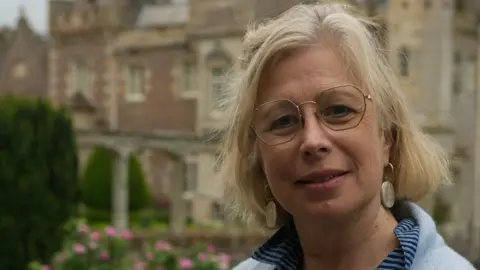
 Walter Scott Book PrizeAlice Jolly took the prize for historical fiction for her book The Matchbox Girl
A book which judges said "may be the most unusual book you read this year" has won the Walter Scott Prize for Historical Fiction.
Alice Jolly's work The Matchbox Girl tells the story of Adelheid Brunner - a mute autistic patient of Dr Hans Asperger in the now-infamous Vienna Children's Hospital during the 1930s, while the city is under Nazi occupation.
Jolly received her prize from Walter Scott's great-great-great-great grandson, Matthew Maxwell Scott, at a ceremony at the Borders Book Festival near Melrose.
The prize, run by the Abbotsford Trust, is now in its 17th year and past editions have been won by Sebastian Barry, Robert Harris, Andrea Levy and Hilary Mantel.
More stories from South Scotland
Listen to news for the Scottish Borders on BBC Sounds
Judges praised the "originality, innovation, ambition" of Jolly's work which "confronts a topic of immense complexity in a gripping tour de force".
"The Matchbox Girl may be the most unusual book you read this year," they said.
"For its honesty, power and storytelling dexterity, our 2026 winner will also be one of the most important."
Jolly was part of the first ever all-British shortlist for the award.
Speaking of writing the book, she said: "I remain constantly troubled by that age of old question as to how people who were certainly not wholly 'evil' nevertheless found themselves drawn into appalling crimes.
"In 2018, two non-fiction books about the history of autism were published which told wildly differing stories about Dr Asperger.
"My book started with the simple question – who was Dr Asperger?".
Dr Asperger is known for his work in child psychiatry and identifying Asperger syndrome, a form of autism, in 1944 - however the term "autistic psychopathy" was used until 1981.
In 1981, the British psychiatrist Lorna Wing introduced the diagnosis of Asperger syndrome.
But documents uncovered in 2018 suggested Dr Asperger sent child patients to the Am Spiegelgrund clinic in Vienna, where they were put to death by the Nazi regime.
Jolly said that as she worked on the book she realised that his forgotten colleagues were "perhaps more interesting than he was".
She said she became obsessed with "bringing them into the light" and celebrating the ways in which they "struggled to hold onto their research, and their principles, despite finding themselves in the eye of the most evil storm of the 20th Century".