
 Getty Images
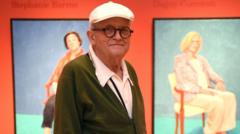
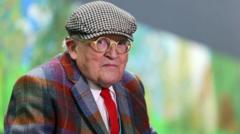
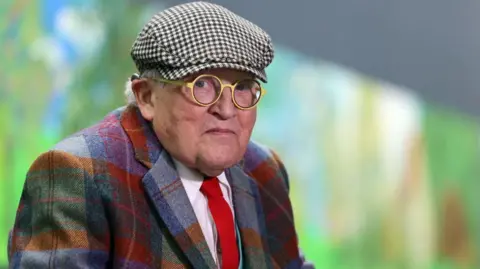
David Hockney, who has died aged 88, was Britain's favourite artist - and a man of trenchant views, expressed in the broadest of Yorkshire vowels.
A genius in practically every medium, he worked with paint, photographs and iPads. He did etchings, lithographs, even stained glass windows - equally at home working with the grandeur of opera design and the intimacy of pen and ink.
A peroxide Bradford blond with round glasses and cheese-cutter hat, he set the art world alight in the 1960s, and packed out art galleries more than half a century later.
In 2018, one of his swimming pool paintings sold for nearly £70 million at auction - a record for a living artist. But Hockney was surprised at the public enthusiasm for his work.
He had simply followed one rule: "Paint the things you love".
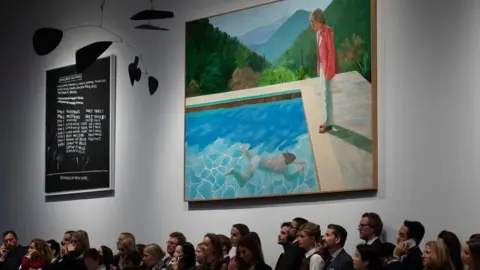 Getty ImagesDavid Hockney's Portrait of an Artist (Pool with Two Figures) on sale at Christie's in November 2018
David Hockney was born on 9 July 1937.
His father, Kenneth, was a conscientious objector who detested social injustice, nuclear weapons and smoking in equal measure. His mother, Laura, was the backbone of the family: strong-willed and devoutly Methodist.
David was one five children; a tight-knit, loving unit jammed into a tiny terrace in Bradford. During bombing raids, they hid under the stairs clutching bibles. In 1940, one explosion flattened the street.
He was single-minded and devoted to drawing. The wartime shortage of paper restricted his early efforts to the kitchen floor and hymn books in church.
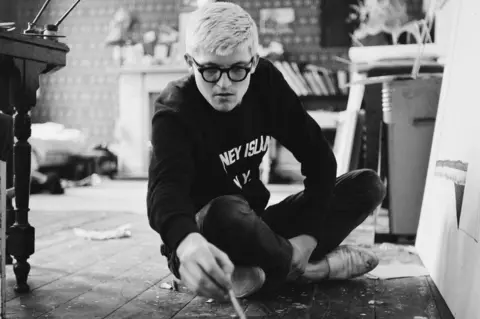 Getty ImagesHockney, pictured at work in the 1960s, spent long hours in the studio and was often haunted by the feeling that he wasn't getting enough done
Later, as a scholarship boy at Bradford Grammar, he refused to do any subject but Art.
"I am no good at science but I can draw," Hockney wrote in one exam. He was popular, funny and the despair of his teachers.
"He should realise that enthusiasm for Art alone is not enough to make a career," said a tutor's misguided report.
At 16, he was allowed to go to art school, arriving in pinstriped suit and bowler hat.
Hockney's appearance may have been flamboyant but his work ethic was Protestant. For 12 hours a day, he worked furiously at his easel.
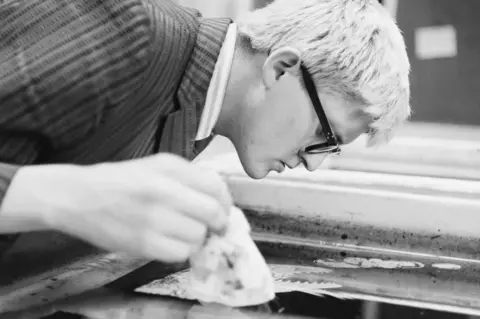 Getty ImagesDavid Hockney making a print in 1965
National Service was spent, like his father, as a conscientious objector. It meant miserable hours washing bodies in a morgue.
But then came the Royal College of Art in London. Hockney lived in an unheated garden shed, spent every waking hour painting and revelled in his newfound bohemia.
The 1960s were in thrall to Pop Art and Abstract Expressionism.
But David's classmate, the American artist RB Kitaj, told him to ignore everyone else and simply paint things he loved. "It was the best advice I ever had," he said.
What interested him was politics, literature and exploring his homosexuality. So one portrait showed himself in an act of love with the American poet, Walt Whitman.
It forced the spectator to confront the interests and sexual fantasies of the artist. It was Hockney reaching for the person he yearned to become.
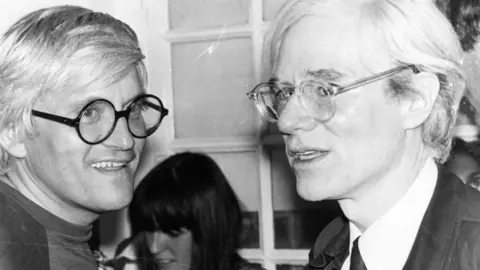 Getty ImagesDavid Hockney and Andy Warhol in the 1970s
He was the college's star student but still gloriously pig-headed. David refused to write the one essay required to graduate, and so failed his finals.
The resulting outcry forced the Royal College to back down.
It gave him his degree and even awarded him its prestigious Gold Medal. Hockney wore a gold lamé jacket at the ceremony, under the traditional academic gown.
Newspapers were launching glossy weekend magazines, turning pop stars and artists into an new breed of classless celebrity.
The Sunday Times showed David hanging out with Andy Warhol.
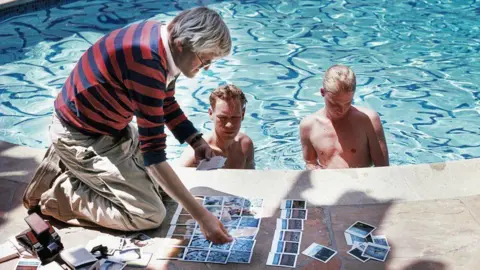 Getty ImagesDavid Hockney at work creating one of his swimming pool images
But - despite his newfound fame - Hockney quit the dreariness of post-war England in search of Paradise.
In 1964, he flew to Los Angeles - looking for the perfect light and bronzed torsos he'd seen in American male magazines.
As they landed, he saw hundreds of swimming pools glittering in the valleys below him. They promised a carefree existence of affluence, leisure and sexual freedom.
Britain had only just abandoned rationing; in California, swimming pools weren't luxuries - just a way of life.
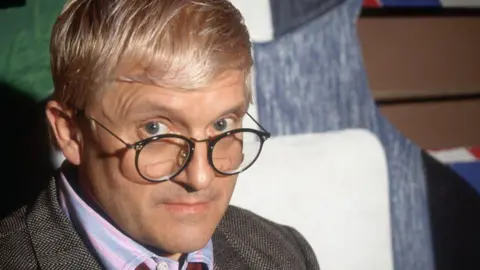 Getty ImagesDavid Hockney found sexual and artistic freedom in California
Hockney was entranced. He ditched his British oil paints in favour of bright, Californian acrylics but retained his Bradford accent - which the Americans adored.
He was sexually promiscuous for the first, and probably only, time in his life and - inspired by an advert on TV - died his hair bright white.
Hockney painted the buildings he saw around him: determined to do for Los Angeles what Piranesi had done for Rome.
And the swimming pools themselves - with glorious weather and naked male bodies - became Hockney's most famous theme.
He had found his Paradise.
"David talks of the coming Golden Age," wrote Cecil Beaton in his diary. "The computer will do away with work; everyone will be ecstatically happy."
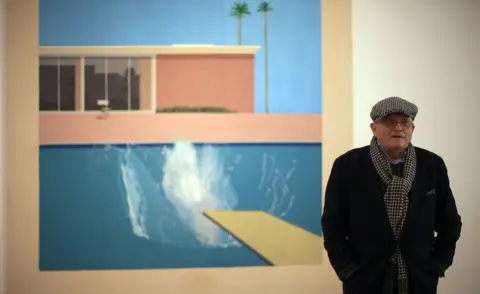 Getty ImagesHockney's 'A Bigger Splash' captures the moment an unseen diver creates chaos in paradise
A Bigger Splash is his best known work.
Hockney painted the angular buildings and cloudless sky with a roller. Then, with a brush, he captures the momentary disturbance of the water caused by an unseen diver.
It is a depiction of order and chaos. But while a camera would have frozen the action, Hockney makes it flow.
As homosexuality was still illegal, these paintings also defended a way of life.
On returning to London four years later, customs officers confiscated Hockney's magazines. These showed naked men in various, non-pornographic poses but the bureaucracy deemed them inappropriate.
Hockney went ballistic. "I'm not some little businessman who's going to run off. I'll see you in court," he told the cowering official.
He launched a loud anti-censorship campaign until the Home Secretary, James Callaghan, stepped in and had them returned.
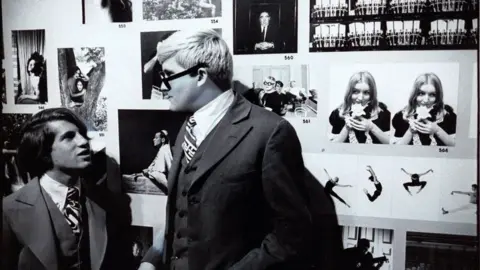 Getty ImagesPeter Schlesinger and David Hockney in 1969
His work-rate remained prodigious. He placed a sign at the foot of his bed in Notting Hill, telling himself to "GET UP AND START WORK IMMEDIATELY".
If he grew tired of drawing, Hockney would take photographs, do etchings or design operas. He was haunted by the feeling he wasn't doing enough.
He was also experiencing heartbreak.
His relationship with Peter Schlesinger - the young Californian subject of many of Hockney's paintings - was fizzling out.
Unwisely, David agreed to take part in a television documentary about his work and was devastated when it focused on the trauma in his love life.
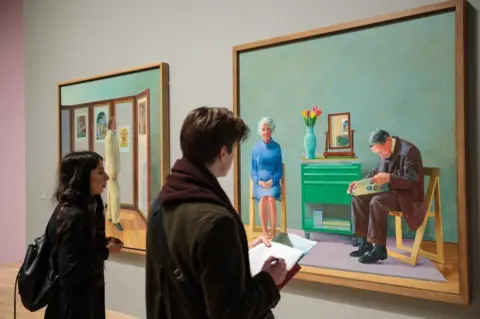 Getty ImagesStudents look at David Hockney's 1977 portrait of his parents
He moved again, this time to Paris. Hockney stood out in his round glasses, colourful rugby shirts and braces.
He spoke lamentable French in an uncompromising Yorkshire accent and concentrated on painting portraits.
He found it difficult to paint people he didn't know, preferring studies of friends and family. Here too, art was all about love. It cost him money but it was consistent with his life-long belief.
What interested him were double portraits.
The spectator is left intrigued by the relationship between the subjects in the painting. Two people, he believed, were more fascinating than one.
The painting of his parents - done in Paris - is one such quiet drama.
They are pictured barely aware of each other's presence; after 48 years of marriage, Kenneth and Laura are together but somehow apart.
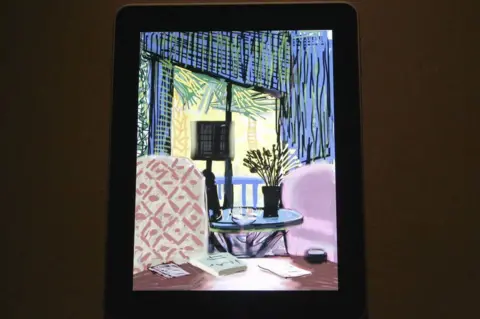 Getty ImagesHockney experimented with polaroids, faxes, photocopiers, smart phones and tablets
Few artists have been more excited by technology than Hockney.
In the 1970s, he became intrigued by the Polaroid camera, making hundreds of collages which played with space and perspective.
Later, he mounted exhibitions with art created by photocopier and fax machine, carefully building vast pictures from single sheets of paper.
By the end of that decade, David Hockney was one of the world's most celebrated artists.
He was becoming profoundly deaf and now sported bright pink hearing aids, but his work had made him wealthy. The boy from Bradford now hung out with Princess Margaret in Mustique.
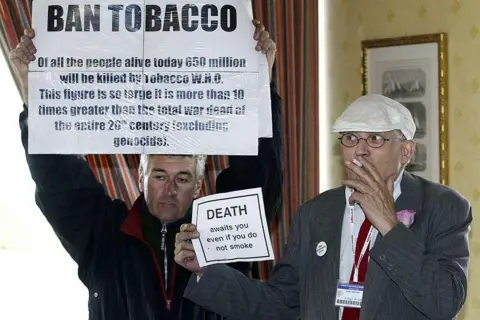 Getty ImagesDavid Hockney and an anti-smoking protester in 2005
But the bubble was about to burst.
The Aids epidemic of the 1980s robbed Hockney of many friends. On one trip to New York, he visited three hospitals to say goodbye.
He threw himself into his work, obsessively making pictures of his friends.
The carefree life they had led was turning into a nightmare. Painting was Hockney's way of holding loved ones close.
He was also becoming something of the "Ancient Mariner".
Hockney grumbled constantly about the iron grip of draconian forces in America: in particular the new lack of tolerance for public smoking.
"On D-Day, Eisenhower smoked 80 cigarettes," he told anyone who would listen. "Do you think he didn't need them?"
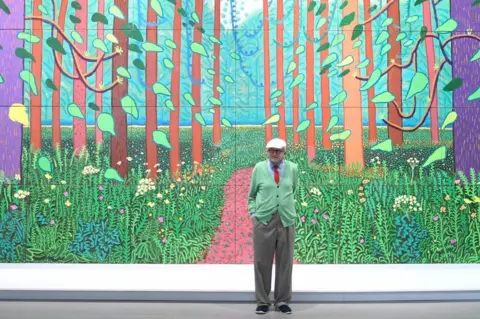 Getty ImagesDavid Hockney in front of 'The Arrival of Spring in Woldgate, East Yorkshire' at the Pompidou Centre in Paris
In Britain, he had little sympathy for Margaret Thatcher, seeing Thatcherism as freedom for the businessman but not the artist.
He criticised her government for being anti-gay and he campaigned against Clause 28.
Not that he had any greater love for Tony Blair. Hockney detested the "cultural bossiness of New Labour" and joined the Countryside March in protest.
He reserved particular dislike for Gordon Brown - whom he condemned as a "dreary Calvinistic prig" - and hoped he would come round "so I can kick him in the balls".
Artistically, what he did in the 1990s was extraordinary.
The London scene was dominated by Damien Hirst, Tracey Emin and the Young British Artists - brazenly exhibiting sharks in formaldehyde and making art out of unmade beds.
But Hockney - the great innovator - just went back to painting.
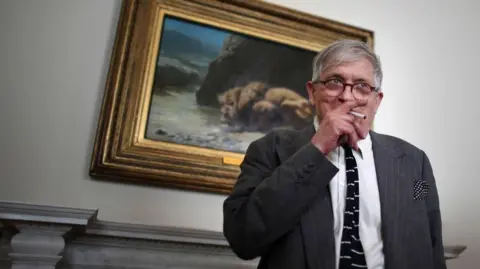 Getty ImagesDavid Hockney in 2011. He was occasionally allowed to smoke in galleries - the only person granted permission to do so
Not just any painting. Hockney's new passion was landscapes: the traditional pastime of the weekend amateur.
He moved to Bridlington, where his sister and elderly mother now lived, and began to paint the Yorkshire Wolds.
Each summer, the teenage Hockney had cycled here from Bradford to earn pocket money on local farms.
The countryside was beautiful and brought back memories of working on the harvest and sleeping in barns with his friends.
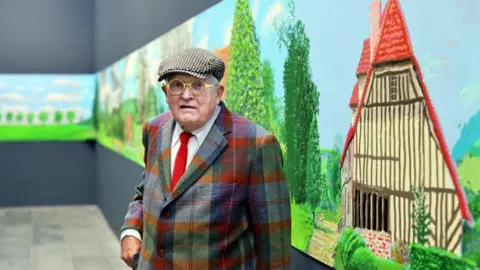 Getty ImagesDavid Hockney stands alongside his 91m long landscape of Normandy, completed during the coronavirus lockdown
For Hockney, this was just as much a paradise as California in the 1960s.
Standing outdoors in all weathers, he painted hundreds of scenes of lush meadows and roadside verges. They were often on a monumental scale.
It was an old man's challenge to an art scene focused on the young, the cynical and the conceptual.
Not everyone responded positively: the critic Brian Sewell, for one, saying they were fit only for "the railings of Green Park".
But these pictures became public favourites. Their huge size actually makes them feel intimate, drawing the viewer into the art.
Infectiously enthusiastic, he continued to innovate well into his eighties, with landscapes of his new home in Normandy completed during the coronavirus lockdown.
In 2023, his self-narrated 4D cinematic immersion experience in London showed paintings, photographs, opera sets projected onto 11-metre-high walls in a cavernous underground space.
But not all his work was of such a titanic scale. He was just as happy making Ipad paintings of his favourite trees, or intimate portraits of Harry Styles.
In 2025, a huge retrospective of his work opened in Paris. Under 24-hour medical care, Hockey's travel plans now included his dachshund and two medical assistants - who inevitably found themselves immortalised in his art.
More exhibitions are being planned, including a huge show at Tate Modern to celebrate what would have been his 90th birthday in 2027.
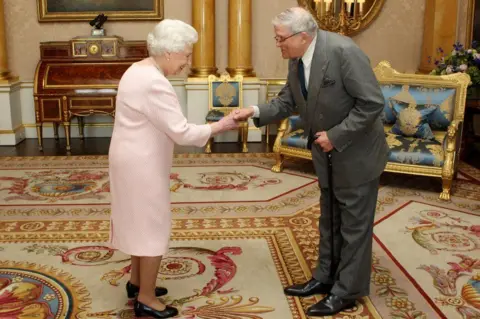 Getty ImagesHockney refused a knighthood but accepted the Order of Merit as it was a personal gift from Queen Elizabeth II
In a long career, David Hockney won every honour. He turned down as many as he could.
He refused a knighthood in 1990 and was furious to discover he'd become a Companion of Honour. The story goes that someone opened the letter and accepted on his behalf.
He did accept the Order of Merit, the most prestigious award for high achievement. Believing it to be the personal gift of Queen Elizabeth II, Hockney felt it ungracious to decline.
But there was one tribute he did enjoy.
In 2007, a party was held at Tate Britain to celebrate Hockney's 70th birthday.
After dinner, it was announced that the smoke alarms would be turned off for 10 minutes to allow Britain's Greatest Living Artist a cigarette.
It was the kind of honour plain 'Mr' Hockney did appreciate. And one which would have been granted to nobody else.
ArtDavid Hockney