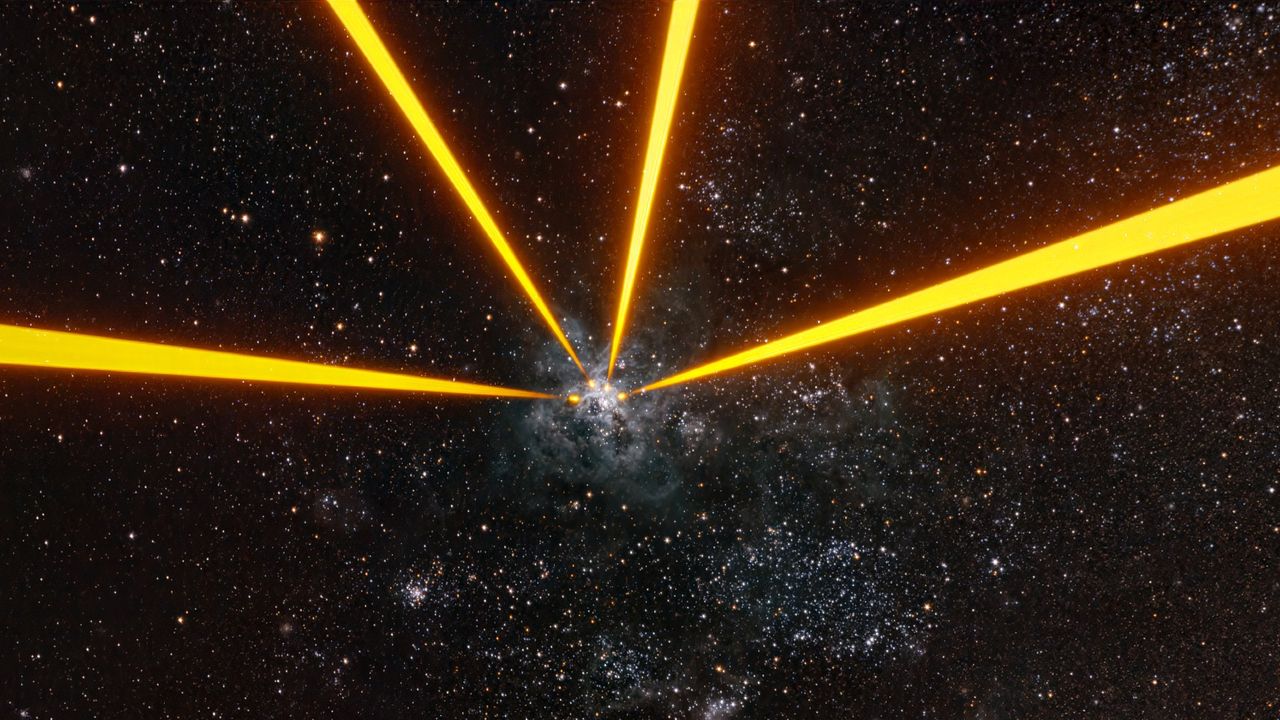
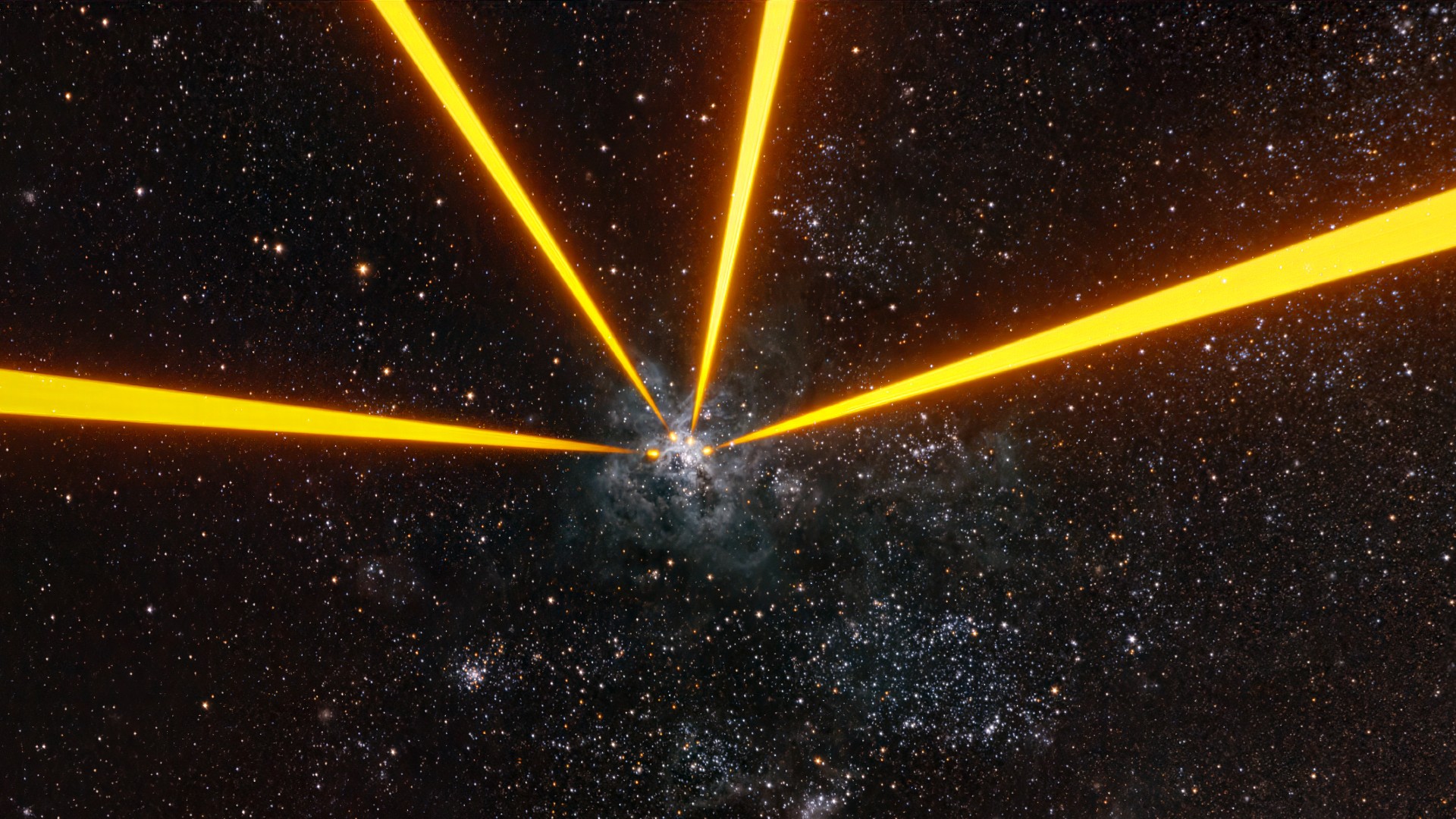
Looking like a scene out of a "Star Wars" title crawl, this photograph from the European Southern Observatory's (ESO) Very Large Telescope Interferometer (VLTI) atop Cerro Paranal in Chile's Atacama Desert showcases some advanced techniques astronomers use to look out into the cosmos.
What is it?
This image shows the ESO's VLTI beaming four separate lasers into the sky towards the Tarantula Nebula. "It might look like we started a space war, but we didn't," the ESO wrote in a statement accompanying the image.
Far from waging galactic warfare, astronomers use these lasers to create "artificial stars" in order to measure atmospheric turbulence. First, scientists can use telescopes pointed at the cosmos to observe how points of light created by the lasers blur and disturb molecules in Earth's atmosphere. Then, they can use computer algorithms on the same images to account for and cancel out that blurring and disturbance.
Article continues belowThe Tarantula Nebula is situated some 160,000 light-years away in the Large Magellanic Cloud, a satellite galaxy of the Milky Way.
Why is it amazing?
Aside from looking like the iconic yellow-on-black "Star Wars" title crawl or laser bolts fired by an Imperial Star Destroyer chasing down the Tantive IV, this image demonstrates the great progress astronomers have made in developing technologies and concepts to better observe the distant universe.
Using laser guide stars and adaptive optics is still very much a young, developing technique only a handful of observatories worldwide have tapped into. The VLTI, which consists of four separate telescopes that work together to form one large virtual telescope, has only been using its Four Laser Guide Star Facility system since 2016.
View MoreYou must confirm your public display name before commenting
Please logout and then login again, you will then be prompted to enter your display name.
Logout Brett TingleyManaging Editor, Space.com
Brett is curious about emerging aerospace technologies, alternative launch concepts, military space developments and uncrewed aircraft systems. Brett's work has appeared on Scientific American, The War Zone, Popular Science, the History Channel, Science Discovery and more. Brett has degrees from Clemson University and the University of North Carolina at Charlotte. In his free time, Brett enjoys skywatching throughout the dark skies of the Appalachian mountains.