
 The Arecibo Observatory was a radio telescope that sent Frank Drake’s infamous “Arecibo Message” (intended to contact intelligent aliens) in 1974. The telescope collapsed in 2020. (Image credit: University of Central Florida) Share this article 0 Join the conversation Add us as a preferred source on Google Newsletter Subscribe to our newsletter
 Over five decades ago, astronomer Frank Drake used one of Earth's largest radio antennas to beam a coded message into space, hoping that it might one day reach the eyes, ears or other inscrutable sensory organs of intelligent aliens. Slicing silently through the Milky Way at light speed, the now-famous Arecibo message has traveled roughly 50 light-years from Earth — about 10 times the distance to the nearest star, Proxima Centauri, but only one-five-hundredth the way to its intended destination in the Hercules constellation.
The search for extraterrestrial intelligence (SETI) is a waiting game — but for radio astronomer Emma Chapman, an astrophysicist at the University of Nottingham, whether humans will ever make contact with extraterrestrial life isn't a question of if but when. The universe is too vast and too plentiful with planets for humanity to be the only game in town, Chapman writes in her new book, "The Echoing Universe: How Radio Astronomy Helps Us See the Invisible Cosmos" (Basic Books, 2026). And when we do hear from our hypothetical alien neighbors, radio astronomers will be the first to know.
During public lectures, I'm often asked, "Do you think aliens exist?"
I am always a little taken aback, as is the audience, when they hear my emphatic answer: "Absolutely. I have no doubts at all."
My surprise comes about because, as a radio astronomer, I have no doubt that life is out there, and I sometimes forget that there can even be a question about the matter.
There is little controversy amongst astronomers, not since the avalanche of exoplanet observations showed us that it was only a matter of time before we found Earth 2.0. Even if habitable worlds are scarce or the emergence of life is rare, the sheer number of planets in the Milky Way, let alone the universe, makes it implausible to think we are alone.
Sign up for the Live Science daily newsletter nowContact me with news and offers from other Future brandsReceive email from us on behalf of our trusted partners or sponsorsI am not engaging here in a willful misunderstanding of what we mean by "alien." When I say I believe there are aliens, I mean intelligent, complex lifeforms, not just basic, microbial life.
The audience is often silent for a beat after I have answered, not expecting such certainty. People expect heated debate over the question of alien life, I think, because there is a conflation, even in the scientific world, between a belief in alien life and a belief in UFOs, or alien abductions. "Have aliens visited our planet?" is a fundamentally different question, and one which I can answer just as emphatically: "Absolutely not. I have no doubts at all."
There is no evidence for interference by extraterrestrial life on Earth. No aliens building the pyramids, no UFOs creating intricate crop circles, and no secret government cover-ups. Many UFO sightings turn out to be Venus gleaming on the horizon, optical illusions or simply shaky camera work. One only needs note how UFO sightings have not increased in line with smartphone ownership and the ability to capture supposed otherworldly events. These claims belong firmly in the realm of conspiracy theories.
SETI, however, stands apart as a rigorous, science-based pursuit, almost exclusively led by radio astronomers. For SETI researchers, the question isn't whether life exists elsewhere — we take that as a given. We want to make contact. We want to find out where these aliens live and communicate with them across the light-years, using radio telescopes as our telephone.
Frank Drake makes the call
In 1974, Frank Drake was the director of the Arecibo Observatory. Drake lived and breathed SETI, and he had become impatient at the pace of the search. SETI is passive. It is about listening and intercepting signals that extraterrestrial life has sent, purposefully or not. Drake wanted to take the initiative, to beam a message out ourselves. And so, METI (messaging extraterrestrial intelligence) was born.

The Hercules globular cluster (M13) contains hundreds of thousands of stars — and potentially as many planets. Frank Drake chose this as the target for his infamous Arecibo Message to intelligent aliens.
(Image credit: ESA/Hubble and NASA)Drake decided to send his signal using the 305-meter dish's antenna as the transmitter, at a
celebration honouring the recent renovation of the dish.
The message consisted of 1,679 binary digits, each representing one of two possible values. Frank Drake envisaged encoding a picture in this way, much like a "paint by numbers" canvas. A radio tone at one wavelength would indicate a solid square, while a tone at a second wavelength would represent an empty square.
Since the message would be transmitted as a long sequence of radio bursts, the challenge for any receiving extraterrestrial intelligence would be to determine how to arrange this list into a meaningful 2D image. The image contains a wealth of information: heavily pixellated diagrams of a human and the Arecibo dish, for example, along with a representation of our Solar System, and the major chemical elements making up our DNA.
The act was symbolic but still, the first intended message is out there, and we cannot undo it now.
Drake selected the number 1,679 deliberately because it is a prime number and also the product of two other primes: 23 and 73. Prime numbers are significant within mathematics, and Drake hoped that any intelligent beings receiving the flow of data would experiment with reshaping the sequence in configurations involving these primes. If they did so, they would discover the intended image, unlocking the deeper meaning of the message.
Drake also converted the message into audio, allowing the audience gathered next to the dish in the Puerto Rican jungle to listen in real time as the two-toned signal was broadcast into space. For three minutes, Earth transmitted a signal 10 million times brighter than our radio sun, making us unmistakably visible to any extraterrestrial intelligence with their own Arecibo within the target area.
I've listened to the signal myself. The "Moonlight Sonata" it certainly is not, but if you close your eyes and reflect on the poignancy of us announcing our presence to the cosmos, it's deeply moving, and I can only imagine it brought a tear to the eye of more than one person in the crowd.
The message was aimed at M13, a dense cluster of stars (and presumably planets) about 21,000 light-years away, in the Hercules constellation. This system was chosen partly for the press release optics of its dense population of potential life-bearing star systems, but mostly because it was above the dish at the time of the ceremony. Awkwardly, by the time the Drake signal reaches the intended coordinates, M13 may have drifted out of the way of the tight beam of the signal. The act was symbolic but still, the first intended message is out there, and we cannot undo it now.
By the time the 1974 ceremony lunch was over, that signal had reached the orbit of Pluto, and by now it is over fifty light-years away, about as far from us as 51 Pegasi b, the first exoplanet to be discovered around a sun-like star.
"Malevolent or hungry" aliens
Drake did this all without needing anyone's permission, and many saw his act as setting a dangerous precedent. Why should the decision to contact alien life be autocratic when any risk is shared by everyone on the planet? England's Astronomer Royal, Sir Martin Ryle, reacted with scathing letters to the International Astronomical Union demanding a ban on any future messages, since "for all we know, any creatures out there might be malevolent — or hungry,"
Drake and, by this time, the majority of SETI scientists considered the argument moot. Electromagnetic radiation has been escaping Earth's atmosphere since radio and television were invented.
Whether we're at risk of invasion depends on two things: first, whether they manage to develop interstellar travel, and second, whether they decide such an endeavour is worth the colossal energy cost. Imagine our own situation — would humanity, in the midst of an energy crisis, unite to devote gargantuan resources into building and launching an interstellar colonisation fleet?
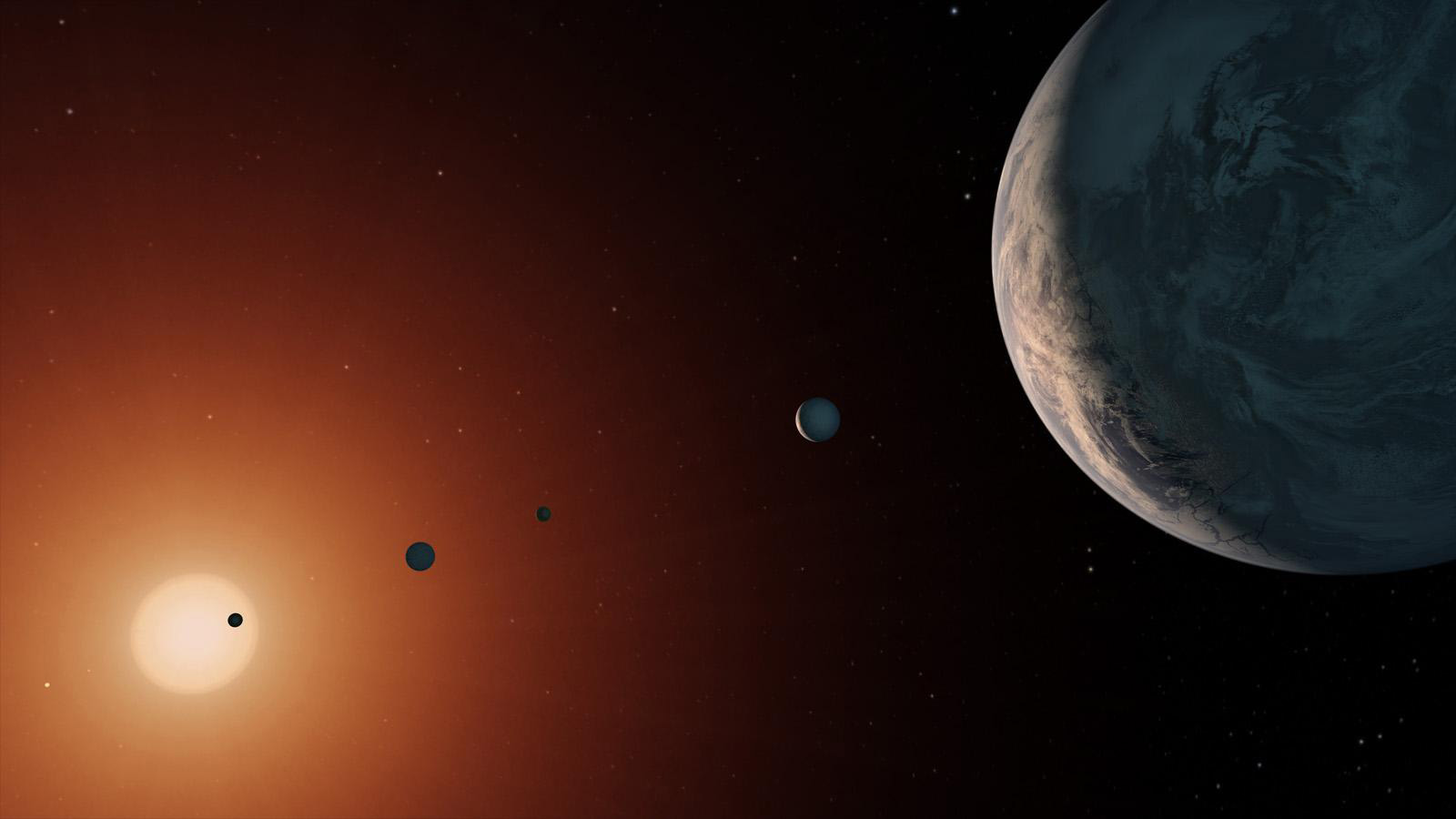
The TRAPPIST-1 star system contains several of the top candidates for habitable planets. If intelligent aliens exist on these planets, they would need to use radio-waves to communicate long-distance.
(Image credit: NASA/JPL-Caltech)In his excellent book "Is Anyone Out There?" Frank Drake makes his position clear: "If I believed the ETs would come out of the sky, I wouldn't bother. I would just sit outside in a lawn chair and wait for them to show up." I am inclined to agree.
Far more likely than any invasion is contact by radio signal. In that case, my hunch is that, once the existence of extraterrestrial intelligence is confirmed, it would then quickly settle into the background of everyday life. After all, aliens have long been a fixture of our entertainment culture — we are primed to accept their existence.
In addition, the news cycle relating to any "conversation" would simply be too long for it to capture the popular imagination even sporadically. TRAPPIST-1, for example, is just over forty light-years away and a message sent there today will not receive a reply for eighty years — more like opening a letter from your grandmother's pen pal than having a lively chat.
For decades, the value of SETI has sparked lively debate among scientists, politicians, policymakers, journalists. Yet, despite harsh budget cuts and scepticism, SETI persists. Our longing to answer the question of whether we are alone in the universe burns so brightly in some that they dedicate their lives to the search, fully aware that only future generations may uncover the truth.
related stories- Will the James Webb telescope lead us to alien life? Scientists say we're getting closer than ever.
- 'No easy explanation': Scientists are debating a 70-year-old UFO mystery as new images come to light
- Did people report seeing UFOs before the 20th century?
Whatever form that life takes, we know how we can expect to be contacted, because the laws of physics do not vary across the galaxy. Whether that planet has a yellow-green sky, whether it has five moons, or its people five legs, radio waves will be the form of light that is used for long- distance communication.
Perhaps, forty light-years away and forty years ago, a little green person on TRAPPIST-1 e switched on a shiny radio telescope and began to send messages towards the star systems all around, crossing all twenty fingers that someone out there would hear them. Perhaps one day we'll turn our dishes towards TRAPPIST-1, and tune in just as that alien message reaches us. It could be in a hundred years. It could be tomorrow. Until that fateful day, we look at the stars, we wait and we listen.
Excerpted from "The Echoing Universe: How Radio Astronomy Helps Us See the Invisible Cosmos," by Emma Chapman. Copyright © 2026 by Emma Chapman. Available from Basic Books, an imprint of Hachette Book Group Inc.

In The Echoing Universe, Emma Chapman tunes us in to the universe and what it is trying to say, through the science of radio astronomy. Everything is sending out signals: the surface of the Moon, distant stars—maybe even extraterrestrials. With radio waves, we can uncover what visible light cannot show us and peer into realms that are otherwise unreachable. Even the hostile surface of Venus, where high temperatures, lethal acid rain, and crushing pressure rapidly annihilate even the hardiest robotic probes, yields its secrets through radio observations.
TOPICS Emma ChapmanLive Science contirbutor
Dr. Emma Chapman is a Royal Society research fellow and lecturer in astrophysics, based at the University of Nottingham. She is the author of the popular science books "First Light" and "The Echoing Universe".
With contributions from View MoreYou must confirm your public display name before commenting
Please logout and then login again, you will then be prompted to enter your display name.
Logout