
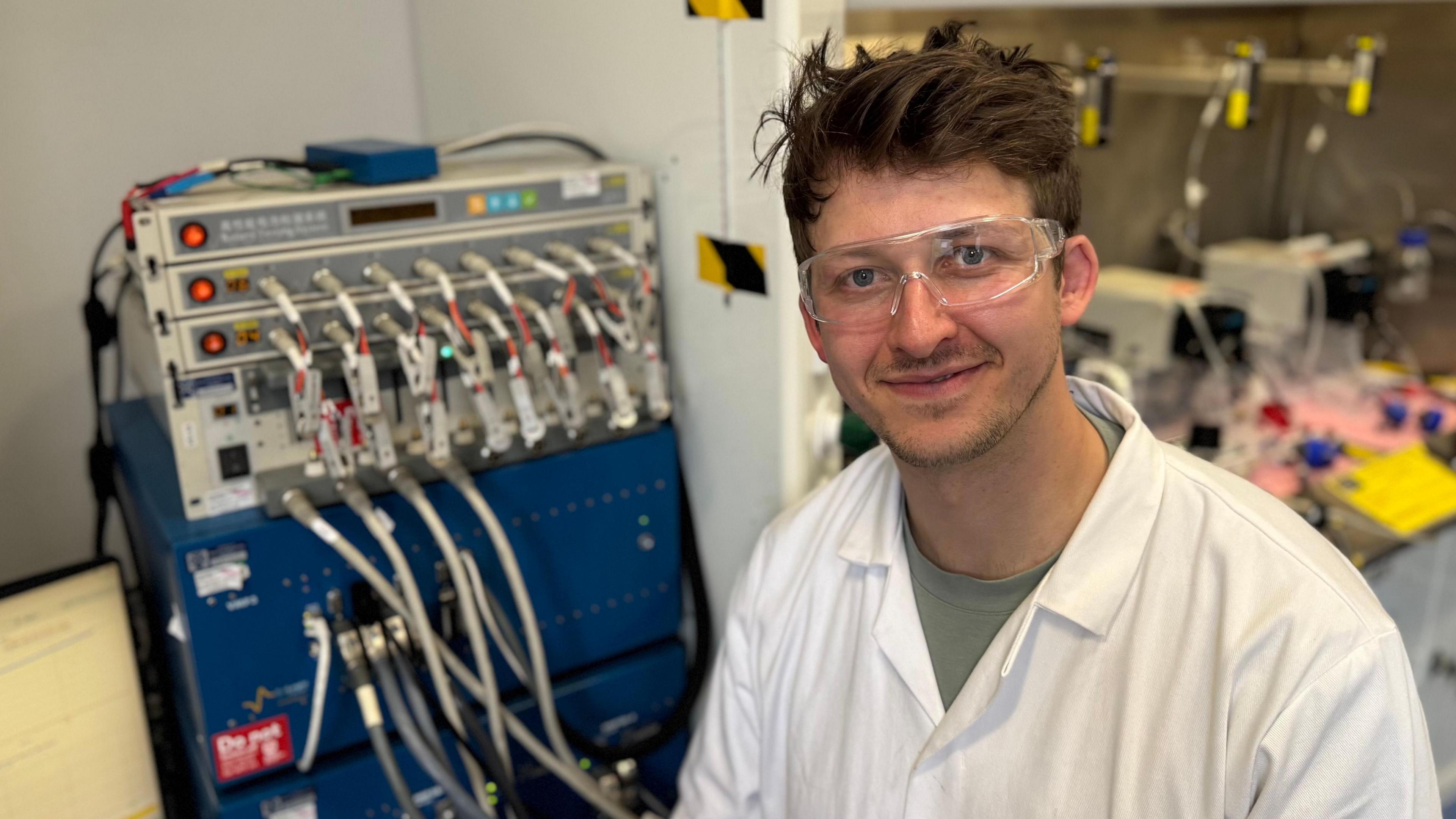
 Image caption,
 Dr Hugh O'Connor developed the 3D-printed cell when he discovered a commercial flow battery for his research would cost up to £3,000
ByLouise CullenAgriculture and environment correspondent, BBC News NI- Published37 minutes ago
A 3D-printed battery developed at Queen's University Belfast could "make a genuine impact" on the road to net zero, say the researchers behind it.
Flow batteries are seen as key to scaling up renewable energy, allowing it to be stored for when the wind is not blowing and the sun is not shining.
But they are expensive and typically use a metallic element - vanadium - that is only produced in a few places round the world.
Now, scientists at QUB have developed one based on iron, which is much easier to source, and have sent it around the world to help standardise research.
It is hoped it will accelerate the renewable energy revolution, making research more reliable and its findings more scalable.
How did this discovery happen?
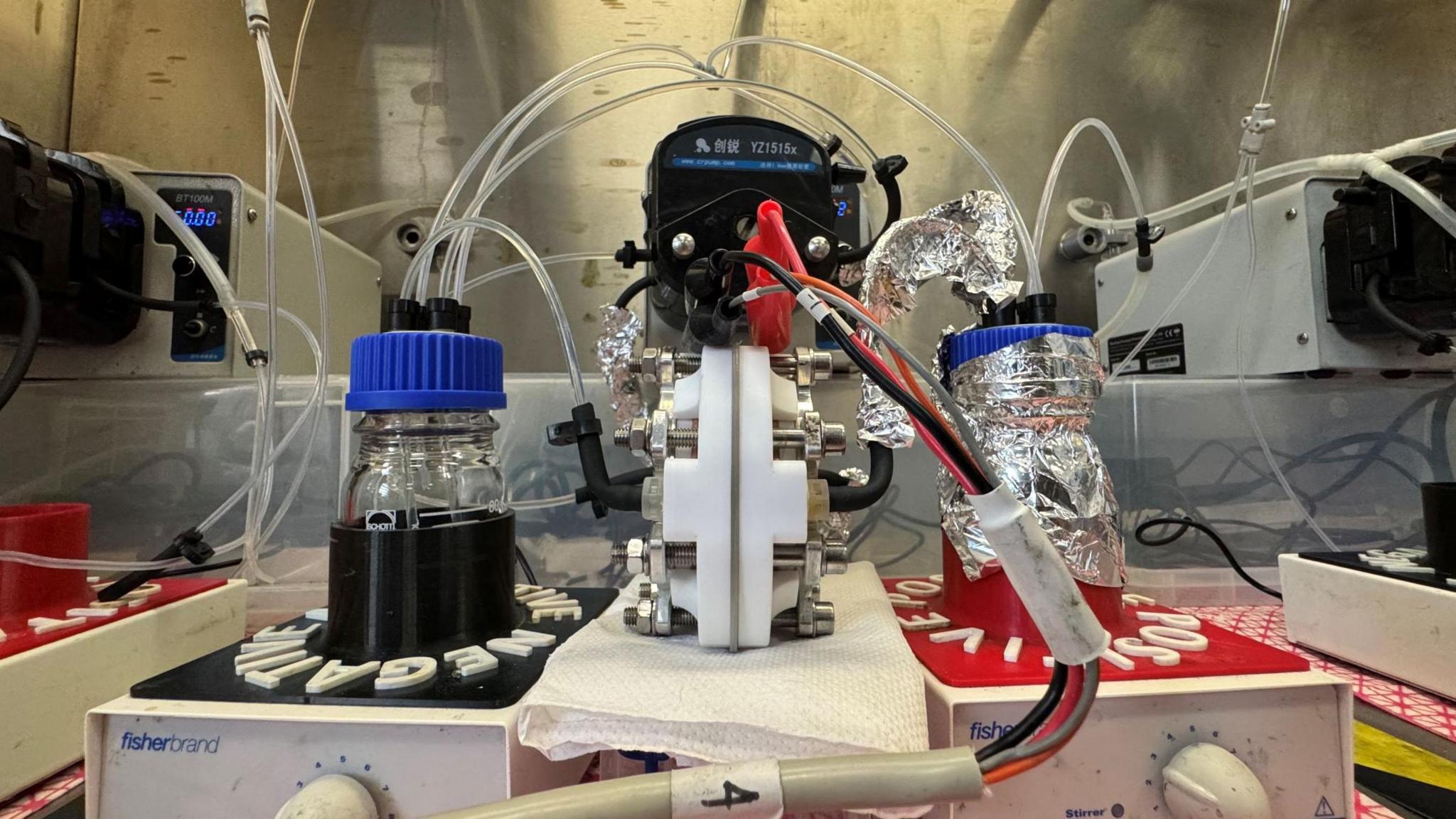
Post-doctoral researcher Dr Hugh O'Connor began tinkering with the design of flow batteries when he needed one for his PhD - and realised it would cost £2,000-£3,000.
"I started 3D-printing them and I made lots of little tweaks. After a lot of trial and error, eventually these started to work really well."
The cell he printed allowed him to carry out the tests he needed for his PhD.
But when he compared his results to other research, O'Connor struggled to find the standards he wanted.
"We were at various conferences and meetings and calls, we noticed that other people were having the same problems, and lots of our colleagues were really interested in this work.
"All of a sudden, we were in this position where we had this really nice cheap cell and we were all tackling the same problem."
'Ikea-style instruction manual'
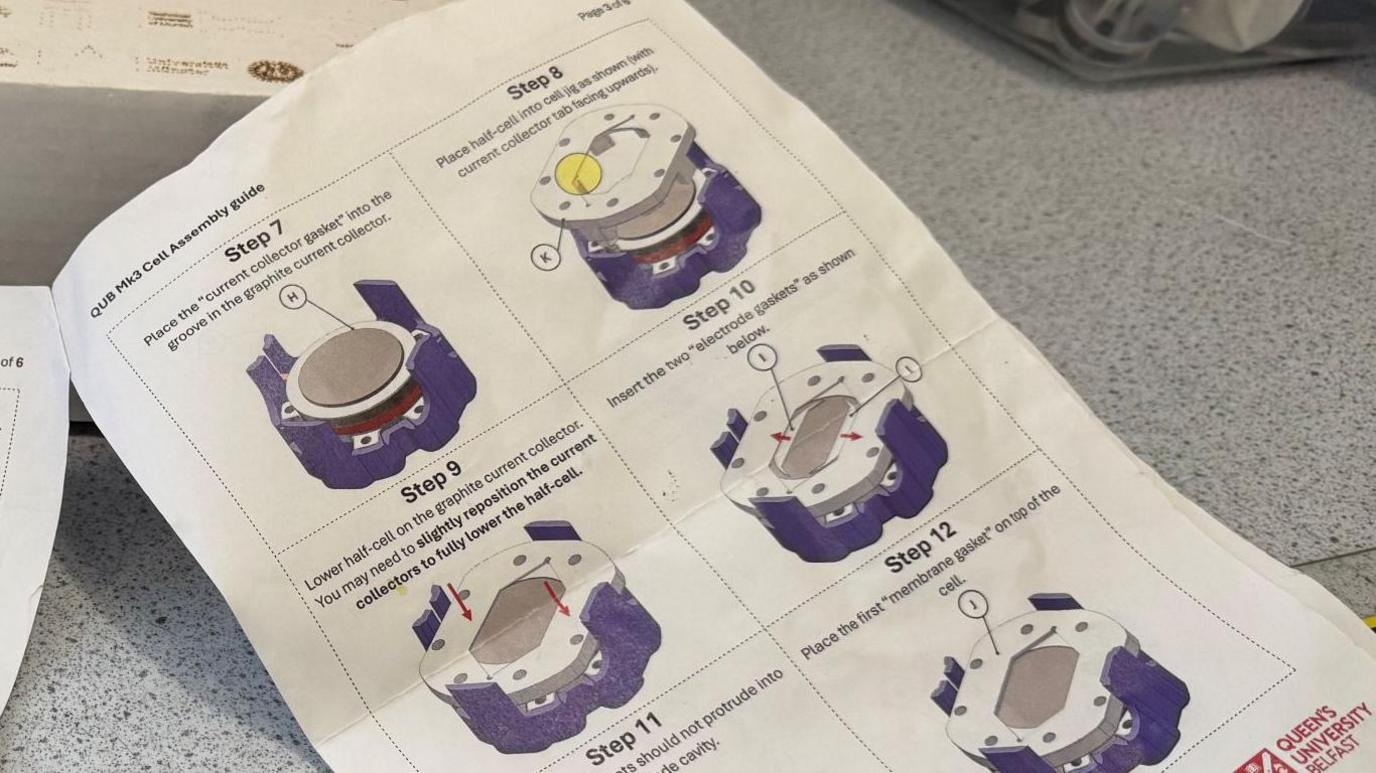 Image caption,
 The battery developed by O'Connor comes with its own step-by-step instruction manual, allowing other researchers to build their own
Discoveries like this are usually monetised by research institutions, constantly seeking funding to support their work.
And O'Connor admitted he briefly "cynically" considered selling his product to colleagues.
But after discussing it with his supervisor, they decided to provide the design to the entire international research community for free.
"We kind of saw it as an opportunity to grow our network rather than make a small amount of money, and we feel like it can really benefit this technology."
His design costs roughly £74 and involves about ten components, from the printed pieces that the liquid flows through, to a membrane, gaskets, electrodes and current collectors.
And it involves careful assembly, simplified by the free guide supplied with the kit.
"It was really important that we sent out like an Ikea-style instruction manual to our participants.
"And I think they followed it quite well."
What is a flow battery?
A flow battery is a device that stores energy in liquids, rather than solid electrodes as lithium-ion batteries do.
The liquids usually contain the metallic element vanadium.
There is more vanadium in the Earth's crust than lithium, but it is less accessible and more volatile in economic terms.
So while flow batteries are regarded as a potential game-changer in the renewable energy race to net zero, they have not been developed widely due to cost and geopolitical constraints.
China has constructed some large-scale batteries, and a trial has also taken place in Scotland.
But global development has also been hampered due to the irregularity of research results.
 Image caption,
 Dr Josh Bailey is one of the many scientists around the world who are using O'Connor's affordable 3D-printed battery
So being able to reproduce results using identical equipment in different institutions gives scientists like Dr Josh Bailey robust evidence to rely on.
As Illuminate Fellow at QUB's School of Chemistry and Chemical Engineering, he and the team are leading studies involving multiple institutions around the world, using O'Connor's affordable 3D-printed cell.
"We really honestly believe that flow batteries can be accelerated by these reproducibility studies and that the technology can be deployed more quickly if we're all using the same standards.
"If we're all going to get to 2050 and be at net zero, a lot more of our electricity needs to be stored in technologies like flow batteries."
QUB is co-leading on the studies along with a number of other universities around the world.
"It's fun to know that the things that we've made here are out there and that we're all working together to improve standards in flow batteries," said Bailey.
Why are flow batteries important?
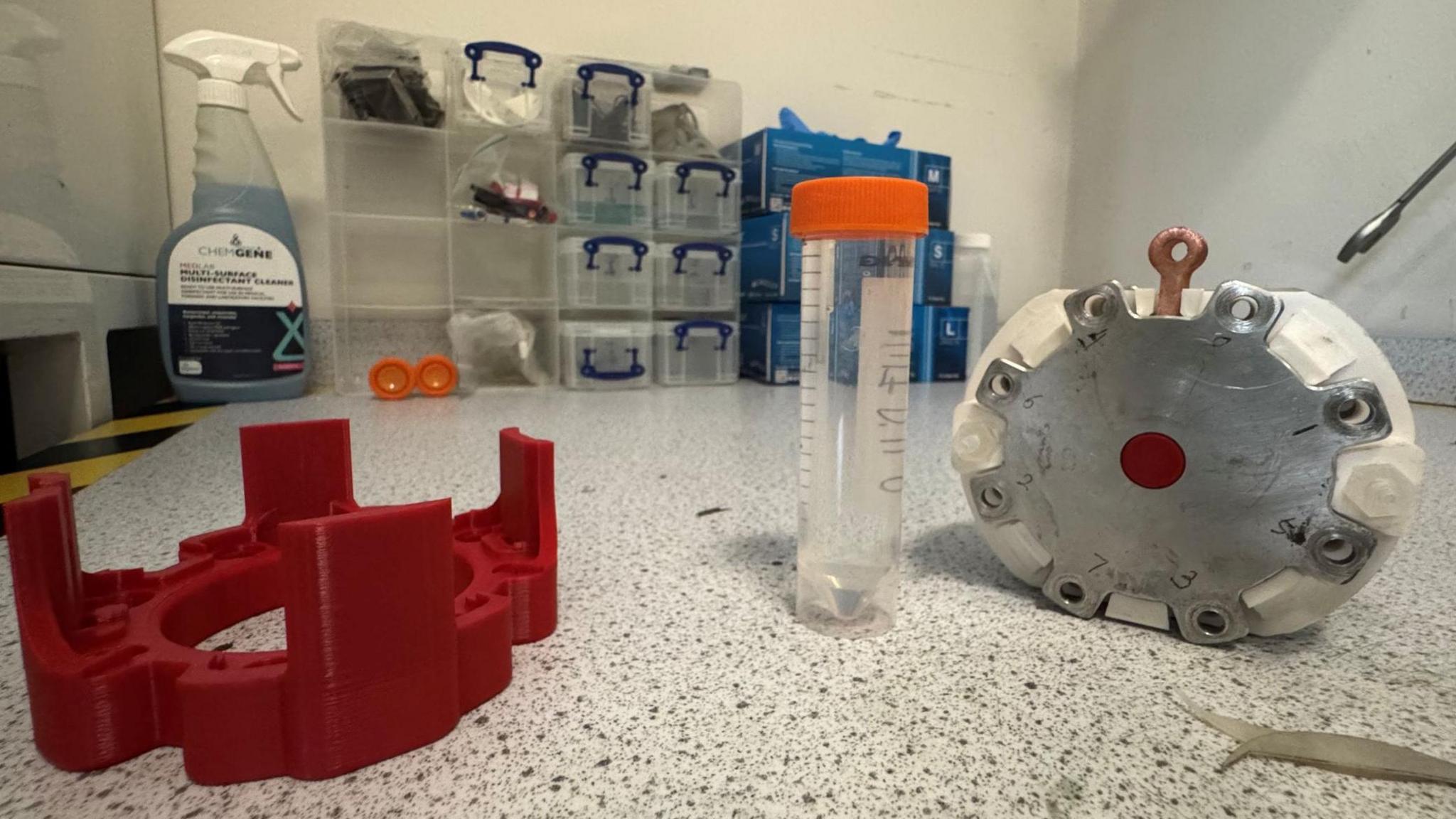 Image caption,
 A 3D-printed battery cell assembled in the lab
The world is increasingly turning to renewable energy.
Globally, renewable sources provided more electricity than coal last year, while the UK recorded its highest ever amount of renewable energy generation.
But reliable and affordable methods of storing all that energy are needed, so it can be used when it is not windy or sunny enough.
And being able to store more energy would also reduce the amount of time turbines have to be switched off to avoid impact on the grid when demand is low.
O'Connor and Bailey are scaling up their work, testing larger stacks of printed cells to see how the technology may be applied to industry.
"It's one thing to look at chemistry and a set of materials at the single cell level in a fume hood," said Bailey.
"It's another thing to see what it is like once you scale it up to a stack.
"So having the single cell, the stack and the system really gets us on the innovation track to see how far can we push the chemistries that we're working on."
Related topics
Turbines turning from wind to sustainable products
- Published4 July
Factory hoping to turn wood dust into electricity
- Published1 February

Renewable energy proposal could reduce bills
- Published21 September 2025