
 Image source, Getty ImagesImage caption,
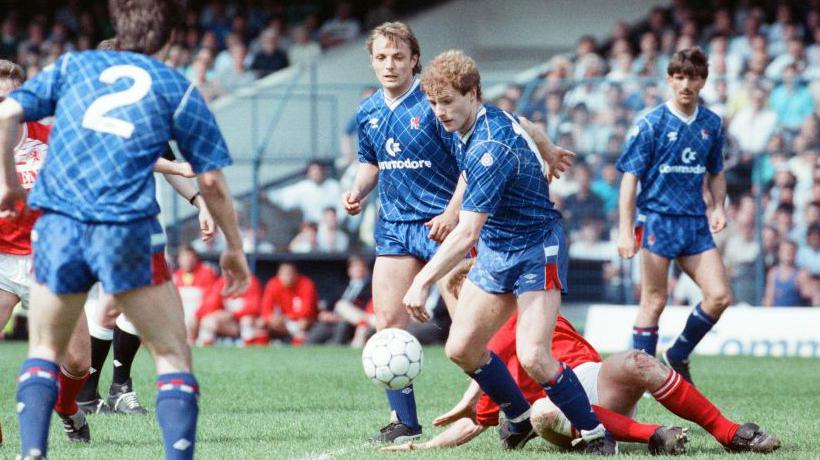
 Middlesbrough beat Chelsea in the second ever Second Division play-off final to win promotion to the top tier and relegate the Blues
ByBen Ashton, BBC Sport England and Chris Peddy, BBC Sport England- Published42 minutes ago
Chelsea have just finished 18th in the top flight, seven points clear of the automatic relegation zone. But after a two-legged play-off final against Middlesbrough, the Blues are relegated to the second tier.
The year was 1988 and the play-offs were taking place for just the second time, having been introduced the season before.
Boro had finished third in what was then the Second Division and won promotion by beating Chelsea 2-1 on aggregate.
For those first two years of the play-offs, Division One teams would compete with Division Two clubs to decide who went up and who went down.
It would be the last time that format was used. And a lot has changed since then.
What started out with games being played in front of 25,000 people at Ayresome Park has become the richest game in world football, worth about £200m and contested with a 90,000-crowd watching on at Wembley Stadium.
BBC Sport takes a look at the evolution of the play-offs.
Why were the play-offs created in the first place?
 Image source, Getty ImagesImage caption,
 Centre-back Peter Shirtliff scored twice in four minutes in extra time for Charlton to give the Addicks a 2-1 replay win in the first ever play-off final in May 1987
When the play-offs were introduced in the 1986-87 season, it was to facilitate a restructuring of the leagues - including reducing the top tier from 22 to 20 clubs - in an attempt to improve the financial state of English football at the time.
The plan was for the format to run for two years and be kept if they were considered a success.
And now 40 years on, evidently that was the case.
Charlton Athletic, who were in Division One, were the eventual winners in the inaugural campaign, beating Leeds United of Division Two 2-1 following extra time in a replay after their two-legged final had ended 1-1 on aggregate.
A year later, only 15,841 fans attended that replay at St Andrew's in Birmingham. It remains the only time Boro have won a play-off final in four attempts.
After Boro overcame Chelsea in 1988, the format was changed and only the four teams finishing directly below the automatic promotion spots in the second tier qualified for the play-off semi-final.
Crystal Palace beat Blackburn Rovers 4-3 on aggregate in 1989 in what would be the last two-legged final.
Since then, the format has been the one we are all familiar with, two-legged semi-finals and a one-off final at Wembley - barring the five seasons between 2001 and 2006 when it was held at Cardiff's Millennium Stadium while the new national stadium was built.
Forty years of the EFL play-offs - 15 key games and moments
- Published12 May
Can stats pick out the Championship play-off winner?
- Published5 May
Non-league inspiration - how it's set to change again
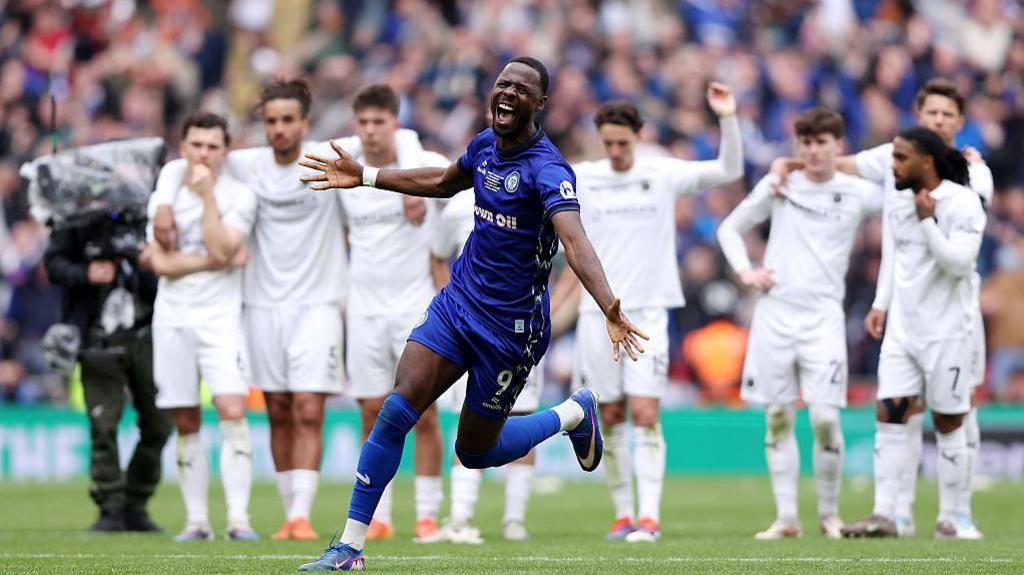 Image source, Getty ImagesImage caption,
 Rochdale beat Boreham Wood in this year's National League promotion final at Wembley
Despite 37 years of gloriously unstable stability, full of more twists and turns than a slinky toy on a rollercoaster, the rulebook is about to be ripped up once again.
Because as of 2027-28, two more teams will enter the fray.
For the first time, the Championship will have six teams involved in the play-offs - more clubs than ever before.
Four sides will compete in a one-off eliminator round, before the winners move on to the more familiar home and away two-legged semi-finals, in which the third-placed team will play the lowest-ranked club remaining in the competition.
It will still culminate in the final at Wembley.
A similar format was introduced in the National League in 2017-18.
The only difference in the fifth-tier system is that only one team is promoted automatically and the play-off semi-finals are a single game played at the home of the team who finished highest in the table.
On no occasion has a team who finished in the bottom two spots [sixth or seventh] won promotion.
This season, fourth-placed Boreham Wood defeated Forest Green Rovers [seventh] in the eliminator round, before winning at Carlisle United [third] in the semi-final, while second-placed Rochdale, who missed out on automatic promotion in a dramatic final-day draw with champions York City despite accruing 106 points, beat Scunthorpe United in the other semi-final.
Rochdale eventually won on penalties having equalised in the seventh minute of added time at Wembley to seal the second promotion spot that many would have argued they deserved in the first place, having finished with 25 more points than Forest Green - the equivalent of eight wins and a draw.
Quiz: Name all the Championship play-off final winners
- Published1 hour ago
How Warnock became play-offs' record-breaking boss
- Published1 day ago
What would have happened this season?
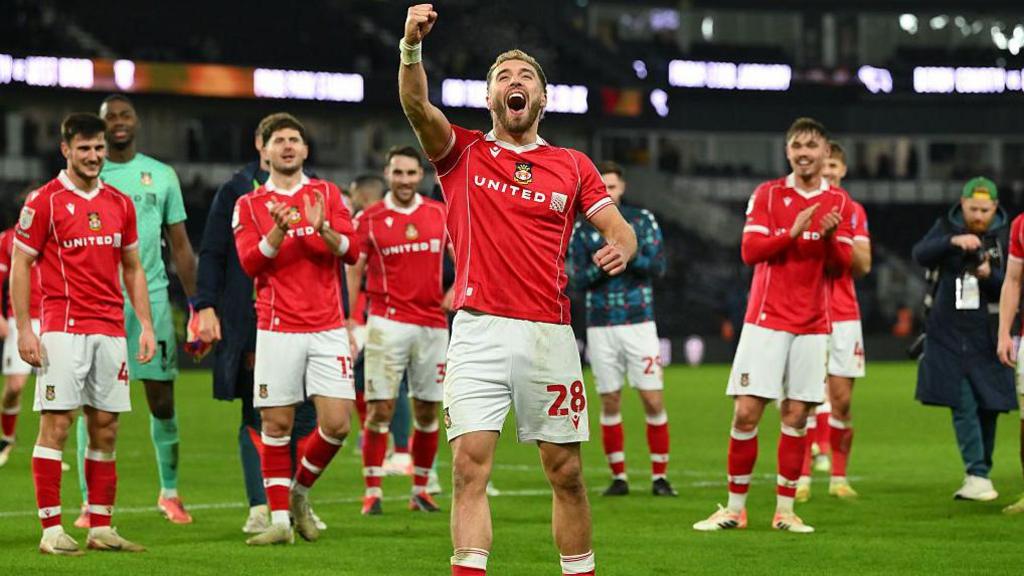 Image source, Getty ImagesImage caption,
 Had the new play-off format been implemented in the Championship this season, both Wrexham and Derby County would have had a shot at promotion
We know Hull City will now face Middlesbrough instead of Southampton in the final under the arch on Saturday, 23 May following the "spygate" scandal which led to Saints' expulsion.
Hull beat Millwall 2-0 on aggregate and Southampton edged out Boro 2-1 after extra-time in a thrilling match at St Mary's before the latter result was retrospectively reversed.
But how would things look if next year's format were in place now?
For a start, we'd have had considerably less drama on the final day of the season.
Rather than scrapping it out for the one remaining play-off spot, the Tigers, Wrexham and Derby County would all already have been assured of a chance to reach the Premier League, with the Red Dragons and Rams filling the seventh and eighth places regardless of Norwich City's [ninth] result.
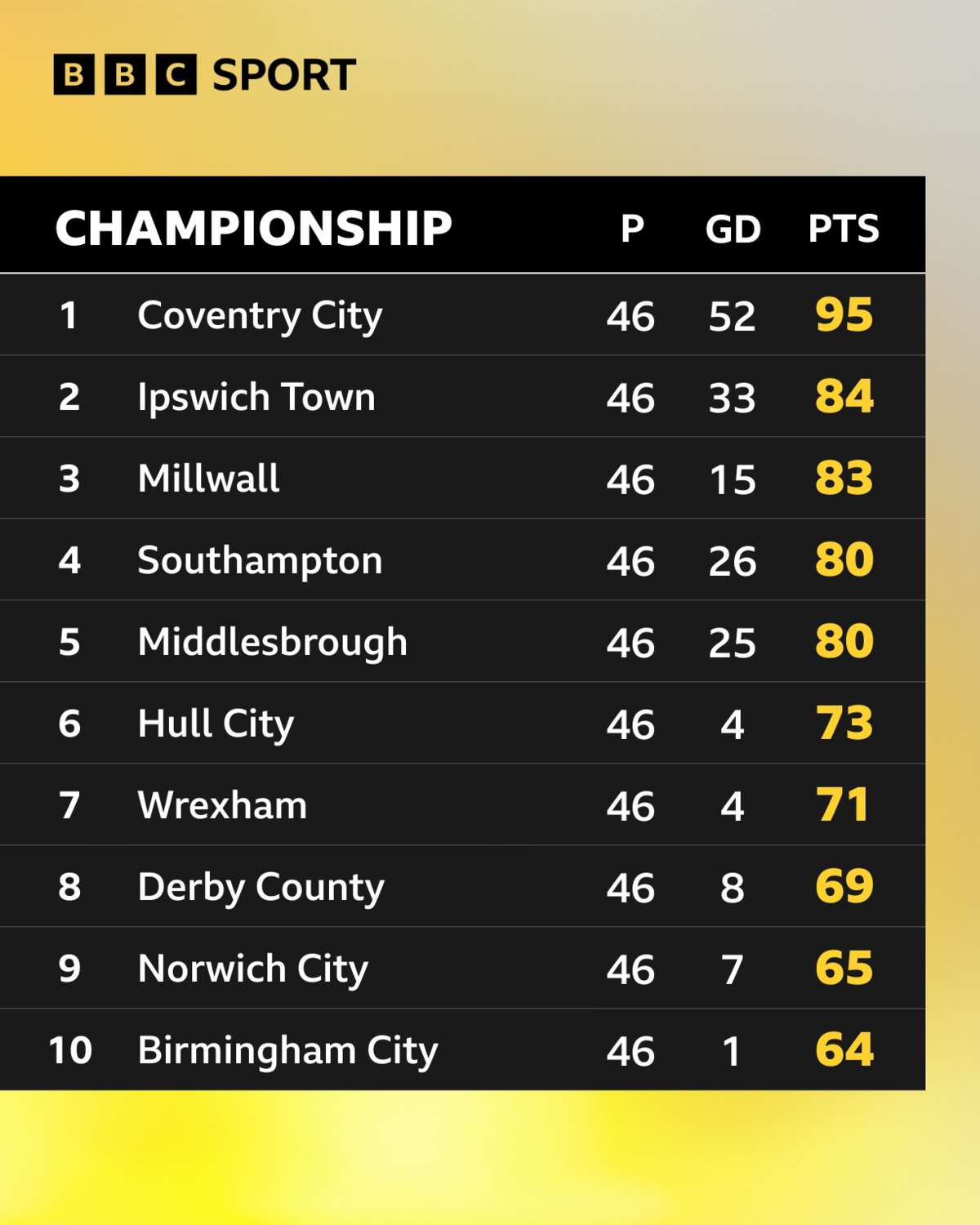 Image source, OptaImage caption,
 Under the new Championship format, Wrexham and Derby County would take the extra spots for finishing seventh and eighth in the table
As it happened, Hull clinched sixth with Wrexham in seventh and Derby eighth, meaning the play-off eliminator round would have been as follows:
Middlesbrough v Derby County
Hull City v Wrexham
The victors would then go on to a two-legged semi-final against Millwall or Southampton, with the winners of those games facing off in the final at Wembley.
'An unbelievable feeling' - the best way to win promotion?
 Image source, Getty ImagesImage caption,
 Tommy Smith won the play-offs with Huddersfield in 2017 and says winning the final is "special"
With all the tension and drama that surrounds the play-offs, there is an argument to be made that it is perhaps the best way to win promotion.
Former right-back Tommy Smith, who won the Championship play-off final with Huddersfield Town in 2017 and played in the Premier League for the Terriers, says it is the "jeopardy" which makes it so unique.
"The play-offs do strange things to you. Moments in time. It brings out things in games that you just don't see in a normal season. There's a key word in it and that's jeopardy," he told BBC's Football Daily 72+ podcast.
Smith described winning the play-off final as an "unbelievable" and "incredible" feeling that will stay with him for the rest of his life.
"Ultimately I've got pictures around my house now, I've got the medal to show for it," he added.
"It's only afterwards when it sinks in that you actually realise what you've achieved. It's a surreal day and a surreal feeling."
Lyle Taylor, who won promotion via the play-offs from the Championship, League One and League Two with Nottingham Forest, Charlton and AFC Wimbledon respectively, said it is a "feeling you can't really describe".
"It's strange. I remember walking up there [the Wembley steps] and it hasn't hit you that you've done it," he said.
"I saw my parents after the finals and the emotion gets you at that point. It's mad because it's such a momentous day, it's such a big part of your life and if you're lucky enough to do it as a footballer, it's incredible."