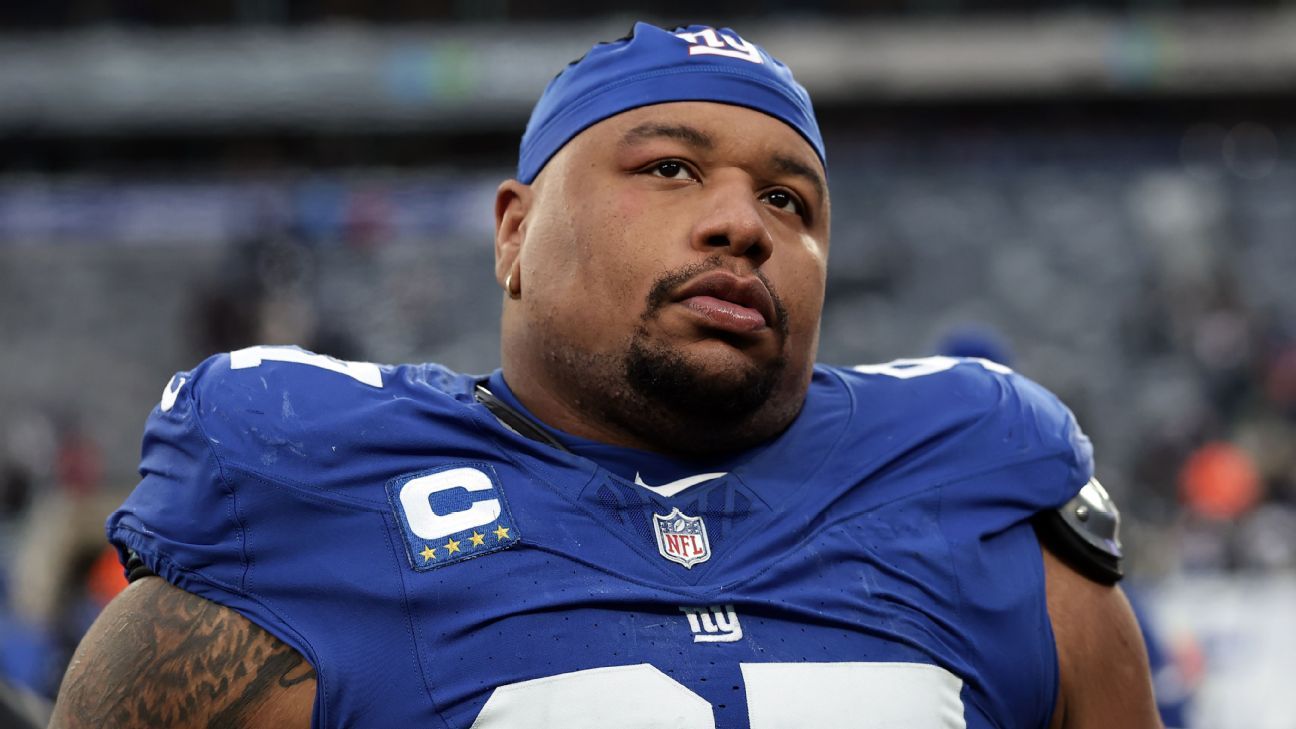
Damien Woody says he was caught by surprise by Dexter Lawrence II's trade request to the Giants. (0:50)
When I was putting together my trade tiers column over the summer and listing all the players who might land a first-round pick or more via a deal, Dexter Lawrence II was the very last cut. The Giants defensive tackle was a preeminent force on the interior and coming off a nine-sack season, but there were plenty of coverage sacks or secondary pressures factored into those sack totals, and Lawrence was already deep into his second contract, a point at which teams around the league had grown reluctant to trade first-round picks for even standout players.
Well, the game has changed. We've seen organizations around the NFL establish and pay a new premium for veteran defensive linemen. Even leaving Micah Parsons' deal with the Packers aside, the Cowboys sent first- and second-round picks to the Jets for Quinnen Williams. The Ravens agreed to send two first-round picks to the Raiders for Maxx Crosby before walking that deal back for injury reasons.
And on Saturday night, the Bengals stunningly became the latest team to go over the top for a veteran lineman, sending the 10th pick to the Giants to add Lawrence to their defensive line. The 28-year-old Lawrence had reportedly sought a new deal with New York, but once the two sides weren't able to find common ground, the Giants pivoted to the trade market.
What they received, frankly, is shocking. There's a reason that the reports on social media from NFL insiders had to include "straight up" to confirm that there wasn't a second-round pick or something substantial heading back to Cincinnati as part of this deal. This is a massive return, one that would have seemed completely stunning to me a year ago, even given that Lawrence was coming off a better season. If we look at the big takeaways from this trade, I have to start there.
Jump to a takeaway: The trade paradigm has shifted The league doesn't like this draft The Bengals see Lawrence as a game-changer The Bengals want Burrow to be happy
Lawrence is now the fourth prominent defensive lineman to be included in a trade for a first-round pick over the past nine months after Parsons, Williams and Crosby (whose deal admittedly didn't come to fruition but still gives us a sense of how he was valued). The Parsons trade doesn't really belong with the other three, given that he was a younger player who hadn't even signed his second contract, let alone played through part of that deal.
The Cowboys' trade for Williams is really the moment where the prices NFL teams were willing to pay for star defensive linemen midway through their second contracts shifted. It's impossible to say whether the Williams trade was the first example of that new world or whether it was the actual trade that caused prices to go up, but it was a return that seemed out of line with what teams had been willing to pay for players with this level of experience and wear and tear on their bodies. Remember that the Bengals hadn't been able to land a first-round pick last offseason as they shopped Trey Hendrickson, who was coming off a 17.5-sack, first-team All-Pro season.
Lawrence didn't land the Giants a first and a second, or a pair of first-round picks, but he did land them another top-10 selection. We see teams trade away top-10 picks as they move up for rookie talent or as part of deals where they've dealt away future first-rounders (and didn't know where their first-rounders would land), but it's incredibly rare to see NFL franchises trade picks this high in the draft for individual veterans.
How rare? We've seen a grand total of two veterans traded for first-round picks that were already guaranteed to be in the top 10 since 2000. One was Randy Moss, who was dealt as part of a deal for the seventh overall pick in 2005. The other was Russell Wilson when he was shipped to the Broncos for a package that included the ninth overall selection in 2022. Moss was a 28-year-old wide receiver with a Hall of Fame résumé. Wilson was a quarterback who had made it to five consecutive Pro Bowls. Lawrence is a very good player, but he isn't a quarterback and he's not on a Hall of Fame track.
Organizations were more comfortable trading first-round picks or high selections for veteran players in the 1980s and 1990s, but as the league went under the salary cap and subsequently introduced the rookie scale in 2011, we saw teams emphasize pick value and younger talent. Front offices grew more thoughtful about player aging expectations and recognized the potential of landing players on cost-controlled deals for the first four years of their NFL careers. They've continued to prioritize youth in free agency, but NFL general managers are suddenly more open to trading first-round picks for veterans.
While some pointed toward the Rams of the past decade as evidence that those picks might be overvalued in the context of recent trades, that's always been shortsighted. The Rams were generally trading their first-round picks for young, established stars entering the primes of their careers -- players like Brandin Cooks, Jalen Ramsey and most recently Trent McDuffie. They reportedly tried to send two first-round picks to the Panthers for Brian Burns. Les Snead made a big move up in the draft for Jared Goff.
The Rams' only exception was trading two first-round picks for Matthew Stafford. Quarterbacks are often the exception.
There was a year where the Dolphins and Raiders both traded first-round picks (plus more) in deals for veteran wide receivers in Tyreek Hill and Davante Adams, respectively, but non-quarterbacks in the middle of their second contracts in the age-28 range hadn't typically landed first-round picks, let alone anything on top of that. We've now seen three trades agreed to involving veterans in this range along the defensive line over the past nine months, although one wasn't executed because of a physical (and the Lawrence trade is still subject to one).
I'm not sure it's a wise shift toward prioritizing what teams believe to be known quantities. The Moss and Wilson trades didn't work out whatsoever. Williams played well in Dallas but wasn't able to turn around the Cowboys' defense in any sort of meaningful way in his first half-season. The Adams deal was a disappointment in Vegas, as the Raiders failed to self-scout and thought they were closer than they actually were to contention. Hill was a fantastic wide receiver for two years in Miami, but the Chiefs would feel pretty happy with what they landed on the other side of the deal, most notably with McDuffie.
With that being said, there's still plenty of time for the Williams trade to play out. We'll see what happens with Lawrence, who now becomes the focal point of the defense in Cincinnati. And there's also the reality of where the league is going schematically. Defenses want to live like the 2025 Seahawks and so many Vic Fangio-influenced units over the past decade. They want to stay out of their base personnel, keep a nickel defender on the field as much as possible, play two deep safeties, show light boxes in terms of size and numbers, influence teams to run the ball and then repeatedly win against offenses by stealing gaps and winning their one-on-one matchups. You need to have standouts up front to make that work, and there aren't many humans on the planet who have Lawrence's combination of size and athleticism.
While I personally might not think trading first-round picks for players approaching 30 is a great idea, it's clear that NFL teams are more open to the idea than they have been in years past. That's going to impact the trade market in the years to come at premium positions. The price the Panthers eventually landed for Burns (a second-round pick and a pair of fifth-rounders) feels light by comparison to what's going around now. The Eagles shouldn't settle for anything short of a first-round pick for A.J. Brown. And if a player like Jeffery Simmons ever landed in trade talks, well, we could be looking at an NBA-sized haul for one of the league's best defensive players, even given that he's turning 29 in July. I'll have to incorporate that moving forward as I evaluate these trades.
An alternate explanation for what's going on might simply be that the NFL doesn't see 2026 first-round picks as particularly valuable. Although there are a few standout hybrid players at the top of the first round and a couple of positions that are relatively deep into Day 2, this is widely regarded around the league as one of the weaker drafts in recent memory.
Organizations want to see drafts with plug-and-play starters at key positions like wide receiver, edge rusher and left tackle, but there aren't many players who project to be standouts in those spots. The players who will come off the board first at those positions have more question marks than usual. Is Texas Tech's David Bailey stout enough to hold up as an NFL edge defender? Is Ohio State's Arvell Reese really an elite pass rusher? Is OSU's Carnell Tate a true WR1 or a player who benefited from playing across from Jeremiah Smith?
I think the answers to all three of those questions are yes, but it's easier to say that from the outside than it is to put a first-round pick behind that call. And given how we've now seen the Packers, Colts, Bengals, Rams and even the Ravens (briefly) trade away first-round picks for veteran players over the past few months, it certainly seems like there are teams that don't see this as a premium draft. The Cowboys, to the contrary, traded away a 2027 first-round pick and held on to their two first-rounders in 2026 as part of the Williams deal.
All of that could make for a fascinating draft this upcoming week. Will teams like the Titans that might want to move down struggle to find trade partners? Will veterans be on the move come draft night if teams with small boards don't land the player they want? Or as Chiefs general manager Brett Veach suggested, will there be a lot of trades from teams that see only a handful of players they really want and go out of their way to make sure they land those precious few standouts?
With the 10th pick, the Bengals might have been in position to draft someone like Miami edge rusher Rueben Bain Jr. or LSU cornerback Mansoor Delane, players who rate among the best at their respective positions in this class. With history telling us how the league views safeties, Ohio State's Caleb Downs might have even fallen to them. Unless the draft went in completely unexpected ways, the Bengals were going to be in position to take a defensive player who would have excited their fan base in Round 1.
Instead, they traded for Lawrence, landing the Bengals a three-time Pro Bowler on the interior. Evaluating Lawrence's impact, especially after last season, is tricky. Let's start with the passing game. Most nose tackles don't have the athletic ability or the time to impact the quarterback. Lawrence is one of the few exceptions to that rule, as he's capable of overwhelming interior linemen one-on-one and winning quickly enough to actually cause opposing passers some problems.
Lawrence's nine-sack season in 2024 is an outlier, and on closer inspection at the time, a handful of those takedowns were cleanup sacks on plays where someone else won and Lawrence benefited. The 2025 season was a case of regression way past the mean, as Lawrence fell all the way to 0.5 sacks. His pressure rate fell from 9.6% in 2024 to 5.9% in 2025, per NFL Next Gen Stats.
Both 2024 and 2025 seem like unrealistic expectations for Lawrence's sack production, or lack thereof. He has averaged five sacks and 16 knockdowns per 17 games as a pro, and those numbers seem eminently reasonable as a projection for Lawrence's 2026 campaign.
That sort of pass-rush production from a 0-technique defensive tackle is excellent, and it'll make life easier for Cincinnati's edge rushers, who won't see double-teams quite as often. But if Lawrence is your best pass rusher, as he projects to be for a Bengals team that didn't have a player top six sacks last season, I'm not sure you're going to have the sort of pass rush you're hoping for from your front four.
The same qualities that make Lawrence so explosive as an interior pass rusher also make him a load to deal with in the run game. He isn't going to shoot gaps and make a lot of tackles for loss in the backfield against the run, having maxed out at four in a single season since joining the Giants, but he's going to absorb double-teams and create opportunities for other players to flow to the ball carrier. Lawrence was double-teamed at the second-highest rate of any interior lineman in the league last season.
Even with a full season from a player avowed to be the best nose tackle in football, though, the Giants were horrific against the run in 2025. They were last in the league in EPA per play against designed runs (plus-0.13), last in yards per carry allowed against those rush attempts (5.4) and 31st in success rate allowed (51.7%). They gave up consistent chunks of yardage, got pushed off the line and then allowed too many big plays once running backs got past the first level.
I don't think anyone can or should pin the majority of those issues on Lawrence. The Giants lost starting linebacker Micah McFadden to a season-ending injury in Week 1, though he isn't exactly Fred Warner. They didn't have great players in the secondary. The tackling and the angles simply weren't good enough. But at the same time, watch enough of those big plays and you'll see a few where Lawrence gets blocked out of the play one-on-one. It wasn't his best season as a run defender, owing perhaps to a balky elbow.
If you're a Bengals fan who wants to write off 2025 as a lost season for Lawrence given the injury, his frustrations with his contract and a New York team that fired its coach at midseason and was out of the postseason picture by mid-November, that's perfectly reasonable. But although the Bengals have made changes on the back end to try to fix some of their problems this offseason, this team had the same issues with tackling and angles that the Giants had. Cincinnati led the league with 170 missed tackles last season. No other team had more than 131. Swapping out Geno Stone for Bryan Cook was a major tackling upgrade, and Boye Mafe will be an upgrade on the edge, but this wasn't a team that looked like it was one very good defensive tackle away from stopping the run in 2025.
It's also fair to say that Lawrence didn't have a great year as the best player on a very bad defense. And now, the Bengals are paying a premium to make Lawrence the best player on what has been a very bad defense in Cincinnati in the hopes that he'll turn it around. That same move failed to turn around the Cowboys with Williams.
And that premium is going to cost Cincinnati a lot. Lawrence already wanted a new contract before the trade, and giving up the 10th pick only reaffirms that the Bengals see Lawrence as a superstar defender. Duke Tobin & Co. will have made this trade knowing that a new deal is going to be on the way for Lawrence. They're not going to end up in another Hendrickson-style staring contest all summer.
Lawrence shouldn't have the leverage to land anything in the ballpark of the $50 million average annual salary that Will Anderson Jr. reportedly signed as part of his deal with the Texans. But the top of the defensive tackle market hasn't shifted since 2024, when Chris Jones signed a deal worth $31.8 million per year to stay with the Chiefs. Five edge rushers have topped that figure since then.
Adjusting for the rise in the salary cap, matching Jones' deal would cost the Bengals just under $38 million per season. Would Lawrence try to push for $40 million per year? Would the Bengals really be able to justify saying no? If you throw in the opportunity cost of trading away the 10th pick and the chance of adding a young, difference-making defender on a rookie deal for four years, that adds another $10.6 million per year to the Lawrence trade's price tag. Factor that implied cost in, and Lawrence could end up being a $50 million-per-year player, which makes anything short of superstardom a disappointment.
Of course, both Bengals fans and executives might wonder if there have ever been difference-makers in the draft for them on defense. In the early days of the Joe Burrow era, the Bengals spent heavily on defense in free agency and built their offense through the draft. As those offensive standouts earned second contracts and re-signing them got more expensive, Tobin's plan was to rebuild the defense through the draft, just as Howie Roseman has done in recent years with the Eagles.
Those picks have mostly been disastrous. The Bengals have used 10 top-100 picks on defenders since their 2021 run to the Super Bowl. The only surefire hit has been cornerback DJ Turner II. Dax Hill has been solid when healthy, and the jury is still out on their 2025 picks, but players such as Cam Taylor-Britt, Zachary Carter and Kris Jenkins Jr. have been major disappointments. If the Bengals had nailed any of their defensive tackle picks, they wouldn't be trading for Lawrence today.
You can understand why the Bengals feel desperate. They've continued to commit resources in the draft to their front seven with disappointing results. They fired defensive coordinator Lou Anarumo and replaced him with Al Golden, but that didn't fix Cincinnati's problems. They didn't have Hendrickson for most of 2025, and he left for the Ravens in free agency last month. The money that might have gone to Hendrickson went to Mafe and Cook instead, and now, they're taking on another large contract by trading for Lawrence. They're desperate because they want to win, of course, but there's another party they also want to please.
This isn't the NBA. It's much more difficult for players to force their way out of situations that aren't tenable or enjoyable in the NFL. And Bengals fans who saw their team land on a wildly successful and charismatic quarterback with the first pick understandably don't want to even broach the idea that their market is just some stopover point before Burrow moves on to brighter lights in a bigger city.
And yet, there's a reason trade talk swirls around Burrow but not around Josh Allen in Buffalo or Patrick Mahomes in Kansas City, neither of whom is in one of the league's biggest or most prominent media markets. The Bengals have not been able to consistently surround Burrow with what he needs to win. Although they did get deals done with Ja'Marr Chase and Tee Higgins, Burrow's top two receivers, the defense simply hasn't been good enough. Burrow played MVP-caliber football in 2024 and had one of the best seasons ever by an NFL quarterback who missed the postseason. He dealt with injuries in 2023 and 2025, and the Bengals went 5-11 in the games Burrow missed those years.
Stephen A. Smith questions whether Joe Burrow should feel confident about his future with the Bengals.
The Bengals have a perception of being particularly cheap, but I'm not sure that's really borne out in terms of on-field spending. Between 2022 and 2025, they were 22nd in the league in cash spending, ahead of teams like the Seahawks (30th) and Rams (32nd). They project to be eighth in cash spent this year, a figure that should rise even higher if Lawrence signs a deal with a massive signing bonus. Their investment off the field, particularly in scouting, might still lag behind the league, but there's a competitive amount of cash being poured into the roster itself.
Last year, Burrow looked enviously toward the Eagles and suggested that Philadelphia "pays everyone." Although that's not actually true, you can understand why Burrow would look at other organizations and see them paying for a quarterback, a standout receiver or two, and difference-makers on both sides of the football.
Nobody can accuse the Bengals of being cheap in making this trade for Lawrence. I'm just not sure it's the best use of their resources, even if the former Giants tackle is likely to deliver a better defense in 2026 than whomever the Bengals were going to take at No. 10. I wonder whether signing Hendrickson when he wanted a new deal, using a first-round pick on a defensive tackle a year ago and holding on to this 2026 first-rounder would have been more cost effective and returned a better defense in the process.
There's another Burrow quote I keep coming back to, though: "The [Super Bowl] window's my whole career." Burrow said that entering the 2022 playoffs. He hasn't been back to the postseason since. Whatever the Bengals have done to try to fix their problems or plug their holes over that time frame has generally made things worse. This is a win-now move from a team that has a player who thinks he can win every year.
If it doesn't work, I wonder whether there's anything else the Bengals will be able to do to convince Burrow that he's in the right place to win on an annual basis. And if Burrow completely loses faith in the organization, well, we've seen how that's gone before in Cincinnati.