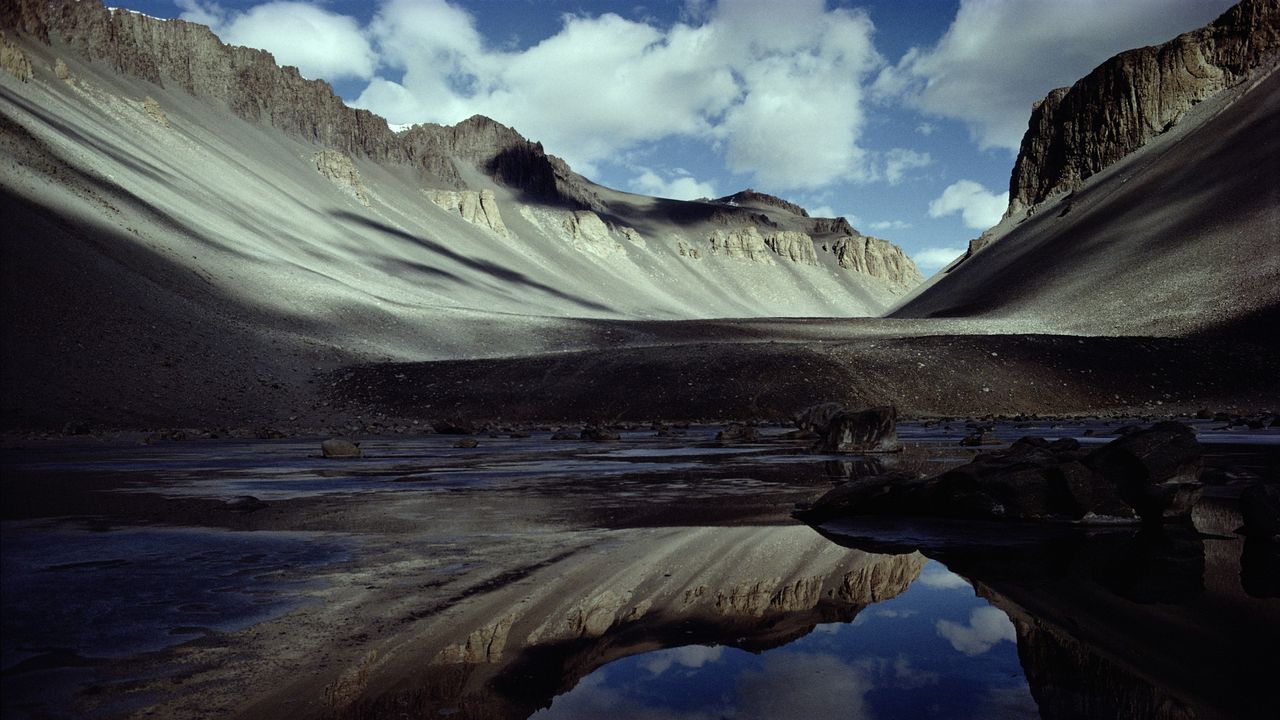
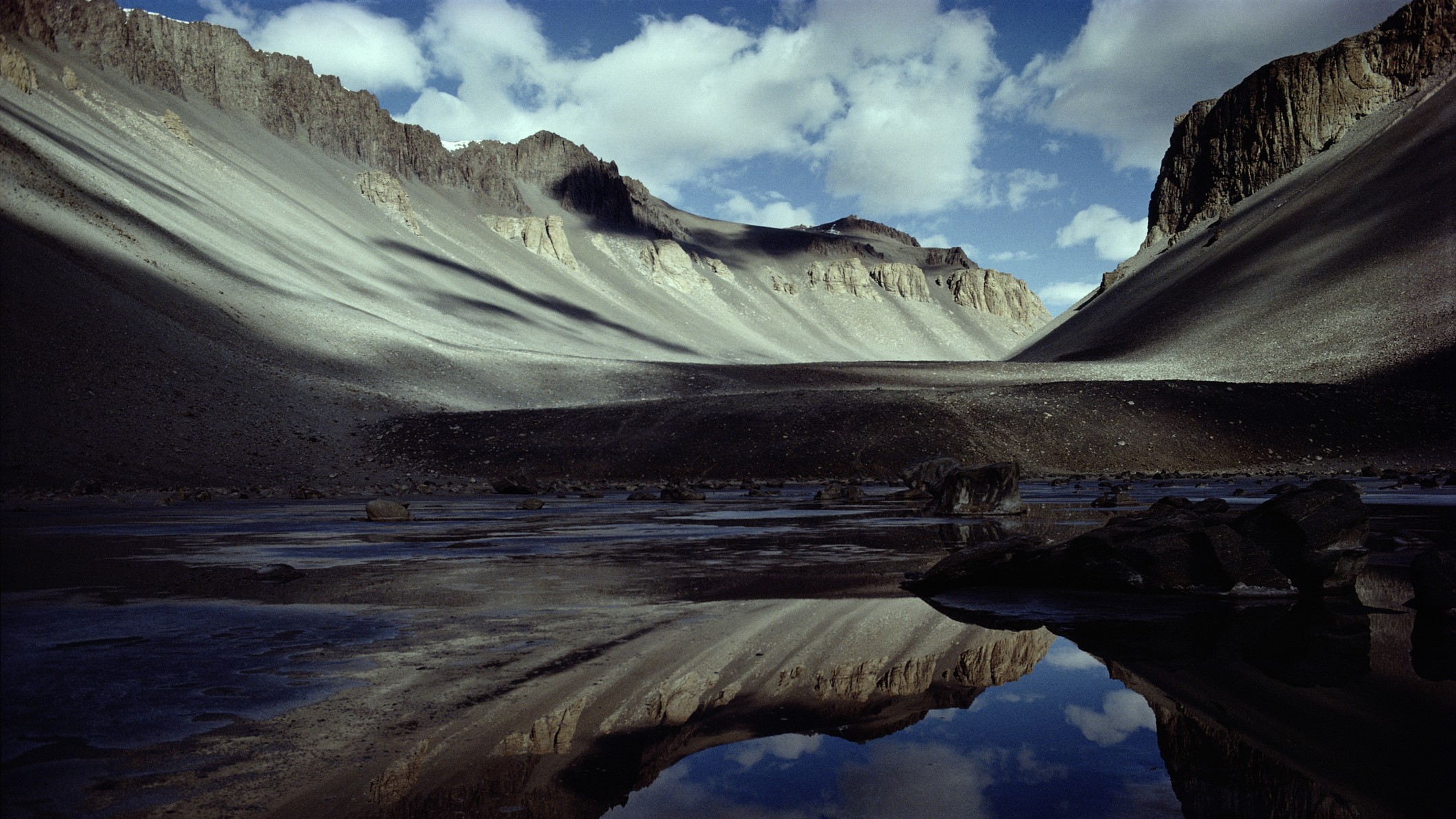
 At 40% salinity, Don Juan Pond is one of the saltiest bodies of water in the world. (Image credit: Kevin Schafer/Getty Images) Share this article 0 Join the conversation Add us as a preferred source on Google Newsletter Subscribe to our newsletter QUICK FACTS
Name: Don Juan Pond
Location: McMurdo Dry Valleys, Antarctica
Coordinates: -77.5625, 161.1915
Why it's incredible: The lake's high salinity keeps it from freezing even in subzero temperatures.
Don Juan Pond is a lake in Antarctica's extremely cold McMurdo Dry Valleys region that has a salinity above 40%, making it one of the saltiest bodies of water on Earth. The pond contains so much salt, it has a syrupy consistency that never freezes, even though temperatures in the Dry Valleys often fall to minus 58 degrees Fahrenheit (minus 50 degrees Celsius).
Don Juan Pond is 4 inches (10 centimeters) deep and slightly smaller than the total area of six football fields. It is named after two U.S. Navy helicopter pilots, Donald Roe and John Hickey, who spotted the pond during a reconnaissance expedition in 1961. There are other lakes in the Dry Valleys — but none are as salty as Don Juan Pond, so they stay frozen solid for most of the year.
Scientists are fascinated by Don Juan Pond because the harsh conditions in the McMurdo Dry Valleys resemble those on Mars, according to NASA. The Red Planet is bitterly cold and dry, rich in a variety of salts, and potentially hosts water. There is evidence for microbial life near Don Juan Pond, and it's possible that some organisms survive in the brine. If life can persist in the Dry Valleys, then life may exist, or may have once existed, in hypersaline features on Mars.
Don Juan Pond has elevated levels of calcium chloride, which is a highly soluble salt that lowers the pond's freezing temperature by keeping apart water molecules that would otherwise bond to make ice crystals. At 40% salinity, Don Juan Pond is much saltier than the Dead Sea, which has a salinity of 34%, and it is 12 times saltier than Earth's oceans, which have a salinity of 3.5%.
Scientists have been studying Don Juan Pond for more than 60 years, but they still aren't sure where the water and calcium chloride come from. Since the lake's discovery, the dominant hypothesis has been that Don Juan Pond is fed by groundwater bubbling to the surface. But in a 2013 study, Brown University geologists reported that the water is moisture from the atmosphere that is trapped by salts in the soil and eventually trickles down into the Upper Wright Valley, where Don Juan Pond is located.
The researchers took thousands of time-lapse photographs of the pond and the Upper Wright Valley's steep slopes. The images showed dark streaks near Don Juan Pond that the team argued were wet, salt-rich sediments funneling water toward the pond. Similar streaks, known as recurring slope linear features, occur on Mars' surface, hinting that a corresponding process may have once taken place on the Red Planet.
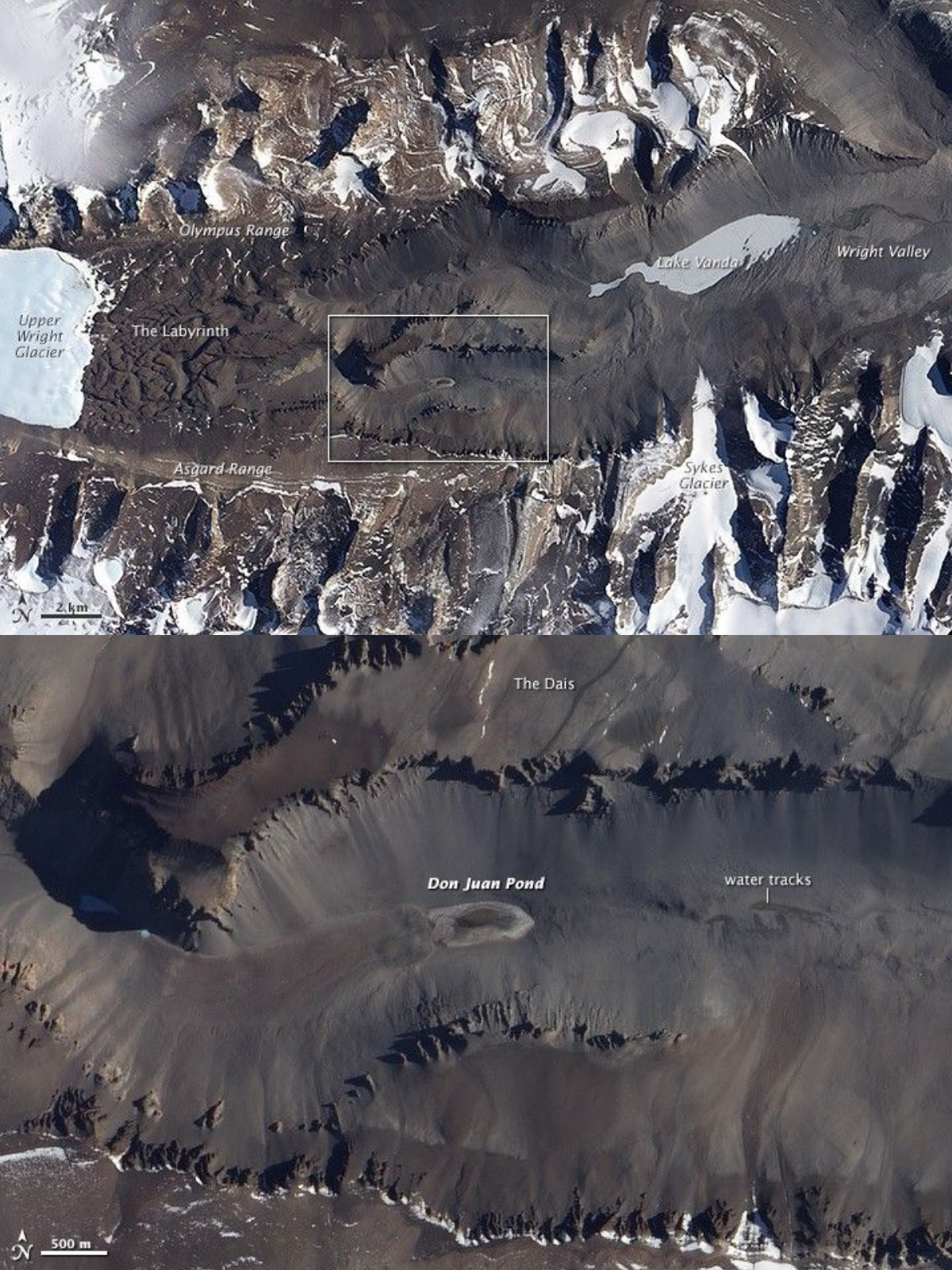
Don Juan Pond is located in the Upper Wright Valley between the Asgard Range and the Olympus Range.
(Image credit: NASA Earth Observatory images by Jesse Allen)However, this hypothesis was contradicted by a 2017 study that revived the groundwater theory. That research, which was based on model simulations, indicated that the only way Don Juan Pond could have acquired its unique chemical makeup is if the water source were a deep groundwater system.
Sign up for the Live Science daily newsletter nowContact me with news and offers from other Future brandsReceive email from us on behalf of our trusted partners or sponsorsMORE INCREDIBLE PLACES- Lake Salda: The only place on Earth similar to Jezero crater on Mars
- Spotted Lake: Canada's soda lake with colorful brine pools that are smelly and slimy 'like the white of an egg'
- Last Chance Lake: The unusual 'soda lake' with conditions that may have given rise to life on Earth
"If we accept that the deep groundwater theory is true, then what we're seeing could be part of a bigger process that involves quite an extensive aquifer," first author Jonathan Toner, an astrobiologist and research assistant professor at the University of Washington, said in a statement in 2017. "When thinking about the implications for a similar environment on Mars, that's much more exciting than just a localized surface phenomenon."
However, the source of water at Don Juan Pond is still debated.
Discover more incredible places, where we highlight the fantastic history and science behind some of the most dramatic landscapes on Earth.
TOPICS Sascha PareStaff writer
 Sascha is a U.K.-based staff writer at Live Science. She holds a bachelor’s degree in biology from the University of Southampton in England and a master’s degree in science communication from Imperial College London. Her work has appeared in The Guardian and the health website Zoe. Besides writing, she enjoys playing tennis, bread-making and browsing second-hand shops for hidden gems.
View MoreYou must confirm your public display name before commenting
Please logout and then login again, you will then be prompted to enter your display name.
Logout