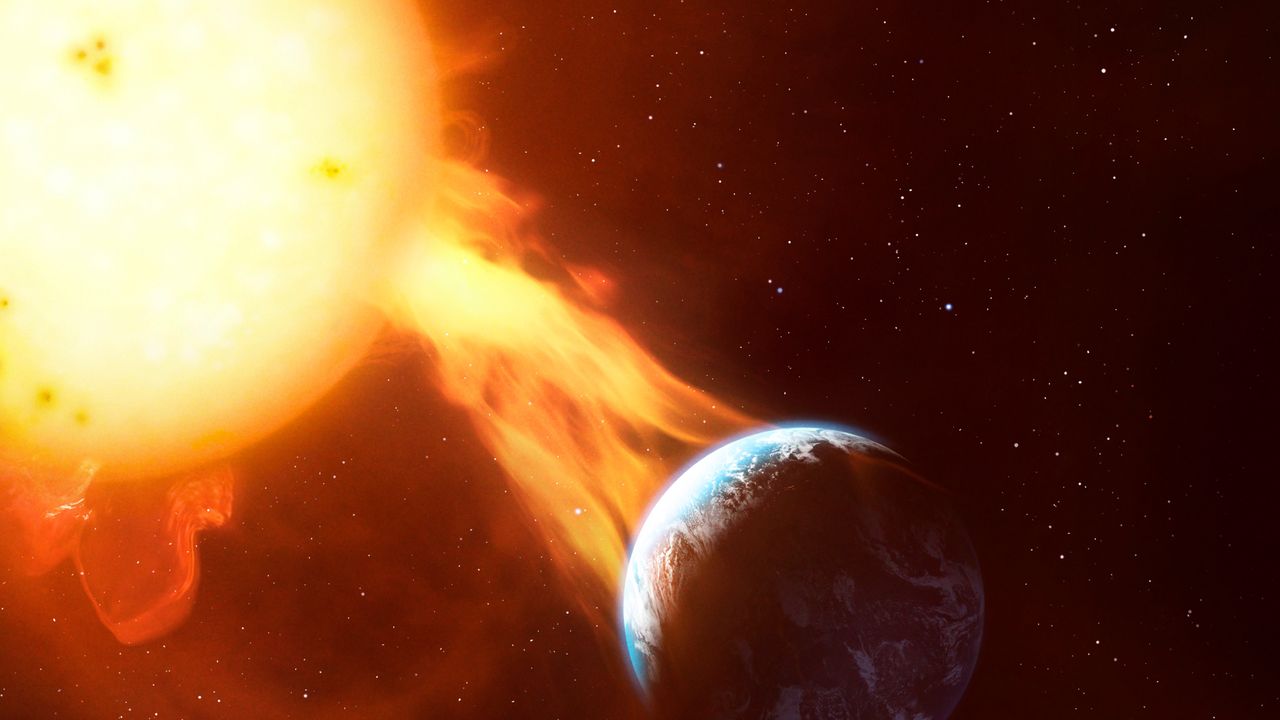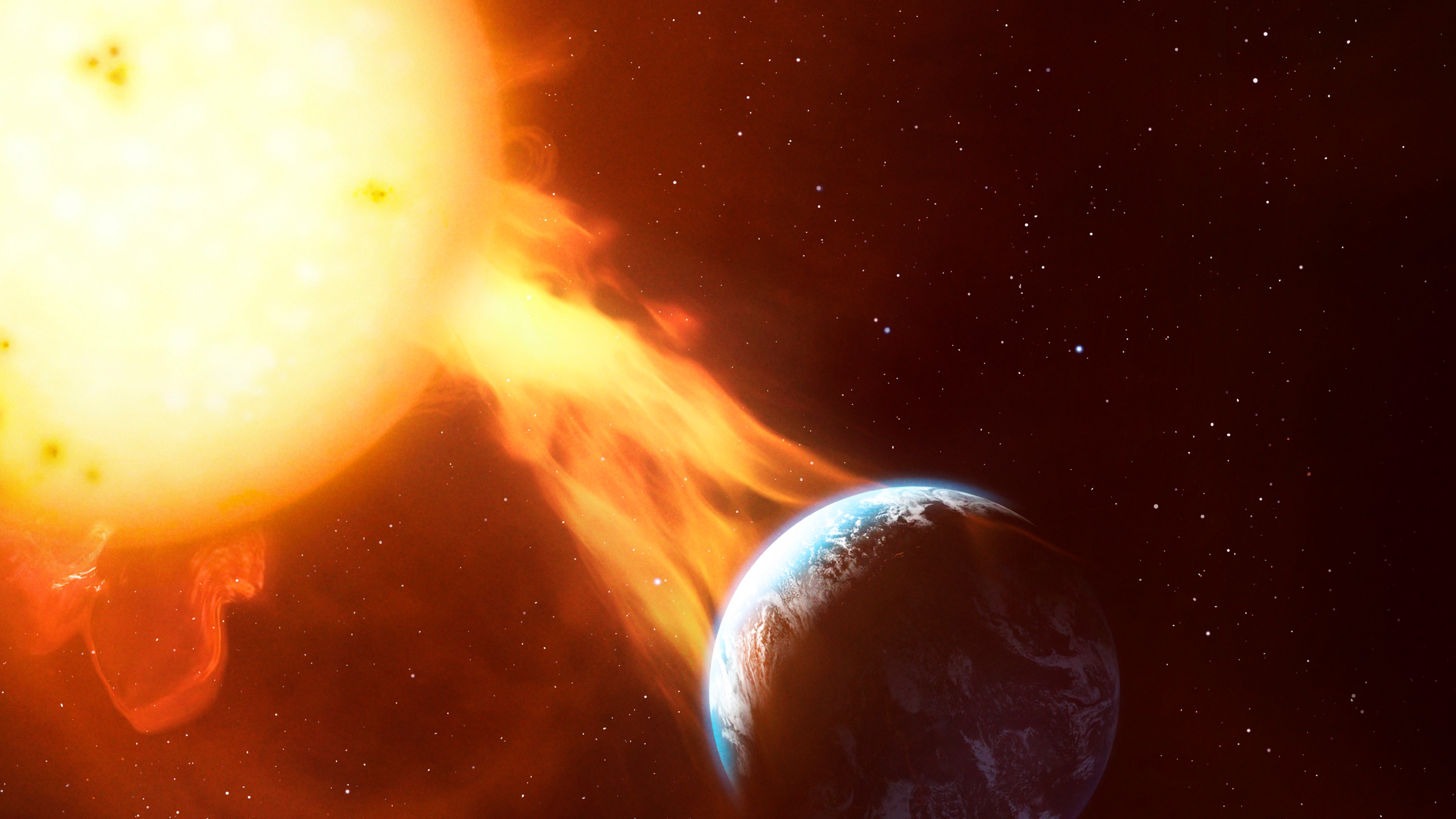
An artist's illustration of a coronal mass ejection blasting toward Earth. (Image credit: Getty Images)
Share this article Join the conversation
Follow us Add us as a preferred source on Google Newsletter Subscribe to our newsletter
A "cannibal" coronal mass ejection (CME) birthed from a rare type of sunspot will slam into Earth tonight (June 4), likely bringing auroras to skies above 23 U.S. states.
The solar outburst began on June 2 from sunspot 4455, a dark patch on the sun's surface where powerful magnetic fields became knotted and unstable. These field lines then snapped, producing a series of X-class solar flares — the most powerful class of solar eruption — alongside multiple CMEs.
CMEs are large, fast-moving clouds of magnetized plasma and solar radiation that occasionally get flung into space alongside solar flares. If CMEs smash into Earth, they cause disturbances in Earth's magnetic field, called geomagnetic storms, that can trigger partial radio blackouts and produce vibrant aurora displays much farther away from Earth's magnetic poles than usual.
One of the CMEs thrown out by yesterday's eruption caught up with and engulfed a slower one, creating a combined, cannibal eruption, according to a model from the U.S. National Oceanic and Atmospheric Administration (NOAA). The cannibal CME is expected to arrive mid-afternoon EDT and will create a strong (G3) or possibly even severe (G4) geomagnetic storm, according to NOAA.
Auroras resulting from this class of geomagnetic storm are often visible from northern parts of Washington, Idaho, Montana, Wyoming, North Dakota, South Dakota, Minnesota, Wisconsin, Michigan, New York and Maine, according to NOAA. Skywatchers farther south in Oregon, Nebraska, Iowa, Illinois, Indiana, Ohio, Pennsylvania, Massachusetts, Connecticut, Rhode Island, Vermont and New Hampshire will also have a chance of catching the light show.
And this may not be the last eruption we see from sunspot 4455. It is a rare "anti-Hale" sunspot, meaning its magnetic polarity is reversed compared with the other sunspots in its hemisphere. This type of polarity, seen in fewer than 10% of sunspots, makes the sunspot highly unstable and more likely to spit out powerful solar flares, according to spaceweather.com.
RELATED STORIES
The last few years have seen a record number of powerful X-class flares explode from the sun's surface, hitting Earth with several major solar storms, including 2024's Mother's Day storm. This record comes partly from improvements to scientists' solar monitoring technologies, but also due to the sun reaching its 11-year peak in sunspot production, or solar maximum, in 2024.
Sign up for the Live Science daily newsletter now
Get the world’s most fascinating discoveries delivered straight to your inbox.
Contact me with news and offers from other Future brandsReceive email from us on behalf of our trusted partners or sponsors
Following this peak, the sun entered a period known as the "battle zone," a relatively understudied solar phase where instabilities across our star's newly flipped magnetic field ramp up the production of solar holes, anti-Hale sunspots and subsequent geomagnetic storms.
The worst case scenario for a solar storm is a superstorm like the 1859 Carrington Event, which released roughly the same energy as 10 billion 1-megaton atomic bombs. After slamming into Earth, the powerful stream of solar particles set telegraph systems around the world on fire and caused auroras brighter than the light of the full moon to appear as far south as the Caribbean.
The Carrington Event unleashed a roughly X45 magnitude solar flare that remains a record, yet it's likely far from the worst the sun can muster — with ancient tree rings harboring evidence of even more powerful blasts that occurred long before humans existed.
 Ben Turner
Acting Trending News Editor
Ben Turner is a U.K. based writer and editor at Live Science. He covers physics and astronomy, tech and climate change. He graduated from University College London with a degree in particle physics before training as a journalist. When he's not writing, Ben enjoys reading literature, playing the guitar and embarrassing himself with chess.
View More
You must confirm your public display name before commenting
Please logout and then login again, you will then be prompted to enter your display name.
Logout