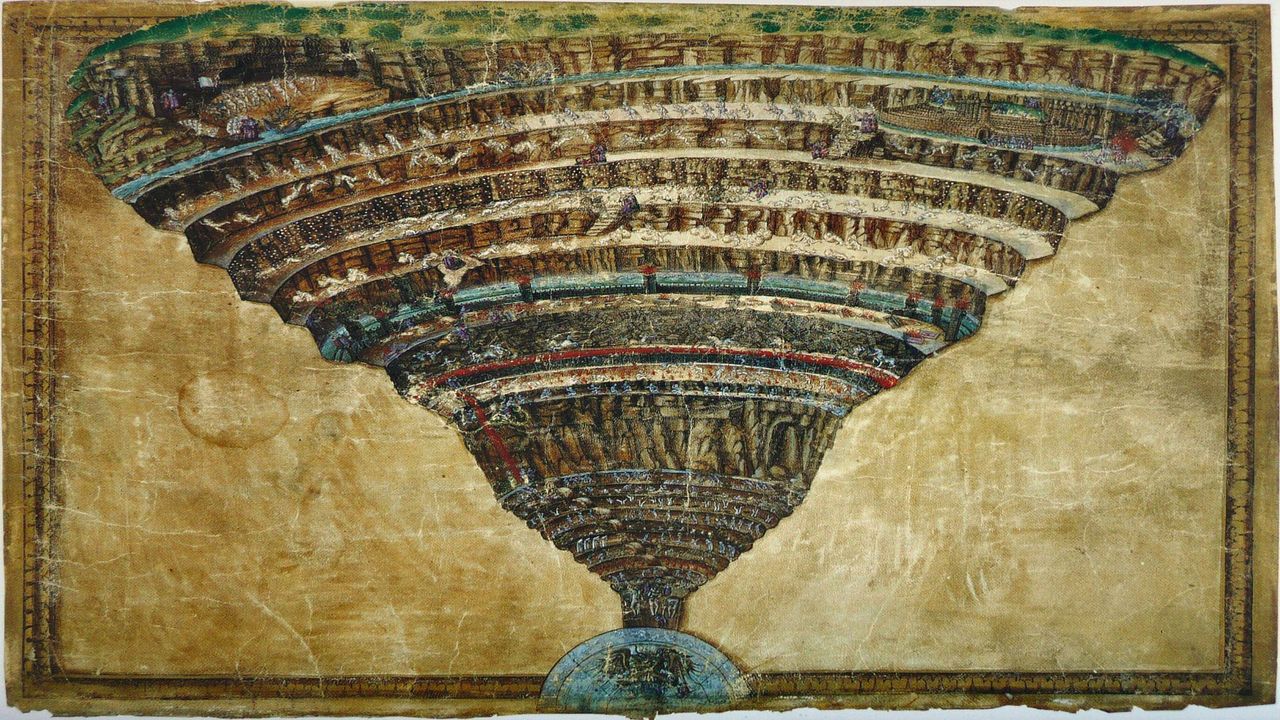
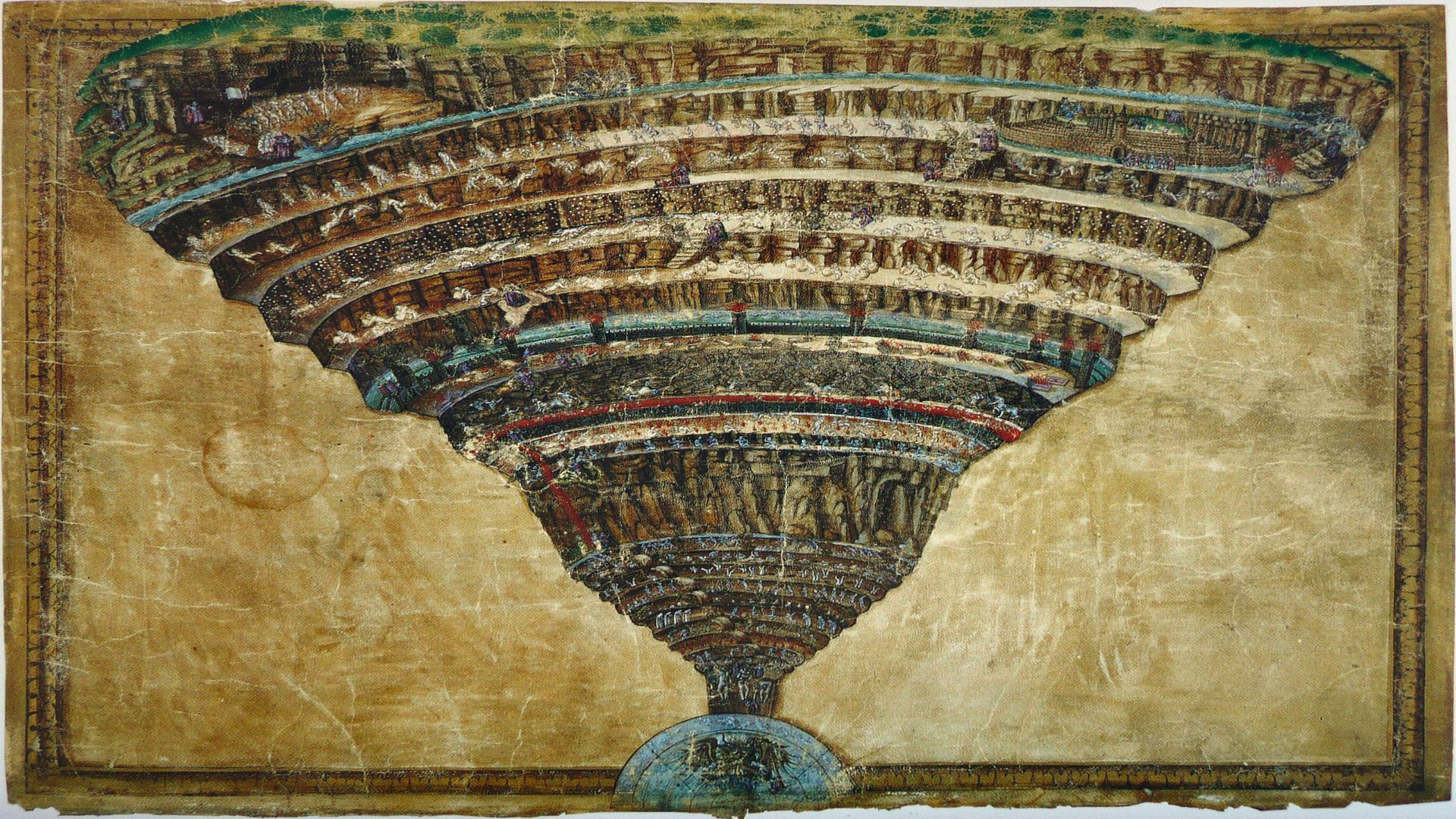
 A painting depicting the "Chart of Hell." (Image credit: Sandro Botticelli (1445–1510)/Wikimedia Commons) Share this article 0 Join the conversation Add us as a preferred source on Google Newsletter Subscribe to our newsletter
 Dante's famous 14th century epic poem, "Inferno," which is the first part of the Italian writer's "Divine Comedy," represents the first time a giant impact of a massive object falling from the heavens was envisaged, according to an expert in the specialized field of geomythology.
In the poem, the massive object in question is the Devil himself, Lucifer, who fell onto the Earth after being expelled from heaven. Yet, according to Timothy Burberry of Marshall University in West Virginia , this fall and subsequent impact is described by Dante in very similar terms to an asteroid impact. Burberry is a professor of English and an expert in geomythology, a field which involves searching old folk tales, myths and stories for evidence of real geological events. Written between 1308 and 1321, Dante's "Inferno" depicts the main character — Dante himself — being guided through Hell by the spirit of the ancient Roman poet Virgil. In what is considered one of the greatest works in the history of European literature, Dante and Virgil travel to the Underworld, where they are taken across the River Styx to Hell by the ferryman Charon — in fact, two of Pluto's moons, Charon and Styx, are named after these details.
The characters then cross the nine concentric circles of hell, beginning with Limbo and then various circles where the souls of those who commit different sins end up. Along the way, the poets encounter the likes of Cleopatra and the various antagonists of the Trojan War — Achilles, Helen of Troy and Paris — in the second circle where those who fell under the sin of lust end up. Further into Hell, in the seventh circle, those who committed great violence, such as Alexander the Great and Attila the Hun, are found. And at the very center of Hell is Satan himself, the traitorous Archangel Lucifer, depicted as a monstrous creature with wings and three heads. Each of those three heads is literally eternally chewing on the bodies of history's three greatest traitors up to that point, at least from Dante's point of view: Brutus and Cassius who had Julius Caesar murdered, and Judas Iscariot who betrayed Jesus.
The pertinent part, from the point of view of Burberry, comes towards the end of Inferno. Dante and Virgil escape Hell by clambering down Satan's monstrous hide and through Earth's center of gravity. Having descended from the northern hemisphere, they climb back up into the southern hemisphere.
Back in the 1300s, the Earth's southern hemisphere was largely unexplored and considered to be mostly ocean — indeed, even today we know it to be 81% ocean. However, Virgil explains to Dante that long ago the southern hemisphere had been completely covered in land. When God expelled Lucifer from heaven, Lucifer plummeted to Earth, smashing through the surface and continuing to burrow down until he reached the center of the planet, creating Hell. The displaced rock raced to the surface, forming the Mountain of Purgatory (which Dante and Virgil climb up in Dante's "Purgatorio," which is the second part of the "Divine Comedy"), becoming the central peak of a multi-ringed crater, the rings forming the nine concentric circles of Hell. The land of the southern hemisphere pulled away from this vile impactor, restructuring itself in the northern hemisphere.
Burberry therefore argues that what Dante is describing is an impact of an asteroid or a comet, violent enough to restructure large parts of the Earth. Perhaps it was similar to the impact thought to have contributed to the extinction of the dinosaurs 66 million years ago, or even the impact that formed the moon 4.5 billion years ago.
If Burberry is correct, then this would be remarkable foresight from Dante.
In the fourteenth century the heavens were considered to be (mostly) fixed and eternal and the concept of things falling to Earth from the stars was unheard of. In fact, it took until the first half of the nineteenth century for meteors to be recognized as being a celestial, not atmospheric, phenomenon, and that meteorites came from space.
"Although Dante was not a scientist, he was one of the first persons in history to think through the physical effects of a large mass slamming into the Earth at high speed," writes Burberry in the abstract of his paper about the subject. "In Dante's vision, the Devil's size and velocity are such that when he lands, he instantly creates Hell: a massive, circular, terraced crater that reaches to the center of the Earth."
Regardless of whether Dante meant to depict an impact from space or not, it does illustrate how geomythology can preview threats from natural disasters long before our scientific knowledge can catch up, argues Burberry. Given the era in which Dante's "Inferno" was written, before Copernicus and Galileo, by describing something falling to Earth Dante was highlighting an idea that indeed went against the established norm at that time.
Burberry presented his research in a poster at the European Geosciences Union General Assembly in Vienna, Austria, held between May 3–8.
View MoreYou must confirm your public display name before commenting
Please logout and then login again, you will then be prompted to enter your display name.
Logout Keith CooperContributing writer
Keith Cooper is a freelance science journalist and editor in the United Kingdom, and has a degree in physics and astrophysics from the University of Manchester. He's the author of "The Contact Paradox: Challenging Our Assumptions in the Search for Extraterrestrial Intelligence" (Bloomsbury Sigma, 2020) and has written articles on astronomy, space, physics and astrobiology for a multitude of magazines and websites.