
 Blue Origin conducts a static fire test with its New Glenn rocket on April 16, 2026. (Image credit: Blue Origin) Share this article 0 Join the conversation Follow us Add us as a preferred source on Google Newsletter Get the Space.com Newsletter
 Breaking space news, the latest updates on rocket launches, skywatching events and more!
Contact me with news and offers from other Future brands Receive email from us on behalf of our trusted partners or sponsors By submitting your information you agree to the Terms & Conditions and Privacy Policy and are aged 16 or over.You are now subscribed
Your newsletter sign-up was successful
Want to add more newsletters?
An account already exists for this email address, please log in. Subscribe to our newsletterBlue Origin's New Glenn rocket just took a big step toward its first-ever reflight.
Blue Origin conducted a 19-second static fire test with New Glenn at Florida's Cape Canaveral Space Force Station this morning (April 16), firing up its seven first-stage engines while the rocket remained anchored to the pad.
The milestone kept New Glenn on track for the planned Sunday (April 19) launch of NG-3, a mission that will reuse a booster from a previous flight — a first for the vehicle.
The two-stage, 322-foot-tall (98 meters) New Glenn has launched twice to date. It debuted on a test flight in January 2025, then successfully sent NASA's twin ESCAPADE probes toward Mars this past November.
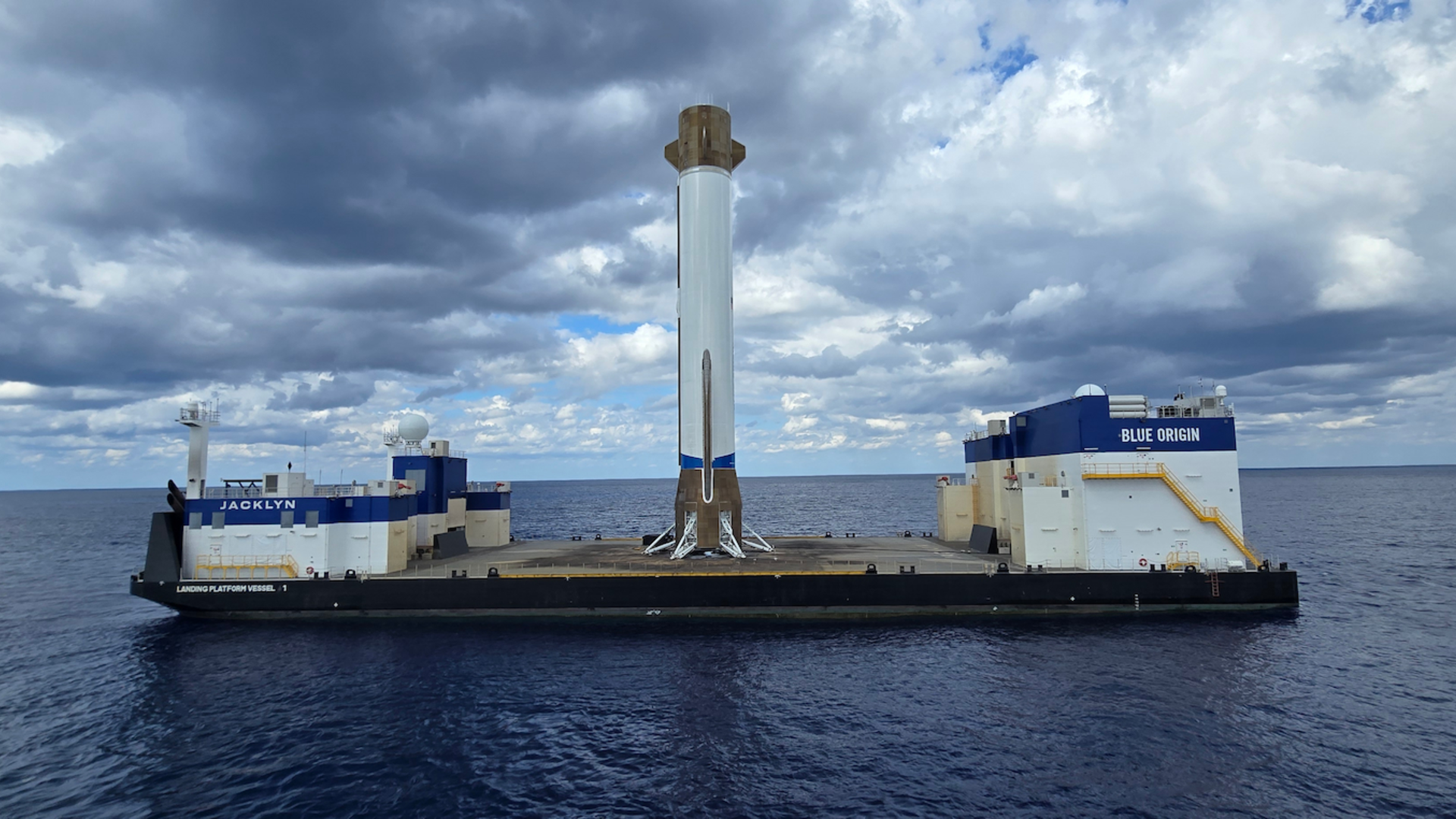
Blue Origin landed New Glenn's first stage during the ESCAPADE launch, bringing it down softly on the drone ship "Jacklyn" in the Atlantic Ocean. And that booster will fly again on NG-3.
Well, the shell of it will, anyway; some key hardware will be new.
"With our first refurbished booster, we elected to replace all seven engines and test out a few upgrades including a thermal protection system on one of the engine nozzles. We plan to use the engines we flew for NG-2 on future flights," Blue Origin CEO Dave Limp said via X on Monday (April 13).
Get the Space.com NewsletterContact me with news and offers from other Future brandsReceive email from us on behalf of our trusted partners or sponsorsSunday's mission, which is scheduled to launch at 6:45 a.m. EDT (1045 GMT), could be the first of many reflights for this particular booster. Each New Glenn first stage is designed to fly at least 25 times, Blue Origin has said.
NG-3 will send a Block 2 BlueBird direct-to-cellphone internet satellite to low Earth orbit (LEO) for the Texas company AST SpaceMobile.
One Block 2 BlueBird has reached space to date, getting there in December aboard an Indian rocket. It's one of the largest satellites in space, with an antenna that covers a whopping 2,400 square feet (223 square meters).
Block 2 BlueBirds are considerably larger than their predecessors, five of which reached LEO. Each of those satellites' antennas cover 693 square feet (64.4 m).
 Mike WallSpaceflight and Tech Editor
Michael Wall is the Spaceflight and Tech Editor for Space.com and joined the team in 2010. He primarily covers human and robotic spaceflight, military space, and exoplanets, but has been known to dabble in the space art beat. His book about the search for alien life, "Out There," was published on Nov. 13, 2018. Before becoming a science writer, Michael worked as a herpetologist and wildlife biologist. He has a Ph.D. in evolutionary biology from the University of Sydney, Australia, a bachelor's degree from the University of Arizona, and a graduate certificate in science writing from the University of California, Santa Cruz. To find out what his latest project is, you can follow Michael on Twitter.
View MoreYou must confirm your public display name before commenting
Please logout and then login again, you will then be prompted to enter your display name.
Logout MORE FROM SPACE... 1The Lyrid meteor shower 2026 has begun! Here's what to expect
- 2This may be the daughter of one of our universe's 1st stars. Scientists call it an 'ancient immigrant'
- 3Space junk cleanup tech that could 'shepherd' debris into Earth's atmosphere gets US patent
- 43D dark energy map is mind-blowing | Space photo of the day for April 16, 2026
- 5How to see once-in-a-lifetime Comet PanSTARRS tonight before it disappears for good


