At first glance, Lionel Messi's legacy with Argentina runs the risk of being unimaginably obvious. The national team's most iconic player would naturally end his decades-long international career as the all-time appearance leader and greatest-ever goalscorer, all while boasting a World Cup and two Copa America titles to his name. The accolades are fitting for a player of his singular caliber, one who has earned the right to be universally adored and appreciated as he confirms his international retirement 21 years after first representing the national team. The achievements, though, almost mask the complex nature of Messi's Argentina tenure.
Lionel Messi announces international retirement: Argentina star won 2022 World Cup and was runner up in 2026 Roger Gonzalez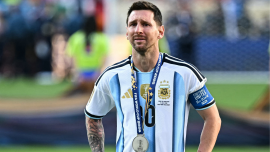
Messi's otherworldly ability with a soccer ball at his feet has never been in question, to the point that the lore of his unlikely journey to the top – his short stature, the contract signed on a napkin, the move to Barcelona in his teenage years – is so pervasive. His story with Argentina is a complex one, the road to his happy ending winding. The majority of his 21 years with the national team came and went before he won his first major international title in 2021, those years instead marred by painful defeats and underwhelming results that Messi shouldered the blame for even if the fault was hardly his. It was an example in the emotion and passion, and ultimately the pressure, that is intertwined with embodying Argentina's storied national team all on his own.
In his decades wearing Argentina's iconic light blue and white jersey, Messi likely experienced every feeling available in a business that is oftentimes reduced to ruthlessness and single-minded, emotionless conviction. The title-winning moments that lined the final years of his international career will be the headlining acts, chief among them lifting the 2022 World Cup, but it came after sizable defeats that challenged a nation's unrelenting belief in him – and his own self-confidence. It was something Messi himself recognized in a handwritten note he penned two days after last month's World Cup final, refusing to skip over the fact that his national team journey was not an experience in going from strength to strength.
"I swear I always gave everything, not only in these last few years when we won everything, but before that too," he wrote in part. "I always fought and gave everything for this shirt, to bring you happiness and make you feel proud to be Argentine through football … Thank you for all the love during these 20 years. I'm going to miss hearing you from the inside. Now I'll be one of you, always supporting from the outside, in the good times and even more in the bad ones. Thank you to my family for always being there and for being with me throughout this beautiful but difficult journey. Thank you to every coach, teammate and director I had the chance to share it with."
Lionel Messi's Argentina career timeline: Two retirements, years of struggle and redemption at 2022 World Cup Francesco Porzio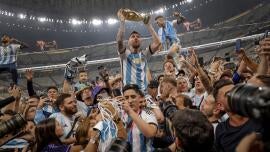
These are the moments that marked Messi's Argentina career.
A star is born
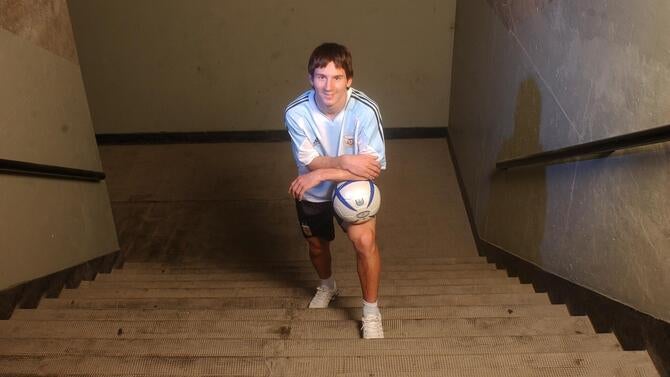
There were signs that a straightforward international career was not waiting for Messi as soon as he made his Argentina debut in a 2-1 win at Hungary in 2005 – within 90 seconds, he was shown a red card for an elbow to the face of an opponent, a call that looks very soft on replay, a benefit referees did not have until more than a decade later.
Unsurprisingly, it did not dim his prospects. Messi was already a talented prospect, leading Argentina to victory at the 2005 FIFA World Youth Championship and wreaking havoc on opposition defenses by methods so memorable that Spain coach Luis de la Fuente told stories about it decades later. He quickly turned that into becoming a senior international and cracked Argentina's roster for the 2006 World Cup in Germany, where they made a quarterfinal run. He scored his only goal at the competition in a 6-0 win over Serbia and Montenegro in the group stage.
 Getty Images
 Messi's stock continued to rise over the coming years, the main international highlight coming with the U-23 team that won gold at the 2008 Olympics in Beijing. He spent much of those years wearing the No. 19, his old Argentina kits still popular enough that there was a healthy section of fans rocking the old Adidas look at the World Cup this summer as La Albiceleste made a run to the final. He inherited the No. 10 shirt upon Juan Roman Riquelme's retirement before the 2010 World Cup, a tacit recognition that Messi had transitioned from heir apparent to the new star of Argentina's national team.
An uneven international career
As he settled into his growing role with Argentina, Messi achieved remarkable success with an all-star version of Barcelona coached by Pep Guardiola. He had two UEFA Champions League winners' medals before the 2010 World Cup and another two after the fact, quickly emerging as a generational talent worthy of several individual accolades and a debate-heavy rivalry with Real Madrid talisman Cristiano Ronaldo.
The transition from talented up-and-comer to true star, though, ensured Messi would feel the pressures he inherited sooner rather than later. The contrasts were quick to spot by the time Argentina arrived in South Africa for the 2010 World Cup, only to be exaggerated for the following World Cup in Brazil four years later. Picking up accolades with Barcelona seemed like child's play for Messi but a true struggle with Argentina, who were again bounced from the World Cup in the quarterfinals in 2010. He failed to score a single goal in South Africa, all while a national hero in Diego Maradona – who led the way during Argentina's previous World Cup title in 1986 – watched on as the national team's coach. Messi again failed to score in the 2011 Copa America, where they again exited the competition in the quarterfinals.
It laid the foundation for the most painful chapter of Messi's international career. His World Cup goalscoring drought came to an end in 2014 in Brazil, where he scored four times en route to the final. He led with four shots in the match but for all his efforts, Argentina fell short in extra time to Germany, the first of three successive defeats in major finals. Argentina lost in the 2015 and 2016 Copa America finals, things inexplicably going against him. The world's best player, somehow, did not have international accolades to show for it. Sports' quietest, most aloof superstar suddenly became shockingly vulnerable after the last of those defeats, a penalty shootout loss to Chile at MetLife Stadium – and he had come to the conclusion that luck would never favor him.
"My thinking right now and thinking about it in the locker room, I'm done playing with the national team," he said in 2016. "I tried my hardest. It's been four finals, and I was not able to win. I tried everything possible. It hurts me more than anyone, but it is evident that this is not for me. I want more than anyone to win a title with the national team, but unfortunately, it did not happen."
The tension persists
It was only a matter of weeks before Messi returned from his international retirement, though he underwent the kind of physical transformation that could only be considered a midlife crisis but in a move rated PG. He had a single tattoo sleeve at the 2016 Copa America but quickly decided to cover every limb with tattoos and, for a brief stretch of time, he went bleach blonde. Argentina's likelihood of reaching another major international final, though, dimmed so much so that they nearly missed out on qualifying for the 2018 World Cup in Russia.
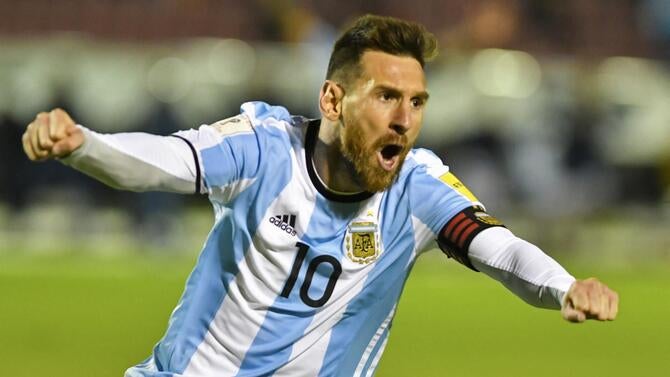
Argentina had more draws than wins heading into the final World Cup qualifier against Ecuador, needing results to swing their way or run the risk of missing out entirely. It would not be the first time, nor would it be the last but Messi's habit of bailing his team out of trouble was on full display that October evening in Quito, where he scored a hat trick while essentially carrying the team on his back. The fraction of us with the ability to watch beIN Sports in the U.S. in 2017 were rewarded by seeing Messi singlehandedly do it all for Argentina, a one-man show if there ever was one.
 Getty Images
 His outing maintained Argentina's streak of participating at every World Cup since 1974, though he was picked apart by a once-adoring nation once the tournament began. He furrowed his brow and rubbed his head during the national anthem before a 3-0 group stage loss to Croatia, only for a local journalist to describe the national team as "not Messi plus 10 anymore [but] 11 minus Messi." He scored just one goal in Russia and Argentina exited in the round of 16 to eventual champions France, his post-retirement spell not exactly going according to plan thus far. Messi had become a national punching bag of sorts, to the point that Maradona said "it's useless trying to make a leader out of a man who goes to the toilet 20 times before a game," comments that he later walked but referenced the pre-game nerves Messi felt that would lead him to vomit beforehand.
If Messi felt winning was impossible with Argentina two years earlier, it looked even more so after the World Cup in Russia. That version of the national team was perhaps less equipped to win a World Cup than anyone Messi had played with, fully a reminder that soccer is a team sport. The star can only bail out the team so often, even if the blame felt like it was solely his to bear.
The stars align
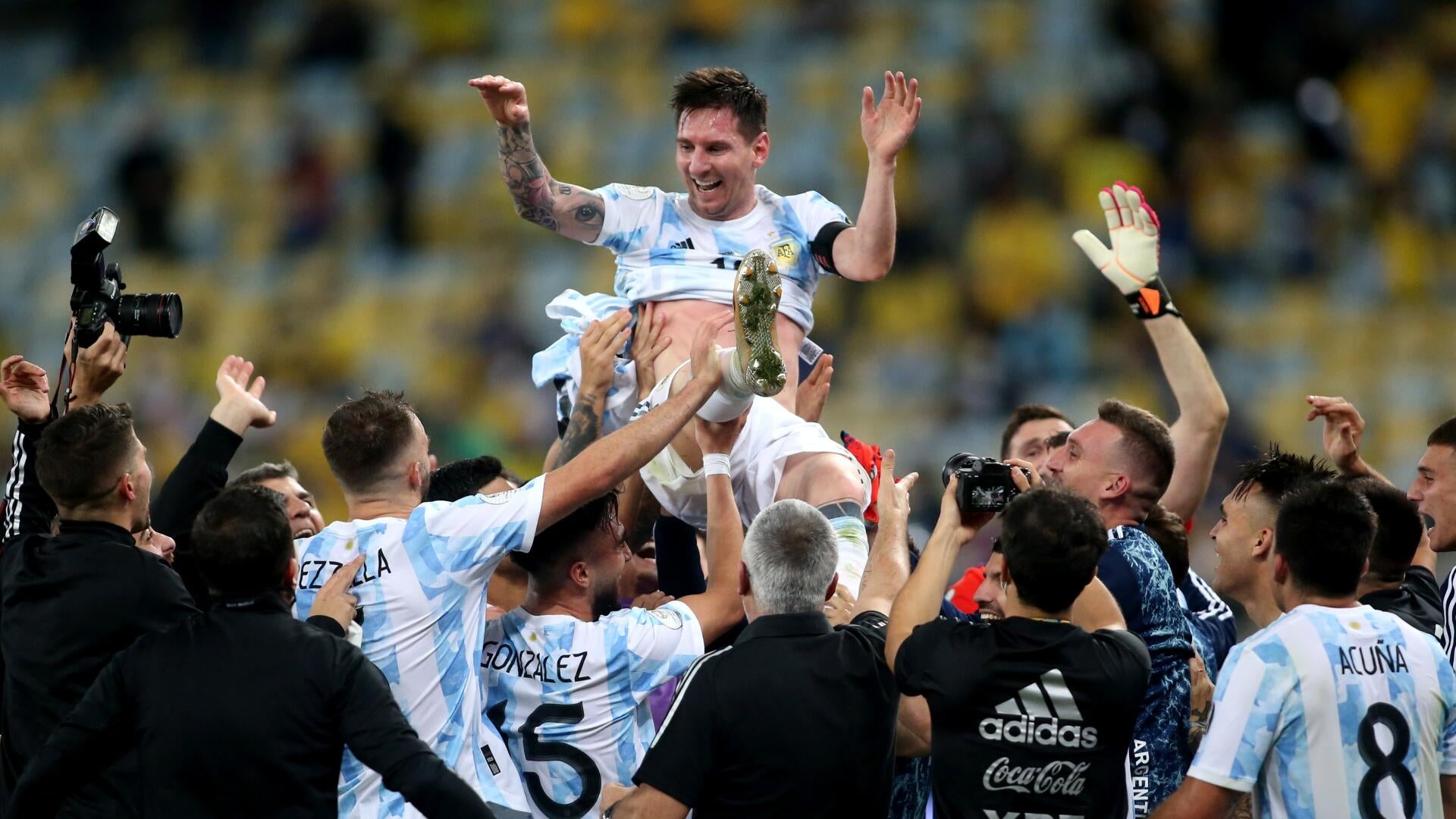
The generational shift that happened for Argentina in the build-up to the 2022 World Cup paved the way for a triumphant final stage of Messi's international career, firstly by winning the Copa America in 2021. It was the national team's first major title since the 1993 Copa America, the start of a dynastic run and the natural reward for an Argentina side that could finally strike a semblance of a balance where they were not completely reliant on Messi.
It was also the perfect precursor to the 2022 World Cup in Qatar, which was slated to be the last time a 35-year-old Messi would play at the tournament. He was past his prime but it was in this stretch when Messi's magic started to be his defining feature – inexplicably, he scored seven goals before claiming the prize that many felt he was destined to win. In what many believed to be the last glimpses of Messi at a World Cup, it felt like most pockets of the world began to appreciate him without reservation. In his second World Cup final, Messi finally had a goal – two, actually – and a penalty in a shootout victory that made all those years of suffering seem well and truly worth it.
The national sentiment in Argentina permanently changed in Messi's favor, a decade-plus of angst finally a thing of the past. The career arc, in more ways than one, was complete.
"I knew God wanted me to be world champion, that he was going to give it to me," Messi said after the final. "I always believed in that. There were a lot of big obstacles along the way. I really suffered. I had a bad time. Me, my family, the people who love me. It was very unfair. People said all kinds of things. But I don't bear a grudge. With humility and in silence I did my job. It's a victory for me, having turned that situation around. Winning over the people of Argentina. At times I was questioned. Today 95 or 100% of Argentinians love me, and that's beautiful."
Extra time with Messi
Messi was skeptical that he would make it all the way to the 2026 World Cup, saying in 2023 that "the most normal thing is that I won't be there," but he played without the shackles of pressure. The pace of his career was different – after two unhappy seasons with Paris Saint-Germain, he joined Inter Miami in the summer of 2023 and began a now-regular habit of lighting up MLS on a regular basis. An injury-plagued 2024 season made it seem unlikely that his body would hold up for another two years but this summer, he was back for his sixth and final World Cup to bask in the glow one last time.
His appearances at the World Cup this summer were full of contrasts, each of them intriguing but never diluting his quality. It was true that Messi was a less active presence in games than he used to be – Father Time is unrelenting and down the stretch, he would go invisible for long stretches of games. Somehow, it did not stop him from chasing the distinction of being the tournament's all-time leading goalscorer. He opened up the World Cup with a hat trick against Algeria and eventually enjoyed his highest-scoring outing at the tournament, notching eight goals en route to the final. He was almost forgettable in Argentina's semifinal win over England, but two late assists turned England's once-resilient defense into a group of onlookers and sent the reigning champions back to the final.
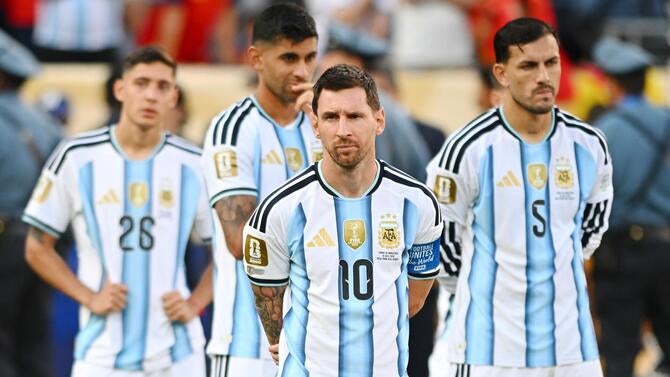
Argentina's return to the World Cup final was a villain arc because of their improbable, last-gasp victories, a fascinating contrast to the universal appreciation most had for Messi. The protagonist for the team everyone loved to hate, though, finally met his match – Spain neutralized him fully in last month's final, Messi capping off his World Cup adventures with an unexpectedly uneventful showing.
 Getty Images
 Yet, the lasting memory on the pitch at MetLife Stadium that day might just be Messi's final moments on a World Cup pitch. The star is famously quiet in public settings but equally unafraid to be emotional, something that is perhaps even easier in the final stages of a glittering career. Messi stood alone at one point, his silver medal hanging from his neck, as he heard thousands of people chant his name. He already had tears in his eyes and they were still there as he took it all in, a perfect goodbye on an imperfect day, Messi somehow finding a fairytale ending despite the trials and tribulations he endured along the way.
Add CBS Sports on Google Join the Conversation comments