Breaking space news, the latest updates on rocket launches, skywatching events and more!
Contact me with news and offers from other Future brands Receive email from us on behalf of our trusted partners or sponsors By submitting your information you agree to the Terms & Conditions and Privacy Policy and are aged 16 or over.You are now subscribed
Your newsletter sign-up was successful
Want to add more newsletters?
An account already exists for this email address, please log in. Subscribe to our newsletter NASA astronaut Jessica Meir captured this image of the Lyrid meteor shower above Earth from aboard the ISS. (Image credit: NASA/Jessica Meir)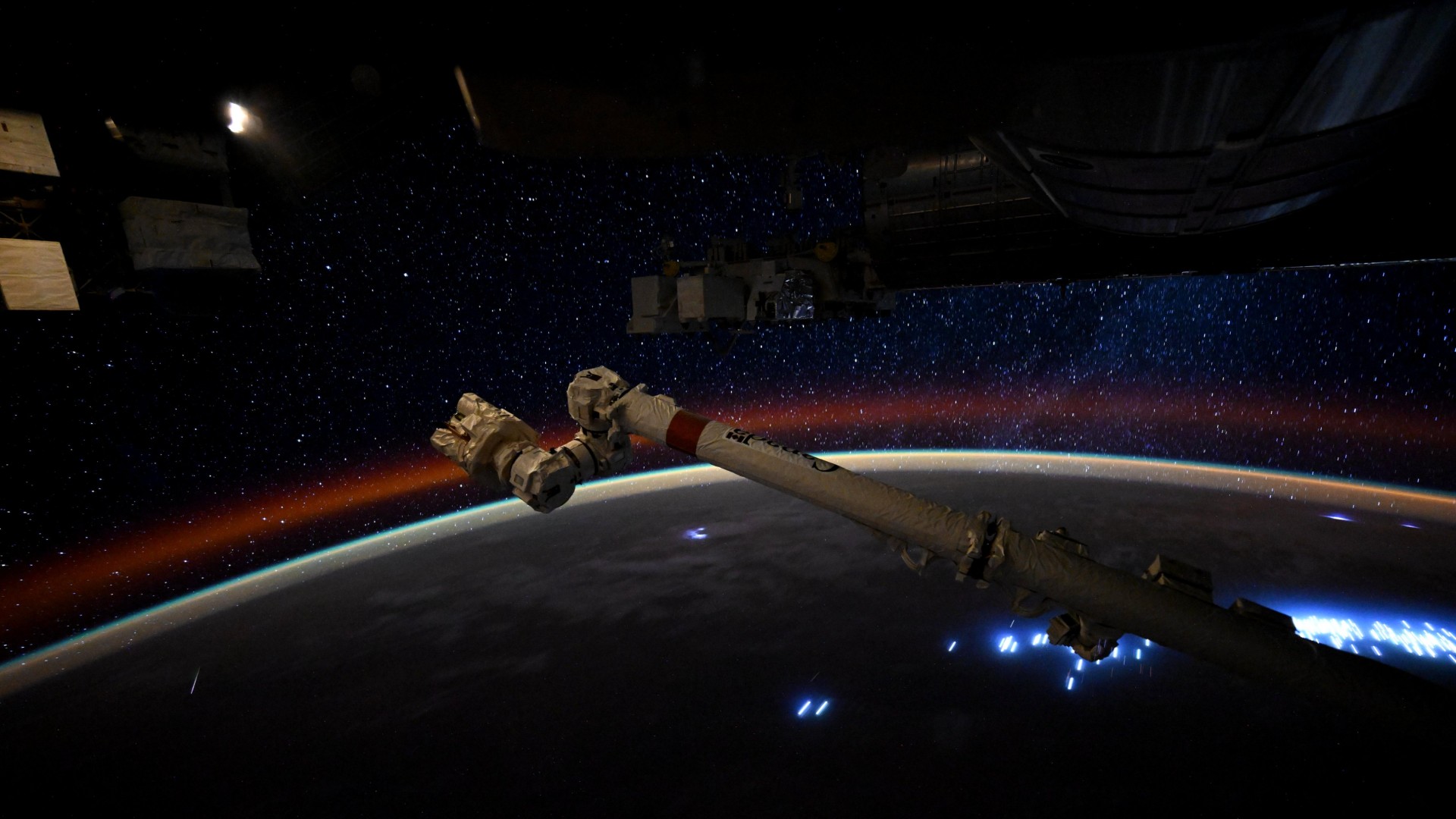
The Lyrid meteor shower peaks tonight (April 21). And, if you spot any Lyrid meteors, you have something cool in common with an astronaut!
What is it?
The Lyrid meteor shower is at its peak this week, with prime viewing happening overnight from April 21 to April 22.
Article continues belowThe Lyrids are made up of bits of debris trailing the long-period comet C/1861 G1 Thatcher, which was discovered in 1861. Long-period comets have very long orbital periods, taking hundreds of years or more to orbit the sun.
Every year around this time, Earth passes through this comet's debris field. Pieces of it burn up in our atmosphere, creating the spectacular meteors that streak across the sky.
The shower produces up to 15 to 20 Lyrid meteors per hour. You can see the Lyrids radiating from around the constellation Lyra (hence their name). If you can, find dark skies for optimal viewing.
In a photograph snapped from aboard the ISS, Meir revealed that she was able to see a Lyrid meteor shower lighting up the dark night skies over Earth.
Get the Space.com NewsletterContact me with news and offers from other Future brandsReceive email from us on behalf of our trusted partners or sponsorsHave you seen any shooting stars lately? We’re in the midst of the Lyrid Meteor shower, and I was lucky enough to photograph some from the @Space_Station cupola. The Lyrids are an annual event best viewed in the Northern Hemisphere by looking toward the constellation Lyra in the… pic.twitter.com/B2FqMdEuqsApril 20, 2026
Why is it incredible?
This photograph is so much more than just proof of a successful meteor shower watch.
It is a stunning visual reminder that our planet is protected by a surprisingly thin atmosphere. As Meir shared in her post, you can see below the horizon where the meteor is streaking.
The experience of living in space aboard the ISS is unique for so many reasons. But what a remarkable moment, for astronauts in space to be able to look down at their home planet and watch our atmosphere interact with a comet like this.
 Chelsea GohdContent Manager
Chelsea Gohd served as a Senior Writer for Space.com from 2018 to 2022 before returning in 2026, covering everything from climate change to planetary science and human spaceflight in both articles and on-camera in videos. With a M.S. in Biology, Chelsea has written and worked for institutions including NASA JPL, the American Museum of Natural History, Scientific American, Discover Magazine Blog, Astronomy Magazine, and Live Science. When not writing, editing or filming something space-y, Gohd is writing music and performing as Foxanne, even launching a song to space in 2021 with Inspiration4. You can follow her online @chelsea.gohd and @foxanne.music
View MoreYou must confirm your public display name before commenting
Please logout and then login again, you will then be prompted to enter your display name.
Logout MORE FROM SPACE... 1NASA reveals its Roman Space Telescope today: How to watch live, and what's next for the next-generation observatory
- 2Don't miss the Lyrid meteor shower 2026 peak tonight! Viewing times, location and tips
- 3NASA's Curiosity rover finds building blocks of life on Mars. Scientists aren't sure how they got there
- 4NASA shuts down Voyager 1 instrument to keep probe exploring interstellar space
- 5600 rocket landings! SpaceX notches another milestone during Sunday Starlink launch (video)