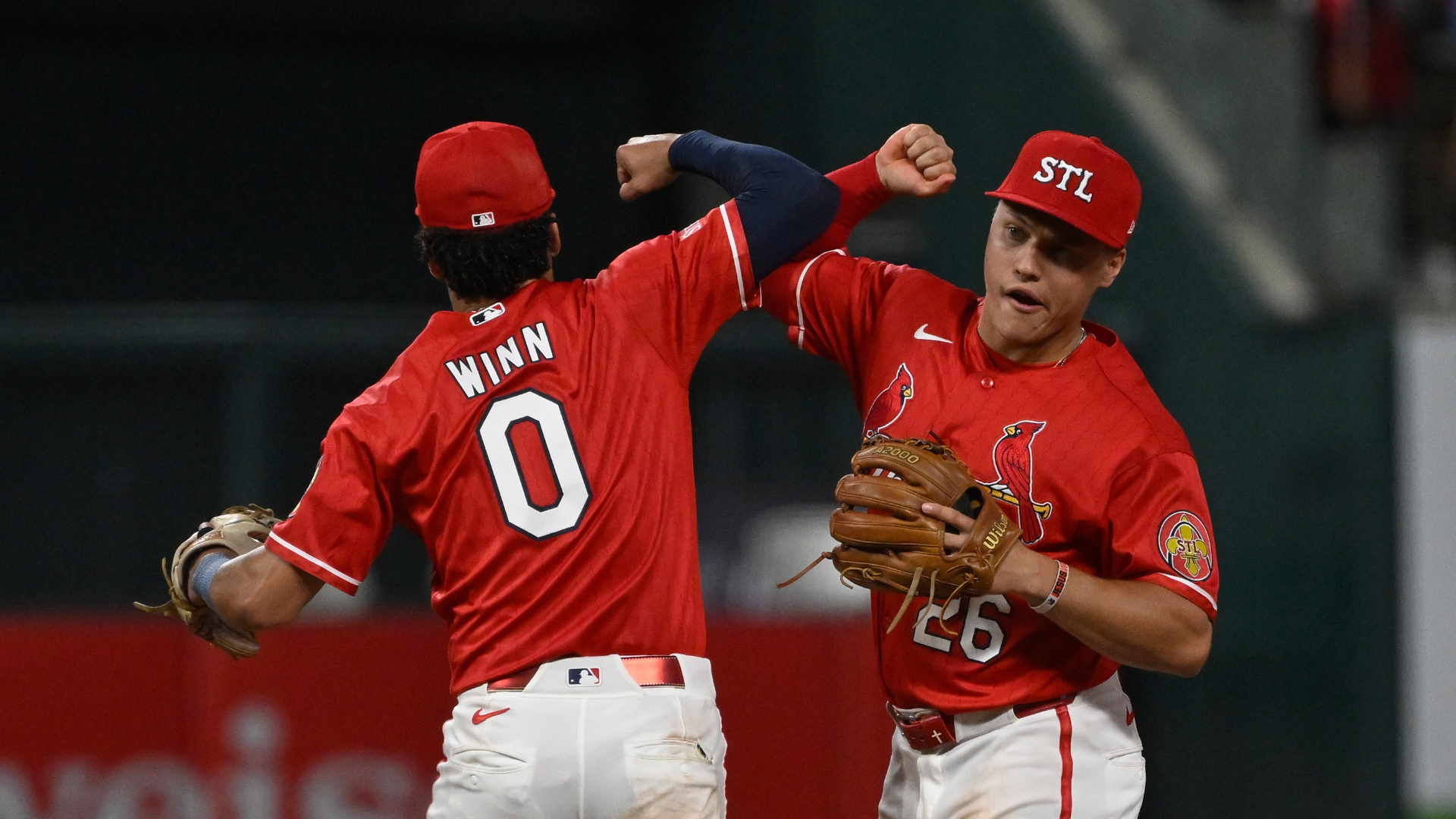
The St. Louis Cardinals weren't supposed to matter much this season.
The club under the final years of bygone lead decision-maker John Mozeliak suffered a downturn in the standings after decades of high-level success. At the same time, the farm system and player development shriveled badly, thanks to paltry investments in technology and inadequate staffing levels, all of which reflected poorly on ownership. That led to the hiring of Chaim Bloom, first as an adviser tasked with conducting a top-to-bottom audit of the organization and then, as president of baseball operations in waiting, with rebuilding that player-development system.
When Bloom formally succeeded Mozeliak at the top of baseball operations, he leaned into a belated rebuild, as he traded away veterans like Brendan Donovan, Sonny Gray, Willson Contreras, and Nolan Arenado for, mostly, desperately needed young pitching. With those moves, he achieved the desired result, as the Cardinals' farm system vaulted up the various and sundry rankings of such things and even topped all comers on a list or two. The cost, though, was surely yet to come.
The expected cost was a tumble further down the standings, perhaps to last place in the National League Central, as the Cardinals under Bloom on-boarded young players and attempted to wring better performance out of the young players already in St. Louis. More than a third of the way through the 2026 Major League Baseball season, though, that debt is still outstanding.
That's because the Cardinals at this writing are 31-27, in second place in the National League Central, and clinging to the third wild-card position in the NL. Framed another way, despite the low expectations and sloughing off of useful veterans, the 2026 Cardinals are on pace for 87 wins and the franchise's first postseason berth since 2022. Much of this is thanks to the breakout of slugger Jordan Walker and the standout work from rookie second baseman JJ Wetherholt, in addition to repeat strong performances from Iván Herrera and Alec Burleson and a rotation notable for its stability.
The Cardinals' spot in the current standings and the surprising nature of it lead us by the hand to this question: Will they keep it up? The Cardinals are either going to continue defying expectations and contending, or they're going to regress in the weeks and months to come and wind up well out of playoff position and leaning further into their rebuild. As for which it will be, let's explore the possibilities now.
The case against the 2026 Cardinals
This one's really reducible to a single present reality: the Cardinals have probably gotten lucky to be where they are right now. We know this because of their run differential, which is a team's runs scored subtracted from its runs allowed. Yes, the Cardinals right now are five games over .500, but at the same time, they're lugging around a run differential of minus-11.
Who cares? Well, the Cardinals should. Up until a certain point in a given season, a team's run differential better projects its future record than its actual record does. If you look at run differential, the 2026 Cardinals right now have a "deserved" record of 28-30. That, in a real way, is the Cardinals' baseline. They've been able to overcome that baseline thus far by succeeding in one-run games and in extra-inning games, which, in the era of the automatic runner, invite similar levels of randomness. Right now, the Cardinals are 11-6 in games decided by one run and 7-2 in extra-inning games (with a bit of overlap between the two). Those wins count, but that's not a sustainable recipe for success, generally speaking. When the game is decided by five or more runs, the Cardinals this season are just 6-7.
All of this points to a course correction for the Cardinals at some point this season. It's not an inevitability, but it is a likelihood -- unless, of course, the Cardinals improve at the load-bearing level of the run scored and the run allowed.
The case for the 2026 Cardinals
The run differential problem is duly noted, but the actual record of course matters more. Teams can and do outplay their fundamental indicators across an entire season, and the deeper we get into the season the better actual record projects future performance than run differential does. To cite just one model from the past, the 1987 Minnesota Twins won the World Series -- at the expense of the Cardinals, coincidentally -- despite being outscored by the opposition during the regular season (by 20 runs, no less). Contending in the face of a negative run differential is a concern, not a burial.
Beyond that, there are paths to improving upon those foundational measures and thus eliminating the worries associated with them. One glaring weakness of the 2026 Cardinals has been the rotation's inability to strike out opposing hitters. Making hitters miss and grab pine without having made contact is essential these days, given the contemporary batter's capacity to do big damage on contact. That said, the Cardinals have a lower bar than most staffs because of their strong ground-ball tendencies and excellent infield defense, especially up the middle with Masyn Winn and Wetherholt. The strikeout situation is also improving as the Cardinals' starting pitchers become more comfortable deploying the new pitches and mechanical adjustments assigned to them by that ramped-up coaching and development staff. Consider how the Cardinals' rotation K%, or their strikeouts as a percentage of batters faced, has tracked this season across weekly-ish blocks (our proxy for trips through the rotation):
WeekRotation K%March 26-April 4
14.0%
April 5-11
14.5%
April 12-18
15.7%
April 19-25
18.7%
April 26-May 2
20.6%
May 3-9
23.1%
May 10-16
15.7%
May 17-25
26.9%
May 26-June 1
20.9%
It's not a perfect upward trendline, but it's pretty close to one. Yes, the usual caveats apply, including quality of competition from week to week, but this is noteworthy improvement in any context. The MLB average this season is a rotation K% of 21.9, and the Cardinals -- after being in dead last in rotation K% for the early weeks of the season -- have been mostly in line with that mean over the last month or so. The rotation's improving strikeout chops plus the Cardinals' knack for keeping its starters healthy via workload management and religious adherence to rest protocols between starts could raise the team's profile moving forward.
Another shortcoming that may be improved upon in the weeks to come is the mostly listless bottom of the order. The Cardinals to date have had a great deal of their offensive value concentrated within the top four spots of the lineup. One thing that will help deepen the attack is the forthcoming return of outfielder Lars Nootbaar. Nootbaar has been on the 60-day injured list all season after undergoing offseason surgery on both heels to correct deformities. The Cardinals and Nootbaar believe the malady negatively affected him at the plate and in the field last season, and the hope is that he'll provide peak production upon his return, which could come by the weekend when his allotted minor-league rehab assignment ends. Nootbaar's return will lengthen the St. Louis lineup right away.
As well, Nootbaar's return will mean a decision in center field. Victor Scott II remains an elite glove, but his bat hasn't developed as hoped. This season, he's been a glaring offensive liability at the bottom of the lineup, and it's possible Nathan Church will claim the center field job once he returns from the IL. Church is almost as good as Scott with the glove, and he's been much better offensively in 2026, in terms of both top-line outputs and underlying batted-ball quality.
Elsewhere, the Cardinals recently recalled Jimmy Crooks, who broke out for 13 home runs and 30 walks in 177 Triple-A plate appearances, all in the name of improving production from the catcher position. Pedro Pagés has his defensive and leadership merits, but he can't hit. The elevation of Crooks to the role of primary catcher should yield improvements when it comes to catcher production and, likewise, further lengthen the lineup. The recent addition of Nelson Velázquez to the active roster as a sorely needed thumper from the right side should also help matters. All of that may be necessary if the Cardinals are going to play like a contender over the balance of the regular season.
The road ahead
June could help the cause. Of their remaining 25 games this month, 14 will come against teams with losing records. As well, the Cardinals will play 15 of those 25 games at home. That's an opportunity to solidify their standing as contenders (and whittle away at troublesome run differential).
If that brings them into July on surer footing, then the leading subplot will be the Aug. 3 trade deadline. Bloom has said time and again his focus will remain on the long-term for this present period of the rebuild. So don't expect any kind of headline-grabbing buy from the Cardinals leading up to the deadline, no matter how June unfolds for them. If, however, Bloom opts not to trade some or all of the older subset of core players -- meaning names like Nootbaar, reclamation project Dustin May, closer Riley O'Brien, go-to lefty reliever JoJo Romero, and perhaps Pagés -- then it probably signals that the front office is taking this team's chances seriously and that the rebuild is yielding fruit ahead of schedule. The standings, of course, will inform those decisions. From the player perspective, their job is to make Bloom's deadline decisions as hard as possible by getting production from the back half of the lineup, racking up more strikeouts, strengthening the underlying indicators, and remaining in playoff position.
Those, you'll note, amount to a lot of uncertainties. A high level of uncertainty seems fitting for a team that thus far has exceeded all of our predictions for them but has done so in a way that feels a bit illusory.
Perhaps the 2026 Cardinals shouldn't have your belief just yet, but they should certainly have your attention.
Add CBS Sports on Google Join the Conversation comments