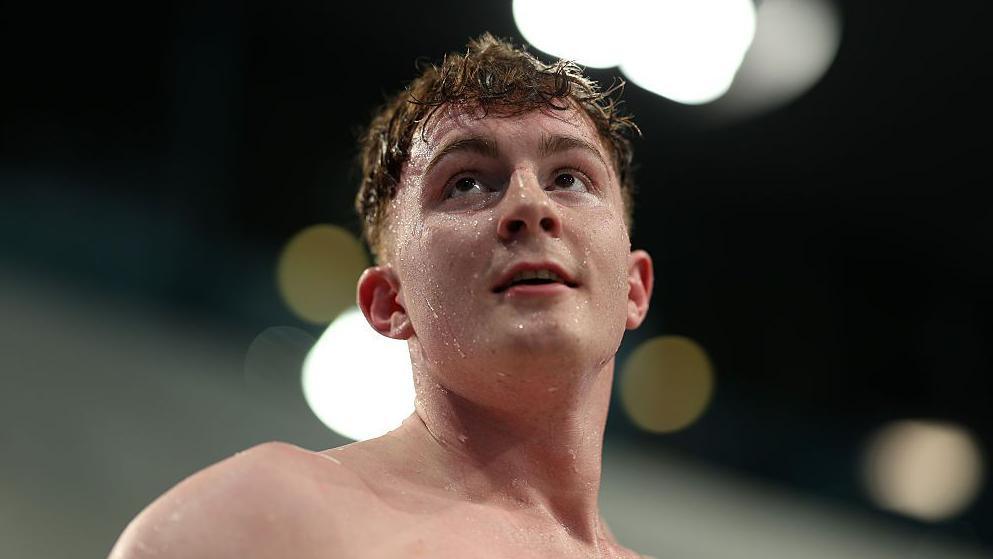
 Image source, Getty ImagesImage caption,
 Archie Goodburn is the Scottish 50m breaststroke record holder
ByKheredine IdessaneBBC Sport Scotland Senior Reporter- Published30 minutes ago
Glasgow 2026 is still well over a month away but swimmer Archie Goodburn has goosebumps already.
Partly because his battle against terminal brain cancer has taken a positive turn and partly because he can already visualise walking into the Commonwealth pool to a wall of noise not just to represent his country but to deliver what would be an extraordinary medal in the 50m breaststroke.
"It would be the proudest moment of my entire life," said the 24-year-old of a possible place on the podium.
"I'd be in absolute bits and I'd have a lot of people to thank. I'm actually tearing up just thinking about it now."
Little wonder. This is a truly remarkable young man. An extraordinary athlete whose life expectancy has been slashed by incurable brain tumours but who nonetheless broke his own Scottish 50m breaststroke record after managing to secure life-changing treatment on a new drug programme that he hopes can help others.
"A personal best post-diagnosis is something that I actually would have struggled to believe if you'd told me in that consulting room back in May 2024," he explained.
"I have been working my socks off and I'm in the best shape of my life heading into these Games.
"The times I've been swimming have been enough to win a medal at every other Commonwealth Games in history and, even if this will be one of the faster Games, I've definitely got my sights set on that podium."
Which is when the hairs on the arms start to rise.
"I get goosebumps thinking about it," he added. "I've matured a lot in the last four years [since Birmingham 2022] and a lot of that's to do with my diagnosis and the harsh reality checks of what's important.
"Sometimes swimming feels less important in comparison to other things, but really we undergo treatment and we go through the hard stuff so we can do the fun stuff. I remind myself of that in those moments and I do start to feel like a little kid."
His current treatment was not officially licensed when Goodburn gave an emotional BBC interview a year ago.
The power of his story helped deliver a message of hope in the fight against brain cancer and his was a strong voice in the campaign to get the drug to market.
His own progress has been encouraging. The tumours are inoperable but their growth has slowed.
"It shows what's possible when the UK government really do take action and do their best to get drugs approved as quickly as possible," he said.
"Off the back of our last chat, the drug we discussed has had its approval and thanks to that, I've been able to return to training and produce some of the best performances of my life.
"I've just recently graduated from university with a first class as well [chemical engineering], so I owe a lot of thanks and maybe a little bit of luck to lots of people. I'm in a fantastic spot and really looking forward to the summer."
Four British champions in Scotland weightlifting team
- Published6 days ago
Adlington heads Scotland's Commonwealth judo squad
- Published7 days ago
'People don't believe I'm a boxer' - but Mitchell manifesting Glasgow gold
- Published8 June
Which is when the hairs on the back of the neck stand up again. This young man still doesn't know whether he'll see 40 but can contemplate a medal triumph against all the odds that would raise the roof at Tollcross Swimming Centre.
"This is the second time I've had goosebumps during this interview," he said. "Football fans and rugby fans will know the feeling when you feel sound in your chest.
"The only time I ever felt that in swimming was in Birmingham, walking out behind Adam Peaty. That is different to just hearing someone cheering you; you can actually feel the sound waves moving through your body.
"I hope that gives us the edge to make those little hundredths of a second."
If anyone deserves a medal, it's Goodburn. One thing is for sure, no one is going to be mentally stronger.
And once the Games are done, the advocacy work for brain cancer awareness continues.
"We're talking about life-changing medications - the most common form where they have a prognosis of 12 to 18 months," he said. "A month is a significant portion of their time remaining.
"It may not seem a lot in government or in policy boards or meetings when they're making these decisions, but days and hours are important. So establishing a national brain cancer lead is something that the advocacy group I'm part of is really calling for to streamline that process as much as possible."