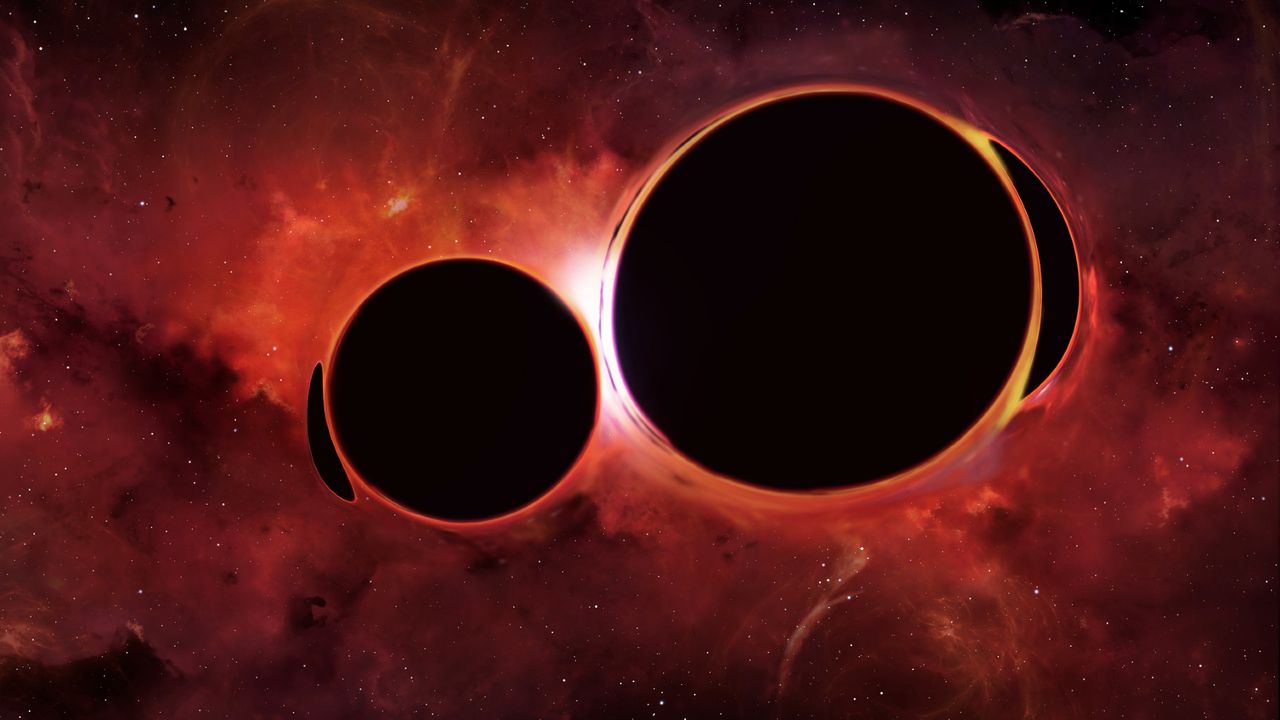
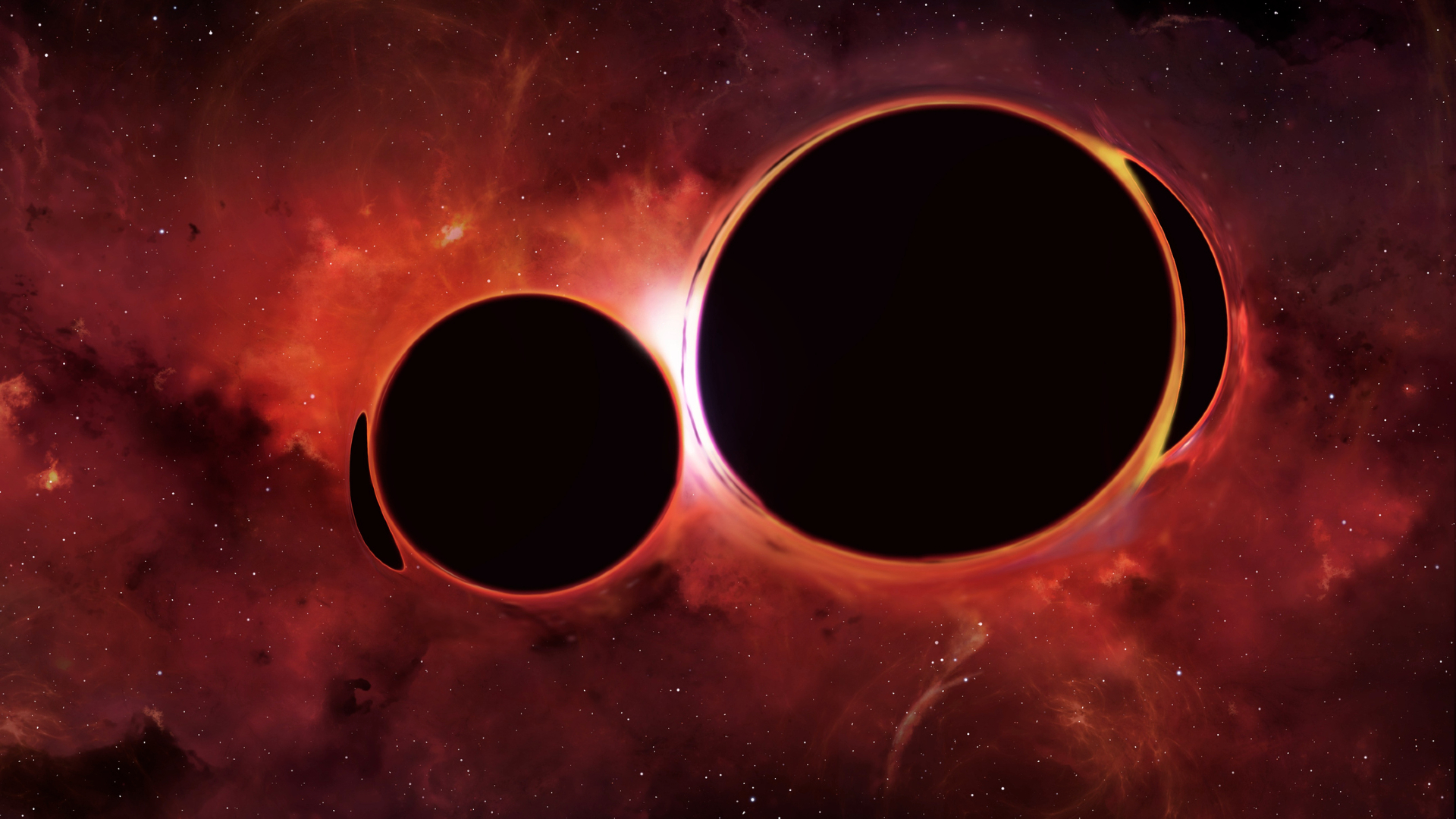
 An illustration showing two black holes beginning to collide. (Image credit: MARK GARLICK/SCIENCE PHOTO LIBRARY via Getty Images) Share this article 0 Join the conversation Follow us Add us as a preferred source on Google Newsletter Sign up for the Live Science daily newsletter now
 Get the world’s most fascinating discoveries delivered straight to your inbox.
Become a Member in Seconds
Unlock instant access to exclusive member features.
Contact me with news and offers from other Future brands Receive email from us on behalf of our trusted partners or sponsors By submitting your information you agree to the Terms & Conditions and Privacy Policy and are aged 16 or over.You are now subscribed
Your newsletter sign-up was successful
Want to add more newsletters?
Join the club
Get full access to premium articles, exclusive features and a growing list of member rewards.
Explore An account already exists for this email address, please log in. Subscribe to our newsletterAstronomers may have discovered an extreme pair of light-spewing black holes that are spiraling toward an enormous collision — the effects of which could be felt in the next century.
Using decades of radio telescope observations, the astronomers studied an ultrabright object that was previously thought to be a blazar — a glowing core of a galaxy usually powered by a black hole — some 500 million light-years from our solar system. The observations revealed a hidden jet of energy that suggests the intensely bright object is actually two black holes on the verge of colliding, perhaps less than 100 years from now.
The findings were published March 27 in the journal Monthly Notices of the Royal Astronomical Society.
Finding two black holes
Blazars are some of the most luminous objects in the universe. They're classified as active galactic nuclei — actively feeding objects at the centers of galaxies, usually powered by supermassive black holes — and typically shoot jets of high-energy radiation toward Earth. Usually, a central black hole is the source for this jet, but in the case of the blazar in the galaxy Markarian 501, something didn't quite add up.
For years, astronomers had observed different orientations of the jet using radio telescope data, making it difficult to determine if its core really did harbor a supermassive black hole. To answer this question, the researchers analyzed over 83 datasets from the Very Long Baseline Array, an international network of 10 radio telescopes.
The results revealed that, instead of one large jet, there was also a second jet looping counterclockwise around the blazar's center. The team believes each of these jets is powered by a supermassive black hole, each weighing between 100 million and a billion times the sun's mass.
Sign up for the Live Science daily newsletter nowContact me with news and offers from other Future brandsReceive email from us on behalf of our trusted partners or sponsors"Realising that [there] was a second jet was awesome," Britzen told BBC Science Focus. "For me it was like: that's how it works? I was so amazed and overwhelmed — and wanted to tell everybody what we just found."
In June 2022, the two black holes lined up perfectly so that the primary black hole's gravity bent the light emitted by the second jet into a near-perfect circle known as an Einstein ring. Thanks to a phenomenon called gravitational lensing — a sort of natural magnifying glass created by intense gravitational forces — this finding adds further evidence to the idea that the blazar is powered by a pair of supermassive black holes.
RELATED STORIES- 'Impossible' black hole collision pushed relativity to its breaking point — and scientists finally understand how
- Universe-shaking collision of black hole and neutron star could upend our understanding of monster cosmic mergers
- Stephen Hawking's long-contested black hole theory finally confirmed — as scientists 'hear' 2 event horizons merge into one
"Since these jets are directed towards us, an Einstein ring supports the scenario," Britzen said.
The two black holes are thought to circle each other clockwise about once every 121 days and are separated by only 250 to 540 times the distance between Earth and the sun — relatively close in the world of astronomy. Gradually, this distance will close until the two objects ultimately merge.
The researchers think that when the doomed black holes do inevitably collide, they will release gravitational waves — ripples in the fabric of space-time unleashed by the most intense events in the universe — that could be more powerful than those from previously studied black hole mergers. If that's the case, gravitational wave detectors on Earth will pick up the signal, offering new clues about the properties of the original black hole pair.
Article SourcesBritzen, S., Olivares, H., Gopal-Krishna, Jaron, F., Pashchenko, I. N., Kun, E., Schinzel, F. K., González, J. B., Paneque, D., & MacDonald, N. R. (2026). Detection of a second jet within the nuclear core of Mrk 501. Monthly Notices of the Royal Astronomical Society. https://doi.org/10.1093/mnras/stag291
How much do you know about black holes? Try our black hole quiz!
 Kenna Hughes-CastleberryContent Manager, Live Science
Kenna Hughes-Castleberry is the Content Manager at Live Science. Formerly, she was the Content Manager at Space.com and before that the Science Communicator at JILA, a physics research institute. Kenna is also a book author, with her upcoming book 'Octopus X' scheduled for release in spring of 2027. Her beats include physics, health, environmental science, technology, AI, animal intelligence, corvids, and cephalopods.
View MoreYou must confirm your public display name before commenting
Please logout and then login again, you will then be prompted to enter your display name.
Logout LATEST ARTICLES 1Anglo-Saxon burial holds an older sister cradling her little brother after they both died 1,400 years ago, possibly of an infectious disease
- 2Colorado River may have pooled and spilled over to form the Grand Canyon, solving a long-standing mystery — but not everyone agrees
- 3Bright-green fireball meteor caught exploding above famous Viking raid site in UK
- 4Northern lights may be visible from several US states Friday and Saturday as giant hole opens up in sun's atmosphere
- 5Hackers used AI to steal hundreds of millions of Mexican government and private citizen records in one of the largest cybersecurity breaches ever


