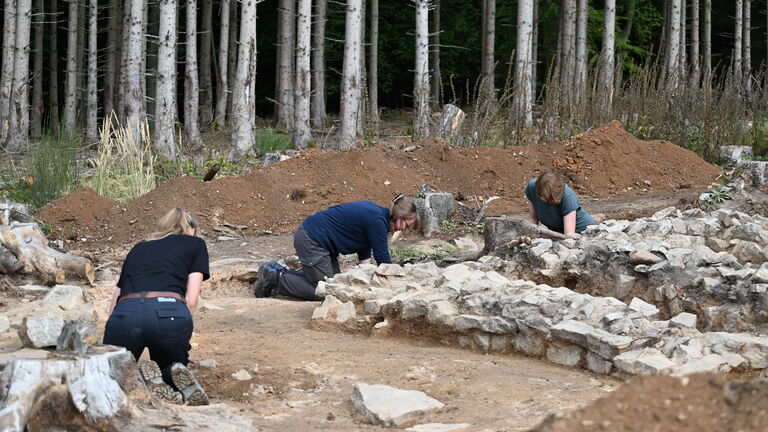
Archaeologists have discovered a temple dedicated to the Roman war god Mars in the wooded foothills of the Taunus mountains in Germany. The temple was part of a military settlement that was built in the third century to defend the border of the Roman Empire against Germanic tribes.
The Roman military constructed thousands of forts across Europe, northern Africa and western Asia while expanding the empire, and most of these fortifications had an adjacent settlement, called a "vicus," that was occupied primarily by merchants, families and other civilians.
Since 2024, archaeologists have been excavating the Kapersburg Roman fort and its adjacent vicus in Hesse, roughly 16 miles (26 kilometers) north of Frankfurt, according to a Sept. 25 translated statement from the Hessen State Office for Monument Preservation.
One of the highlights of the current excavation is the unexpected discovery of a Roman temple, Kai Mückenberger, an archaeologist with Hessen Archaeology, a part of the Hesse State Office for Monument Preservation, said in a translated video. "Inside the temple, we found several fragments of a dedicatory inscription," he said. Experts have already translated a portion of the inscription, which mentions that the temple was dedicated to Mars, the Roman god of war.
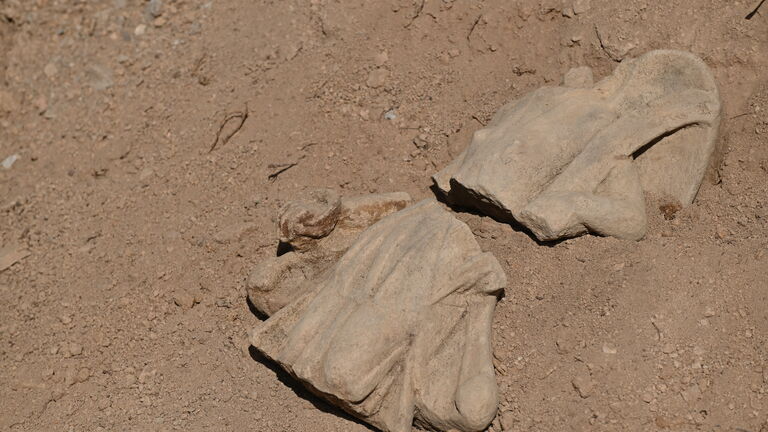
"We also have the remains of a Mars [statue]," Mückenberger said, as well as a statuette of "a winged figure holding a palm branch and laurel wreath," which is likely the ancient Roman goddess Victoria, a personification of victory in battle.
When archaeologists first excavated the Kapersburg fort near the turn of the 20th century, they discovered that it was built in the early second century, likely under either Emperor Trajan, who ruled from A.D. 98 to 117, or Emperor Hadrian, who reigned from A.D. 117 to 138 and expanded the Roman Empire further into northern England, building Hadrian's Wall. The Kapersburg fort was used by a unit of Roman soldiers and cavalry for about a century and a half, until around A.D. 275.
Although the fort's defensive structures and some of its walls have been visible since antiquity, practically nothing was known about its nearby vicus prior to the excavations that began in 2024, according to Mückenberger.
"The astonishing thing is the exquisite preservation of the archaeological layers that start right beneath the forest floor," Mückenberger said. These layers, which include burnt material, almost never survive in agricultural areas but have been well preserved at the vicus. "This is an incredible learning process and a gain in knowledge for us," Mückenberger added.
RELATED STORIES- 'Extremely rare' Roman military camp found in Slovakia holds hastily buried remains of Marcus Aurelius' soldiers — with some dumped in wells
- Ancient bullets reveal where a Roman camp hid in the Pyrenees of Spain before being ambushed
- 1,700-year-old Roman marching camps discovered in Germany — along with a multitude of artifacts, like coins and the remnants of shoes
During their excavations, the research team discovered far fewer houses than they expected. However, they found much more evidence of craft activities, such as blacksmith pits and ovens for drying wheat and baking bread.
"These are all very technical elements related to local services, indicating that we're in a kind of intermediate area not directly adjacent to the fort itself, but perhaps more like the fort's craft area," Mückenberger said.
The temple and votive statues provide new insight into the Roman world of beliefs on the border of the empire, according to the statement. But when the fort was no longer useful, the Romans leveled the camp and replaced it with residential buildings, the archaeologists discovered.
Mückenberger and his team plan to continue their excavation of the site next year.
From Augustus to Nero, see how much you know about ancient Rome's famous leaders with our Roman emperor quiz!