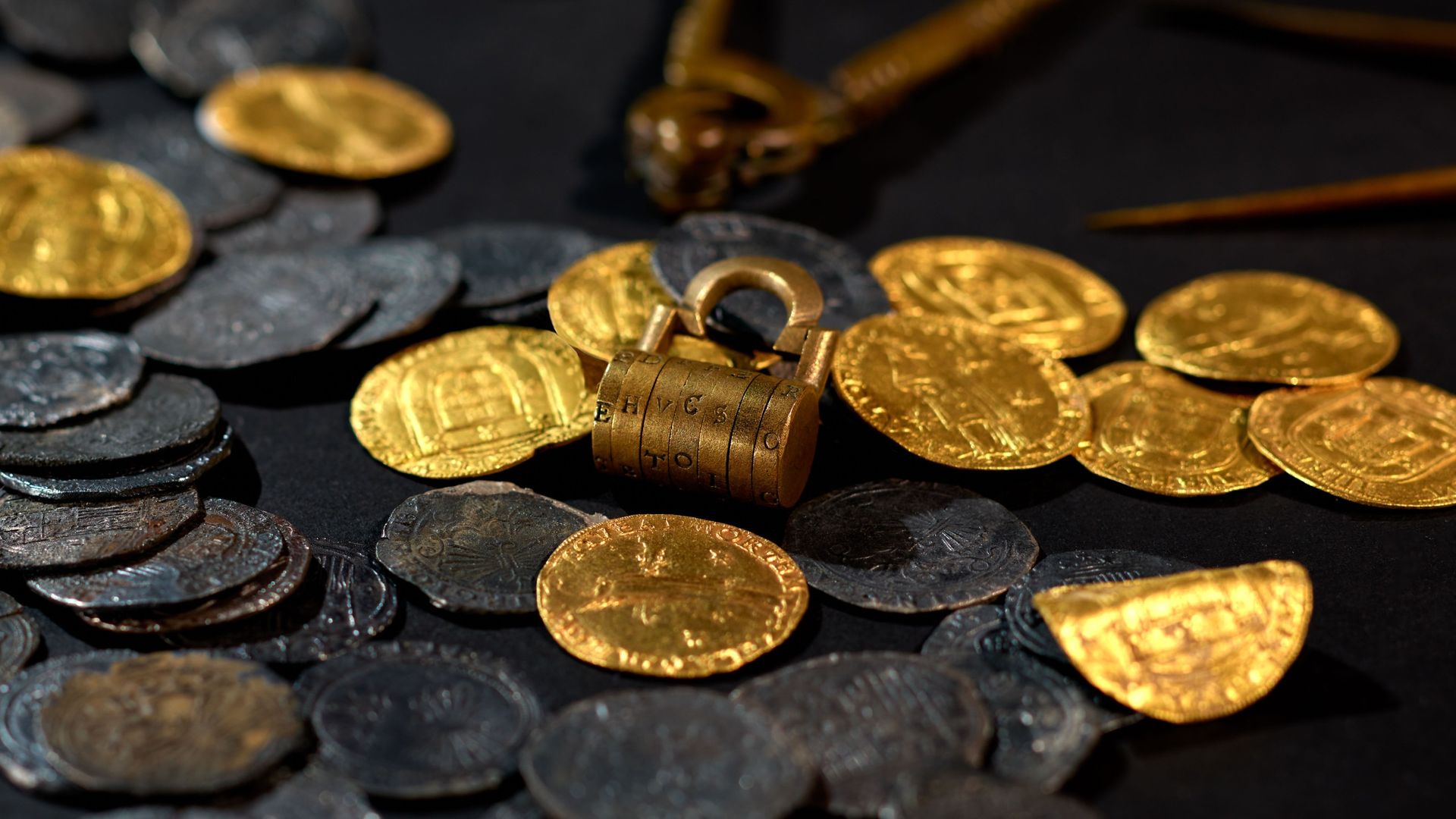
An Elizabethan padlock has been opened for the first time in more than 400 years after researchers used X-ray imaging techniques to crack its four-letter combination.
The brass lock was part of the Ann Francis treasure hoard, named after the British merchant ship that wrecked during a storm off the coast of Wales in 1583. Researchers believe the lock once secured a chest aboard the ship, before becoming separated from whatever riches it was protecting.
Some of the Ann Francis' cargo was recovered at the time of the wreck, while the rest was claimed by the sea. In recent decades, dredging and storms on Margam beach in South Wales have exposed some of the ship's lost treasure.
Between 1996 and 2017, metal detectorist Peter Hughes found the lock and much of the hoard, which included gold and silver coins. The lock was subsequently acquired by Amgueddfa Cymru — National Museum Wales, which worked with researchers at Cardiff University in Wales to decipher its combination.
To study the lock's internal mechanisms, the team used micro-CT scans, which make thousands of X-rays that can then be configured into a 3D digital image. By matching internal notches to external letters in the digital 3D image, the researchers were able to decipher the correct four-letter code — "ANCE" — and open the lock.
"We normally use this technology to study bones and other biological structures, so investigating a 400-year-old padlock was certainly a first for us," David Williams, a research associate at the Musculoskeletal Biomechanics Research Facility at Cardiff University, said in a statement. "It's not every day you get to solve a 400-year-old mystery!"
Smugglers' ship
The Ann Francis was owned by Francis Shaxton, a merchant and notorious smuggler. Francis claimed the ship was sailing along the eastern English coast from King’s Lynn to Hartlepool, when it was actually traveling in the opposite direction, heading to Spain to deliver a cargo of wheat. Spain was dependent on grain shipments at the time and paid for such shipments in gold and silver from colonial conquests in Central and South America, according to Amgueddfa Cymru.
The ship was traveling back from Spain to England when, on the evening of Dec. 28, 1583, it was caught in a violent storm. After heading off course, the ship ended its journey in ruin off Margam beach.
A parish register noted the loss of 14 sailors during the same month as the wreckage, which could have been The Ann Francis's crew, according to Amgueddfa Cymru. The deaths were blamed on the nefarious work of a supposed witch.
Locals were quick to loot the Ann Francis wreck before a legal dispute ensued over who had the right to its goods. One Welsh lord claiming the wreck made an inventory list of items he impounded, which included cannons, guns, a piece of mast, Spanish silver and three chests with their locks broken. The newly cracked lock could have originally secured one of these chests, according to Amgueddfa Cymru.
Centuries after the ship was wrecked, Hughes found the lock near a previously undiscovered stash of Spanish silver coins and coin weights while metal detecting on the beach.
"When I found the lock I was immediately astonished by the incredible workmanship and its astonishing condition," Hughes said. "When I moved the ring dials of the combination they turned with ease after over 400 years beneath the sands and I was left in disbelief."
RELATED STORIES- Wreck of World War II Japanese 'hellship' that sank with more than 1,000 Allied POWs on board discovered off the Philippines
- First shipwrecks linked to real pirates of the Caribbean found in Bahamas
- Divers find marble treasure from Athens' Acropolis in Lord Elgin's shipwrecked brig at the bottom of the Aegean Sea
Hughes said he attempted to open the lock himself over many years but could never find the right combination. After Amgueddfa Cymru acquired the lock, staff were concerned that they could hear grit moving around inside the dials, and with more than 1,000 possible combinations, they didn't want to cause any damage.
The micro-CT scans offered a nondestructive view inside the lock, and an opportunity to finally identify the correct four-letter combination.
"Elizabethan combination locks are known in Britain, but this one is in exceptionally good condition and is associated with a dated wreck, making it a unique find and the code a tantalising mystery to solve," Alastair Willis, the senior curator for numismatics and the Welsh economy at Amgueddfa Cymru, said in the statement. "Of course, now we've solved it, we are left wondering if the code meant something to its owner."